
The Soft Cyborg Is Here. But Does It Have Taste?
Explore how electronic jewelry, audio earrings, and posthuman fashion turn wearable technology into part of personal style and identity.
TL;DR
- Soft-cyborg fashion describes technology that blends into the body and everyday styling rather than announcing itself as a machine.
- Electronic jewelry such as audio earrings and AI clip earphones sits between wearable tech, fashion, and personal identity.
- Posthuman fashion includes reactive garments, body-specific digital construction, and accessories that respond to people or environments.
- A wearable is more likely to be chosen when its function works with the wearer’s taste, body, and social life.
Why Are Wearables Starting to Look Like Jewelry?
PERIPHERII is calling an earphone an earring.

Not an earbud with a charm attached. An actual earring with a Bluetooth audio module tucked behind the jewelry. Priamble is open-ear, connects to your phone, takes calls, plays music and podcasts, and gives you access to a voice assistant without sealing the ear canal.
The technology is still there.
It just isn’t doing all the talking.
OF HUNGER is making a similar move from the other direction. The brand describes its Electronic Gems as mineral-inspired wearable objects that merge jewelry aesthetics with electronic design. Its AI clip earphones are positioned as both a luxury accessory and a professional audio device, with listening, translation, recording and interaction built into the pitch.
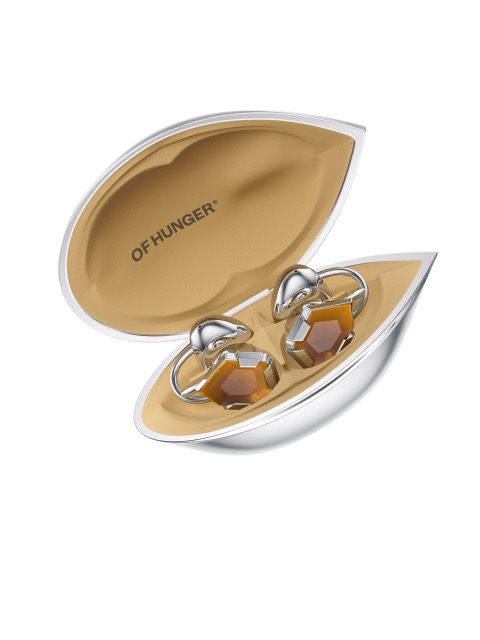
One starts with audio and moves toward jewelry.
The other starts with a gem and moves toward electronics.
That is the interesting part. Not whether either one should be filed under earbuds, jewelry or wearable tech. The category is already doing something more complicated than the shelf labels.
The real question is: what makes a person want technology close to their body in the first place?
What Is Soft Cyborg Fashion?
We keep using “cyborg” to mean metal, wires, visible joints and a person who looks like they have just left a robotics lab.
That is the loud version.
The version arriving in fashion is much quieter. It can be an audio earring, a clip, a necklace, a ring, a body attachment or a garment that makes the technology part of the styling before anybody asks what it does.
An ISEA proceedings paper uses “Soft Cyborg” for soft body accessories and electronic devices that blend into the body and interact with the wearer, the body or the surrounding network.
I like the term because it is less interested in whether the device looks futuristic than in what happens after the device gets worn.
A smartwatch is not interesting because it is a tiny computer. It is interesting when it changes what you do with your wrist, your phone, your attention and your social life.
An audio earring is not interesting because somebody managed to make an earphone smaller.
It is interesting because somebody is asking whether listening can become part of how you look.
How Is Soft Cyborg Different From Wearable Tech?
Wearable Tech is function first. The Apple Watch, the Oura ring. Tech people wear them and fashion people tolerate them.
Fashion Tech is technology pointed at fashion or the fashion industry. Virtual try-on, AI styling, digital clothing.
Wearable Fashion Tech(TM) is the fashion you actually want to wear that has tech.
Soft Cyborg is the condition that happens when the technology becomes close enough to the body, and ordinary enough in the styling, that it changes how the wearer is read.
Wearable Fashion Tech is a product and positioning problem.
Soft Cyborg is the cultural consequence.
That distinction matters because a product can be technically impressive and still be socially dead on arrival. We have seen this with smartwatches, fitness trackers, AI pins and AI necklaces that asked the wearer to carry the entire visual identity of the company.
Tolerance is not a business model.
How Do Electronic Accessories Become Fashion?
NOERAH’s FW26 debut collection starts with “accessorize until you’re dressed.”

That is not a styling tip. It is a business model for the body.
The studio builds around wearable objects, attachments and bodily extensions. Jewelry, clothing and the body merge into one expressive system. Soft and fluid materials meet strong and solid elements. Pieces are constructed directly on the body, physically or digitally.
The accessory is not the final decision.
It is the pattern.
This is where fashion stops being a surface applied to technology. The body becomes the place where the category gets decided. What is close to the face? What sits on the hand? What can be worn with a jacket, a hairstyle, a dress, a work meeting, a night out?
The product has to survive all of those rooms.
That is why the best electronic accessories are not necessarily the ones that hide the most. They are the ones that let the wearer decide what the object means.
PERIPHERII wants Priamble to read as jewelry first. OF HUNGER wants Electronic Gems to read as a luxury object that also happens to listen, translate and record.
The tech cannot disappear so completely that the object becomes decoration.
It also cannot be so loud that the wearer becomes a walking product demo.
The sweet spot is recognition on the wearer’s terms.
What Is the Difference Between a Hard Cyborg and a Soft Cyborg?
Anouk Wipprecht’s Spider Dress does not have this problem.
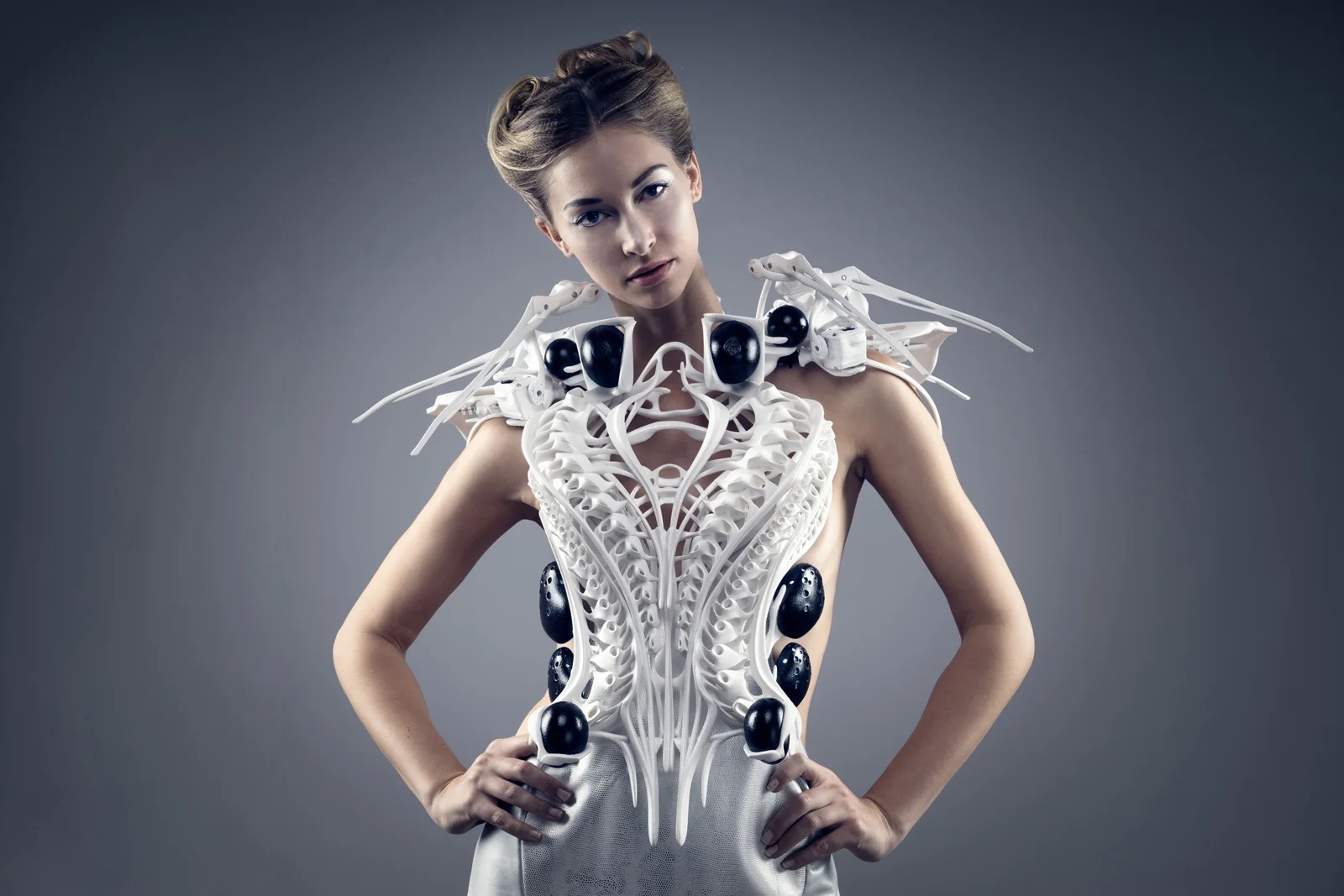
The dress uses sensors and movable arms to respond to the space around the wearer. It creates a more defined personal boundary, with the garment acting outwardly on the room.
It is fashion as defense mechanism.
The Spider Dress wants you to see the technology. It wants the mechanical arms, the movement, the threat response. The body becomes a shell and the garment acts on the wearer’s behalf.
That is a clear proposition.
The soft cyborg has to negotiate a messier one. It may listen, record, translate, connect or help the wearer become more legible in a room. It has to be useful without making the person look like they are wearing a user manual.
This is why soft-cyborg design is not just “make it prettier.”
Pretty is not a function.
The object needs a reason to exist in the social life of the wearer. It needs to fit the face, the hand, the hair, the outfit and the moment when someone says, “What is that?”
That question is not a problem. It is distribution.
How Does Robotic Glamour Change Posthuman Fashion?
Iris van Herpen is useful here because her posthuman language does not depend on the obvious vocabulary of robotics.
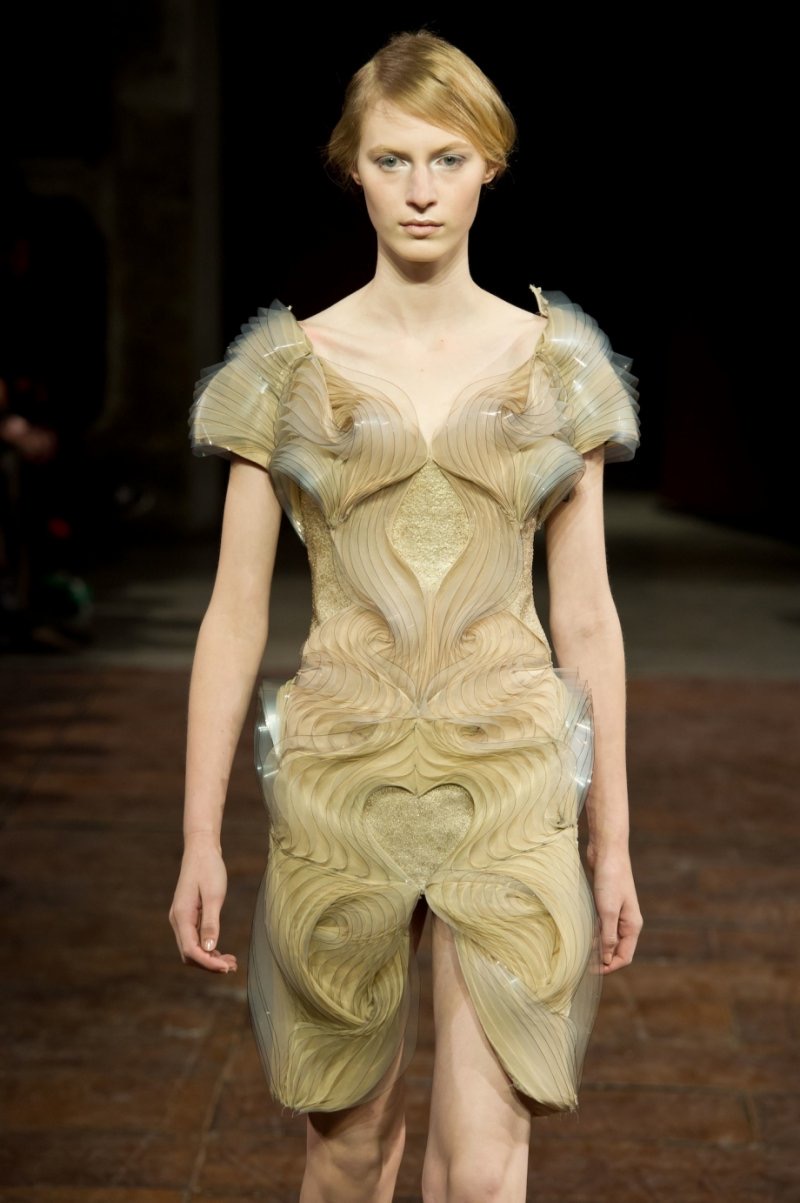
The ArtScience Museum describes her garments as hybrid structures and extensions of the body. Her work moves between anatomy, nature, science and technology, using 3D printing, laser cutting and other experimental processes.
The effect is not always a machine strapped onto a person.
It can look like a body developing a new material logic.
That is where robotic glamour gets more interesting than cyberpunk costume. The artificial thing does not have to be hard, black or industrial. It can be translucent, fluid, anatomical, strange and genuinely beautiful.
The Museum of Modern Art’s Kinematics Dress record makes the same shift through manufacturing. Nervous System built it from more than 3,000 unique parts. A 3D scan of the client’s body became the basis for a digitally tessellated surface of triangular nylon tiles, hinged together to fit that body.
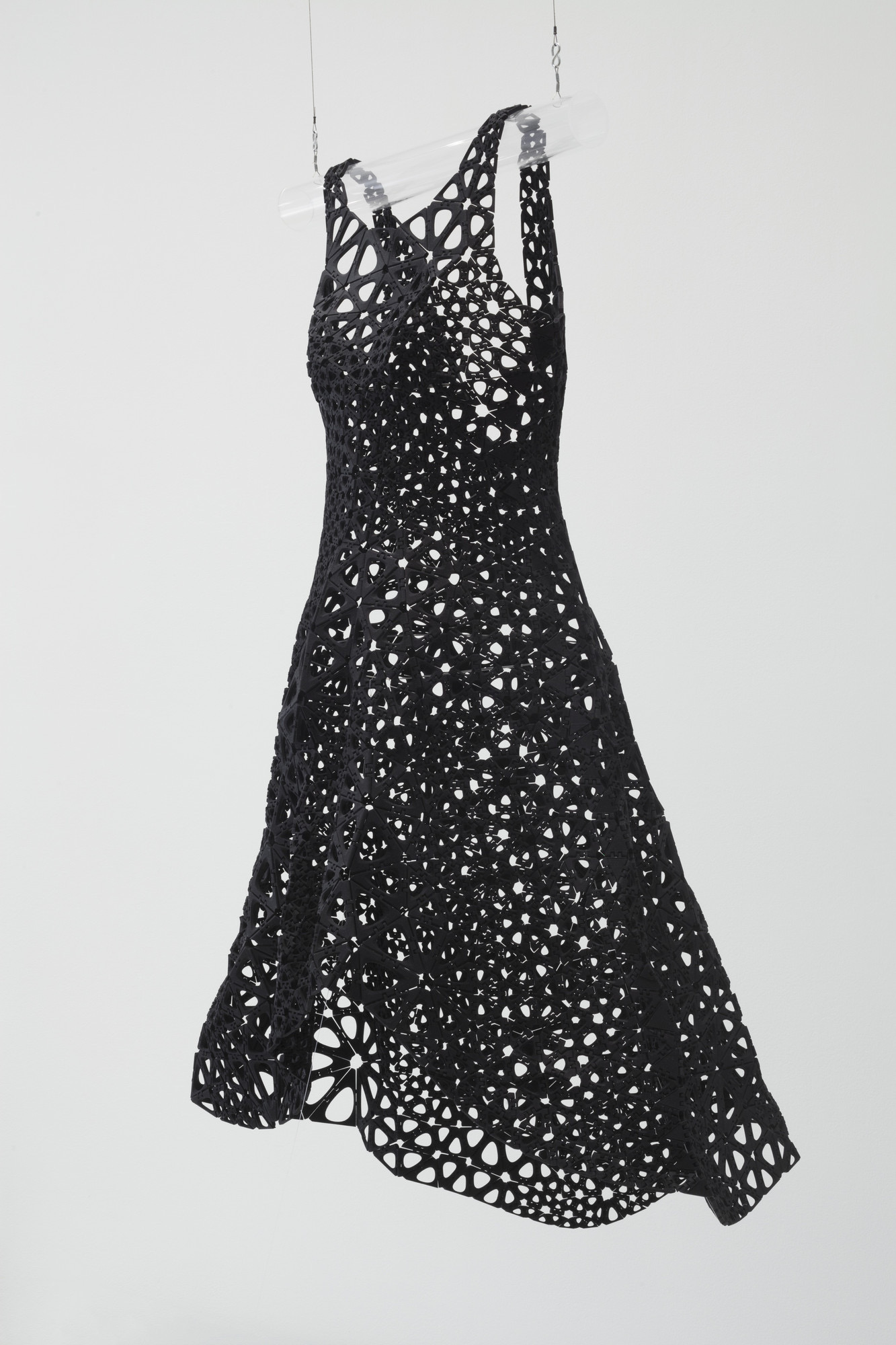
It is not an electronic wearable.
It is still a posthuman object because it changes the relationship between the body and the thing being worn. The garment is no longer made for an imagined standard body and adjusted later. The body enters the construction process at the beginning.
The body is not just what goes inside the clothes.
It is the design brief.
How Are Accessories Becoming On-Body Systems?
The MIT Media Lab’s Kino project imagines accessories as mobile, living objects. They can move across clothing, change their appearance according to social context, respond to the environment and work with mobile devices as personalized on-body assistants.
This is the point where an accessory stops being static decoration.
A brooch can move. A garment can react. A device can become part of how you are understood in a room without becoming the whole room.
Era is building from a related idea at the platform level. Its pitch is an intelligence layer for physical objects, including objects shaped by jewelers and designers. The ambition is technology that feels less present because it has found the right object to live inside.
The future of wearables may not be more devices.
It may be fewer visible devices, with more intelligence hidden inside the things people already choose.
But “hidden” is not the same as invisible. A successful accessory still needs a point of view.
What Should Wearable Fashion Tech Do?
1 / Would someone wear it before they understood it?
This is the mirror test.
The render can look incredible. The launch video can be cinematic. The founder can explain the AI layer for 45 minutes.
None of that tells you whether the object earns a place on the body.
The earring, ring, necklace or clip has to work before the pitch deck arrives. If the wearer needs to defend the product every time someone sees it, the brand has outsourced its design problem to the customer.
2 / Does the function change the social life of the object?
A speaker inside jewelry is not automatically fashion tech.
A sensor inside a dress is not automatically meaningful.
The function needs to change what the wearer can do, signal, remember, share or control. Otherwise it is a technology demo wearing accessories.
The best products create a new little action. A tap. A glance. A conversation. A reason to ask what is happening.
That action is where the product leaves the spec sheet and enters culture.
3 / Who gets to look good in it?
This is the question tech companies keep skipping.
A wearable is not designed for an abstract user. It is worn on a face, a wrist, a hand, a hairstyle and a body with a point of view.
The HNF’s “From Wearables to Cyborgs” exhibition places smart clothing and wearable technology in a history that reaches back to the mid-1960s, describing technology moving closer to and into the body. The historical direction is clear.
The commercial direction is not.
Integration does not equal adoption. People do not only ask whether a wearable works. They ask whether it works with them.
That is the difference between a device people tolerate and an object they choose.
The soft cyborg is not the opposite of the hard cyborg. It is what happens when the machine stops needing to announce itself and starts negotiating with taste.
Sometimes that looks like a reactive mechanical dress.
Sometimes it looks like a 3D-printed body-specific garment.
Sometimes it is an audio earring that wants to be read as jewelry before it is read as electronics.
The product category is still moving. The wearer is deciding where it belongs.