
Wires, Cameras, and the Future That Got Too Smooth
Beyond the blue wallpaper and chrome outfits, cybercore is a quiet rebellion against invisible technology. A personal essay on why we're clinging to old wires and awkward digital memories.
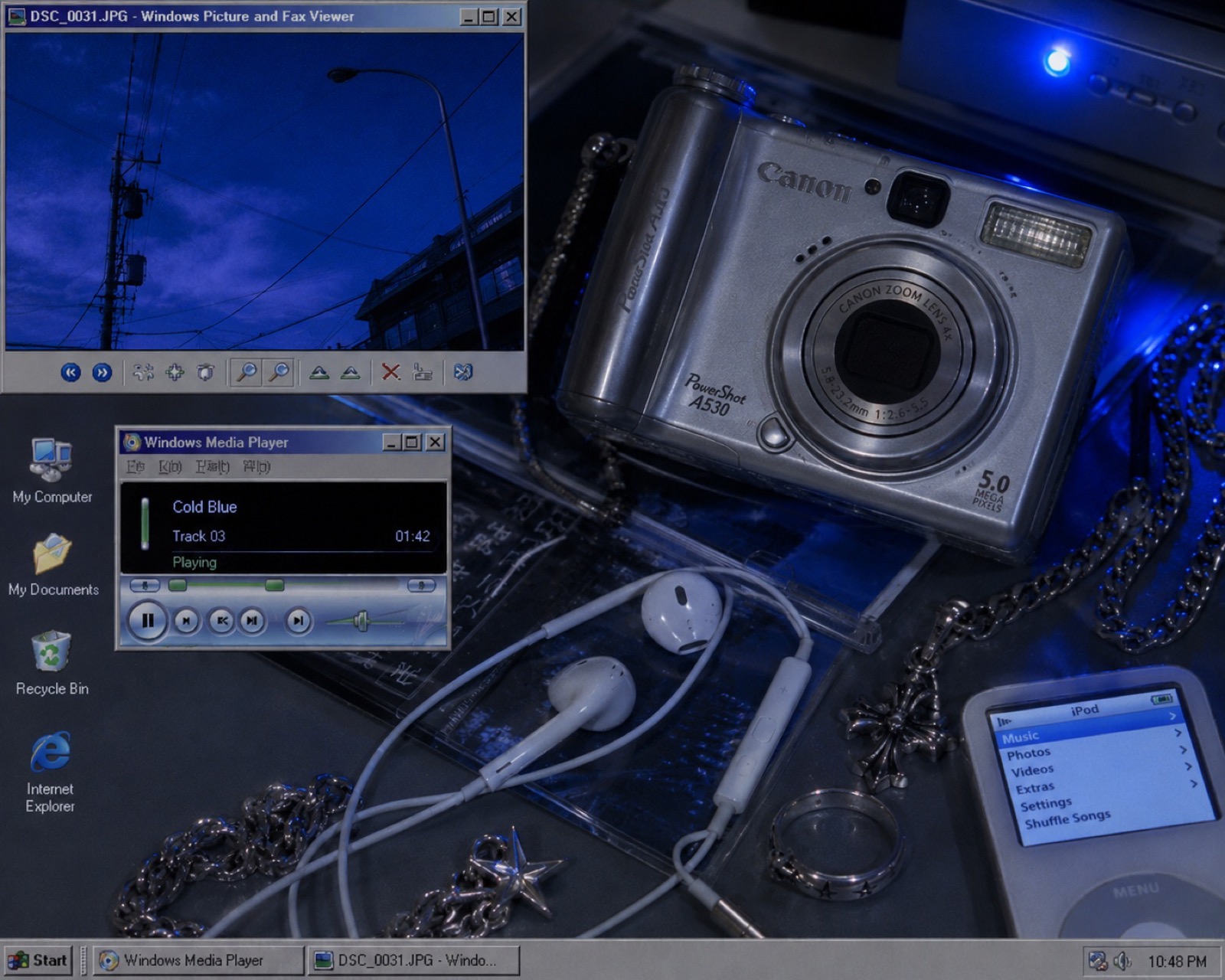
The first cybercore object I understood was not a jacket or a pair of pants. It was a wire.
A white wire, specifically. Dangling from someone’s ears on the train, snaking down into a tote bag, looking both intentionally styled and mildly inconvenient. A few years ago, wired headphones read as the thing you used because you lost your AirPods or refused to spend money on them. Now, with the wired headphone comeback being treated as both a practical choice and a fashion signal, they look almost decorative. A little line drawn from the ear to the pocket. Functional, yes, but also a visible refusal of the clean, sealed, Bluetooth future we were all supposed to want.
This is where cybercore aesthetic starts to make sense to me.
Not as “neon clothes” or “Y2K but techy” or “blue wallpaper with a butterfly and Windows 98 error box,” though it can be all of those things. Cybercore is more interesting when you treat it as a way of making technology touchable again. It takes the objects and surfaces of old digital life – wires, digital cameras, chrome, glitch graphics, media players, anime stills, low-res shine, a very specific electric blue – and turns them into something the body can wear, hold, decorate with, or hide behind.
I typed “what is cybercore aesthetic” into search and immediately felt the term splinter into a dozen tiny rooms: cybercore aesthetic outfits, cybercore aesthetic clothing, cybercore aesthetic wallpaper, cybercore aesthetic gif, cybercore aesthetic room, cybercore aesthetic background, cybercore aesthetic green, cybercore aesthetics, cybercore y2k aesthetic. I even saw “chicane cybercore aesthetic,” which felt either like an algorithmic typo or a strange little portal into how quickly aesthetics become search debris.
That, to me, is already part of the point. Cybercore does not live in one clean category. It lives in the confusion between a search term, an outfit, a bedroom wall, a Pinterest board, a TikTok caption, an Etsy cybercore fashion listing, a pair of sunglasses, a USB-C earbud, a camera case, and the feeling that the old internet had more texture than the current one.
the future arrived, and it was kind of too smooth
The funny thing about cybercore is that it looks futuristic by looking backwards.
It borrows from the late 90s and early 2000s, but not in the pink velour, rhinestone flip-phone, Paris Hilton sense of Y2K. That version is still very much alive, obviously. But Cyber Y2K fashion is the colder sibling: silver instead of hot pink, mesh instead of terry cloth, wraparound sunglasses instead of bug-eyed glamour shades, cables instead of charms, low-slung tech pants instead of Juicy sweats.
If standard Y2K remembers the mall, cybercore remembers the computer lab.
The palette is often blue, silver, black, white, acid green, translucent plastic. The visual world is full of old UI boxes, scanlines, low-res celestial graphics, anime girls, butterflies, hearts, stars, CRT glow, chrome typography, and the kind of digital gradients that look like they should be playing behind a CD-ROM menu. The older design lineage sometimes overlaps with what CARI calls Metalheart: chrome, abstraction, late-90s digital depth, the internet trying very hard to look like a machine with feelings. It is nostalgic, but not in a warm way. More like staring at a desktop background from a computer you were not allowed to touch as a child.
This is why cybercore aesthetic green feels different from, say, a spring green cardigan. Cybercore green is code green. Matrix green. LED green. The green of a loading bar, a tiny status light, a screen telling you something is alive. Even when the color is used decoratively, it carries this little technological pulse.
The actual clothing version is less about print and more about surface. A silver pant. A mesh long-sleeve. A tight technical top. A reflective jacket. A carabiner. A wraparound sunglass shape that makes your face look slightly less available to the world. Chrome eyewear is especially important because it sits right at the border between ornament and shield. Sunglasses already let you look without being looked at; chrome wraparounds make that exchange feel more mechanical.
I get the appeal. Sometimes a regular outfit feels too emotionally exposed. Sometimes you want a little hardware between you and everyone else.
old tech as jewelry
The wired headphone comeback as fashion is probably the cleanest example of cybercore moving from image to body.
The practical reasons are obvious: they are cheaper, they do not need charging, they do not disappear into the abyss as easily as one single AirPod. But that does not fully explain why they look good right now.
The wire does something aesthetically that AirPods do not. AirPods are designed to disappear into the fantasy of frictionless convenience. Wired headphones insist on being seen. They create a line, an interruption, a tether. They make listening look physical.
I think this is why they sit so naturally with cybercore. Cybercore loves old tech not because old tech works better, but because it has better boundaries. Buttons, cords, shells, flashes, hinges, ports. You know where the object begins and ends. You can hold it. You can clip it to something. You can decorate around it.
Digital cameras are doing a similar thing. The Y2K digicam look has become its own style language: slightly soft focus, built-in flash, vivid colors, date stamps if you’re lucky. An instant camera styled as a Y2K accessory can complete an outfit the same way a bag does. It says: I am not just wearing the look, I am prepared to document the look in the correct texture.
There is something almost sweet about that. We spent years trying to make images sharper, cleaner, more seamless. Now the “bad” photo is desirable because it feels less aggressively optimized. A little blur, a little flash glare, a little timestamp. Proof that the machine had a personality.
Cybercore aesthetic is full of this kind of technological sentimentality. Not nostalgia for a simpler life exactly, because early internet life was not simple. It was buggy, slow, ugly, chaotic, and full of strangers saying weird things in forums. But it had edges. It had visible seams. You could hear the computer working.
when the screen becomes a room
Cybercore is not only something you wear. That’s why the search terms are so revealing.
Cybercore aesthetic wallpaper and cybercore aesthetic background point to the screen version: blue collages, anime faces, floating chrome shapes, old media players, glowing icons, butterflies over pixelated skies. Cybercore aesthetic gif points to motion: blinking, looping, glitching, shimmering, not quite resting. Cybercore aesthetic room takes the same language and makes it spatial: LED strips, grid bedding, neon blue wall collages, metallic objects, a desk setup that looks like it belongs to someone who has strong feelings about both Hatsune Miku and cable management.
This is where the aesthetic becomes more than a fashion trend. It becomes a private environment.
A wallpaper is not the same thing as a jacket, but both do similar emotional work. They create a filter between you and the world. A cybercore room lets the fantasy become ambient. It is not enough to put on chrome sunglasses; the glow has to be behind you, around you, in the corner of your phone screen, in the little avatar-space where you decide what version of yourself gets to appear.
I don’t mean that in a cynical way. I think we underestimate how much people need small environments to think inside. A bedroom aesthetic, a phone background, a saved folder of GIFs – these are not just teenage decorations. They are mood architectures. They let you rehearse a self before you fully become it.
The room search also shows the problem with any clean definition of cybercore aesthetics. Once an aesthetic leaves the outfit and becomes a wallpaper, a room, a username, a nail set, a shirt mockup, a camera case, a pair of wired earbuds tied into a hair bow, it stops being only about style. It becomes a consumer language for a feeling.
And the feeling is: I want technology to look less invisible and more like something I can actually touch.
not just a moodboard formula
One thing that irritates me about some aesthetic explainers is how quickly they flatten everything into a formula. Add neon. Add chrome. Add old computer graphics. Add anime. Done.
But cybercore is not compelling because the references are so random. It is compelling because the references contradict each other.
It wants the future, but it keeps reaching for obsolete objects. It wants sleekness, but it loves glitch. It wants digital escape, but it keeps putting physical stuff on the body: headphones, sunglasses, metal hardware, cameras, mesh, reflective fabric. It wants to look post-human, but the best versions are very human because they are so obviously about discomfort, longing, protection, and display.
This is why I don’t think cybercore should be understood as just another -core to subscribe to. I don’t really subscribe to any one -core in my own style because that feels too static. The more interesting question is what a person is trying to solve when they reach for the aesthetic.
A silver ear cuff can solve the problem of wanting adornment without piercing your ear. A wired headphone can solve the problem of wanting music without charging a second little device. A chrome wraparound sunglass can solve the problem of wanting to look at people without fully being seen. A digital camera can solve the problem of wanting memories that don’t look like they were pre-smoothed by the phone. A cybercore wallpaper can solve the problem of wanting your screen to feel like a portal instead of a productivity rectangle.
These are small solutions, but fashion is full of small solutions that reveal bigger anxieties. Accessory-maxxing makes sense in this context because cybercore is not only about clothing. It is about the small things that edit the outfit: the headphones, the camera, the glasses, the silver thing clipped to a belt loop, the object that says the look has a little interface.
A cable is never just a cable once it is styled on purpose. It becomes a line of separation. A tiny practical inconvenience that says the object still has a body, and so do you.
so, what is cybercore aesthetic?
If I had to answer plainly: cybercore aesthetic is a nostalgic digital style built from early internet visuals, Y2K futurism, cyberpunk-adjacent hardware, old tech accessories, chrome surfaces, blue/green screen glow, anime references, and the desire to make technology feel wearable and atmospheric. For the cleaner definition and how it differs from Y3K, the field guide entry is useful; this essay is more about why the wires feel personal.
But the plainer answer misses the better part.
A cybercore outfit might be a mesh top, low-slung pants, chrome sunglasses, and one reflective accessory. A cybercore background might be blue, glitchy, celestial, and filled with obsolete UI. A cybercore room might be LED-lit and slightly bedroom-computer-lab-coded. A cybercore gif might blink like an old loading screen. All of these belong to the same family because they are trying to give digital life a surface again.
The wider fashion context helps, too. The 2026 Y2K summer trend conversation is already circling metallics and late-2000s grime, while Depop’s 2026 Fashion Trends Report names early-2000s fragments, metallic fabrics, and bold accessories as part of a broader edited-self mood. Cybercore sits inside that, but it feels more specific. Less “let’s bring back the 2000s” and more “what if the obsolete parts of the internet became wearable again?”
That’s why I’m more interested in the cybercore object than the cybercore checklist. The single reflective piece that makes a normal outfit feel a little less normal. The wired earbuds that suddenly look intentional. The camera that becomes part of the look before it takes the photo. The blue wallpaper that makes your phone feel like a tiny aquarium of old internet memory.
I don’t think everyone needs to dress cybercore head-to-toe. Actually, that might be where it gets least interesting. The best cybercore pieces have a little bit of ugliness, or inconvenience, or unresolvedness to them. A wire that gets tangled. A flash photo that looks too harsh. A chrome fabric that catches light in a slightly embarrassing way. A green that reads more screen than grass.
Maybe that’s the part I like. Cybercore gives all this obsolete tech junk a second life as ornament, but it doesn’t fully smooth out the awkwardness.
A little awkwardness is good. The future was getting boring.