
What Is Cybercore Aesthetic?
A guide to cybercore aesthetic: meaning, core elements, visual and outfit signals, and how it differs from Y3K, cyberpunk, cybersigilism, and Y2K.
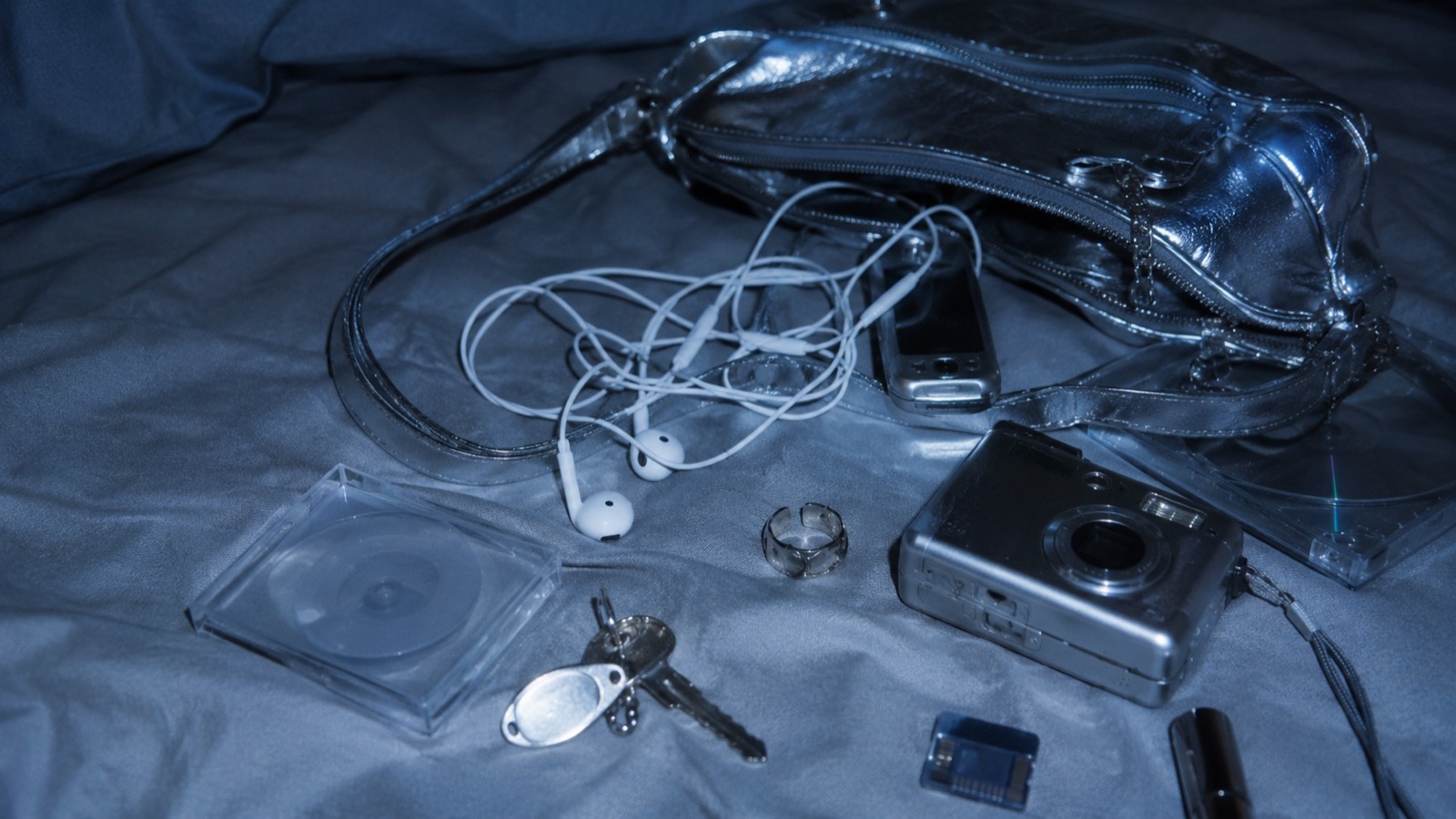
The easiest way into cybercore is not a computer. It is a pair of wired earphones hanging against a shirt, a compact camera flash in a dim room, a silver bag that looks a little too much like device casing, or a flip phone held like a tiny prop from another version of the future.
Cybercore is a modern internet aesthetic that turns early digital culture into a cold, nostalgic, screen-lit visual language. It draws from early web interfaces, Y2K-era hardware, retro anime, flip phones, wired earphones, chrome surfaces, blue light, and the soft loneliness of being online.
It is not just “technology style.” A gadget sitting near an outfit does not automatically make the outfit cybercore. The object has to change the atmosphere. It has to make the body feel closer to a screen, an old desktop folder, a music video loading page, a blue anime still, or a piece of hardware that should be obsolete but somehow feels emotionally current again.
what cybercore means
Cybercore is a 2020s reinterpretation of late-1990s and early-2000s digital artifacts. That distinction matters. It is not the same thing as historical Y2K culture, which was a real consumer moment with its own malls, magazines, phones, plastics, optimism, anxiety, and corporate futurism.
Cybercore is what happens when that period gets filtered through screenshots, moodboards, anime edits, old software textures, and the internet’s ability to make anything feel both intimate and dead.
Aesthetics Wiki’s Cybercore entry gives the useful surface vocabulary: early internet UI, retro anime, flip phones, butterflies, angels, celestial imagery, scanlines, saturated blue, silver, white, and digital escapism. But the more interesting question is what all of those symbols are doing together.
The answer, I think, is that cybercore makes obsolete technology feel emotionally available again. A wired earphone, a compact camera, a phone charm, or a metallic headphone shell is not valuable because it is the most advanced version of itself. It is valuable because it remembers a time when digital devices were more visible, more awkward, and more physically attached to us.
This is where cybercore becomes more specific than simple nostalgia. It does not ask us to recreate the 2000s exactly. It edits the early internet into something colder, cleaner, bluer, and more melancholy than the actual early internet ever was. Real early online life was messy, ugly, slow, and full of pop-ups. Cybercore keeps some of that mess, but it turns it into atmosphere.
the parts that make it cybercore
the old interface
Cybercore loves the visible remains of early digital life: browser windows, cursors, dialogue boxes, pixel icons, scanlines, old loading screens, low-resolution images, error messages, and legacy software textures.
These details matter because they make the aesthetic feel screen-based rather than simply futuristic. Cybercore is not always trying to look dimensional, expensive, or realistic. Sometimes it looks best when it feels flat, cropped, pasted, saved, renamed, and rediscovered.
the personal device
The strongest cybercore objects are personal and slightly obsolete: flip phones, compact digital cameras, wired earphones, MP3 players, translucent plastic, chrome devices, glossy headphones, and small accessories that sit close to the face or hands.
This is different from generic techwear, where the visual language often comes from performance, utility, and tactical function. Cybercore is more emotional. It cares about the device as a memory object. It cares about the way a phone used to flip open, the way a cable used to tangle, the way a camera flash made every indoor photo feel a little too bright.
the screen-lit palette
The core palette is screen-lit: saturated blue, white, silver, violet, icy pink, and holographic gradient. Black can appear, but it should not swallow the whole look. Cybercore needs some kind of glow, reflection, or artificial light source to separate it from plain dark futurism.
This is also where a lot of people confuse cybercore with any outfit that happens to include silver. Silver is not enough. The silver has to behave like a technological surface: chrome, liquid metal, device casing, lens reflection, headphone shell, phone hardware, or jewelry that looks engineered rather than inherited.
the anime or avatar body
Retro anime, virtual idols, game interfaces, avatars, and stylized digital characters give cybercore its human figure. The person inside cybercore often feels a little distant, a little artificial, a little too clean for the real world.
This does not mean the outfit needs to become cosplay. Usually the wearable version is better when it only takes one or two cues: blue-tinted eyewear, face-level hardware, a slim metallic bag, pale glossy makeup, or a single anime-adjacent color relationship.
the escapist mood
The emotional core of cybercore is escapism. Not cheerful escape, exactly. More like the feeling of being online in a room by yourself, looking at something beautiful and artificial until the rest of the world gets quiet.
This is why cybercore can feel softer than cyberpunk, even when both use cyber imagery. Cybercore is not primarily about danger, rebellion, or corporate dystopia. It is about the emotional weather of digital life: isolation, fantasy, memory, and the strange comfort of a screen.
how cybercore shows up
in images
Cybercore visuals often include blue light, silver shine, digital blur, scanlines, celestial symbols, floating windows, angels, butterflies, stars, pixels, low-resolution texture, and soft artificial glow. A cybercore image might look like it came from an old desktop folder called “dreams,” “icons,” or “untitled.”
The celestial imagery is not random. Stars, moons, planets, angels, and butterflies soften the hardware. They make the digital world feel emotional instead of purely mechanical. This is why cybercore can hold both a flip phone and a pair of wings in the same image without feeling contradictory.
in objects
The object language is where cybercore becomes wearable. Flip phones, compact cameras, wired earphones, metallic headphones, silver bags, clear plastic accessories, chrome sunglasses, phone charms, open-ear audio jewelry, smart rings, and small visible devices all belong in the cybercore orbit.
A useful way to separate ordinary gadgets from cybercore objects is to ask whether the device contributes to styling. A broader guide to fashion tech accessories frames this well: the object has to be judged not only by function, but by how it sits on the body, the hand, the face, or the outfit.
The same logic applies to futuristic tech accessories like smart rings, open-ear audio, AI glasses, and modular daily-carry objects. They become cybercore only when they participate in the visual system. They have to look intentional, not merely present.
Wired earphones are especially good cybercore objects because they are both functional and visibly nostalgic. They make a line across the neck, the chest, the hair, or the hand. That is why the return of wired earphones as fashion accessories feels less like a random TikTok revival and more like a symptom of this larger desire for visible, low-tech intimacy.
in outfits
The most wearable cybercore outfit does not need to announce itself too loudly. In fact, it usually falls apart when every reference is used at once.
Start with one screen-lit color. Icy blue is the obvious one, but silver, white, violet, or pale pink can work if the finish feels synthetic. Add one visible tech object: wired earphones, headphones, a compact camera, open-ear audio, a chrome phone case, or sunglasses with a sharp lens shape. Add one metallic surface: silver bag, hardware belt, chrome jewelry, ear cuff, ring stack. Then add one nostalgic detail: a charm, a low-resolution print, a translucent material, a tiny star, or a shape that feels like old digital plastic.
That is enough. The goal is not to look like a robot. The goal is to look as if the outfit belongs near a screen.
This is also where ear styling matters. Cybercore lives around the face: ears, eyes, hair, neck, and hands. A guide to cyberpunk ear cuffs and open-ear audio jewelry is technically about cyberpunk styling, but the practical lesson carries over: visible hardware needs proportion, comfort, and a relationship to the rest of the outfit. Otherwise it just looks like a device you forgot to remove.
how to tell cybercore apart
Cybercore and Y3K aesthetic overlap because both deal with digital futurism, synthetic surfaces, and post-internet styling. But they look in different directions. Y3K looks further forward: more alien, more synthetic, more post-human, more future-pop. Cybercore looks backward through digital memory. Its future is built from old internet fragments.
Cyberpunk has a much heavier cultural history. The Encyclopedia of Science Fiction’s cyberpunk entry traces the term through 1980s science fiction, cybernetics, data networks, virtual reality, body modification, urban density, and the punk association with alienation and anti-establishment energy. Oxford Bibliographies similarly frames cyberpunk as a science-fiction subgenre concerned with dystopian futures, technology, corporate power, AI, robotics, and cybernetics.
Cybercore borrows from the same cyber vocabulary, but it is usually less narrative and less political. It does not require hackers, megacorporations, surveillance, neon alleys, or social breakdown. Cyberpunk asks what technology does to society under power. Cybercore asks what digital life feels like after its objects become nostalgic.
Cybersigilism is sharper and more symbol-driven: tattoo-like lines, techno-occult marks, tribal curves, digital sigils, and spiritualized machinery. Cybercore can include symbols, but it is not built only from symbols. If cybersigilism feels like a mark carved into the body, cybercore feels like a screen reflecting onto the body.
Y2K is broader, poppier, and more historically tied to millennium-era fashion and consumer culture. It can include low-rise jeans, rhinestones, baby tees, candy colors, mall brands, pop stars, metallic handbags, and the commercial optimism of a new century. Cybercore is more selective. It takes a few Y2K-era signals and cools them down. The color gets bluer. The mood gets lonelier. The devices become stranger. The image feels less like a party photo and more like a file recovered from an old hard drive.
how to use cybercore without turning it into costume
The easiest way to ruin cybercore is to treat it like a shopping checklist. Blue sunglasses, silver bag, wired earphones, anime top, chrome shoes, star clips, metallic pants, phone charms, done. Technically, yes, the references are there. But the outfit will probably feel like a moodboard collapsed onto a person.
The better move is restraint. Choose one object that does the work.
If the object is wired earphones, let the cable be visible and keep the rest of the outfit simple enough for the line to register. If the object is a silver bag, repeat the metal once near the face or hands. If the object is open-ear audio, do not hide it under hair and then wonder why it has no styling function. If the color is icy blue, do not bury it under five unrelated colors.
Cybercore is strongest when the technology feels personal. Not maximal. Not expensive. Personal. The thing should look like it belongs to your daily ritual, not like it was borrowed for a concept shoot.
That is why the old objects matter so much. A flip phone is not more advanced than a smartphone. Wired earphones are not more seamless than wireless ones. A compact camera is not more convenient than a phone camera. But they all make the relationship between body and device more visible. You can see the hand opening, the cable hanging, the flash firing, the object being carried.
You do not need the whole cybercore universe to make the reference work. Sometimes it is just the cable, the flash, the silver shell, the tiny charm, the cold blue lens. One object, placed correctly, can carry the memory of an entire digital era.