
How Cyberpunk Fashion and Cybercore Became Everyday Style
Explore how film costumes, rave culture and Y2K nostalgia shaped cyberpunk fashion and cybercore, from technical clothing to jewelry and everyday devices.
TL;DR
- Cyberpunk fashion developed through film imagery and lived subcultures, including rave culture, rather than movie imitation alone.
- Cybercore draws on Y2K pop culture and early digital imagery, bringing playful nostalgia into futuristic dress.
- Technical function and theatrical style can coexist; quieter clothing is not inherently more authentic than a dramatic outfit.
- Accessories can bring futuristic references into familiar outfits, while wearable devices must also fit the routines and bodies using them.
Imagine putting together the perfect cyberpunk fashion look: a long black coat, narrow glasses, something shiny at the throat. In a photograph, you look as though you know which corporation controls the city. Then you have to take the coat off, carry your groceries, and find somewhere to put the glasses. The city, unfortunately, has not provided a costume department.
It’s tempting to call this the point where the fantasy falls apart. I think it’s where the clothes become interesting. What attracted you to the coat? Its shape? A particular character? The idea of looking slightly unavailable to the ordinary world? Those are different desires, even if they produce a very similar shopping basket.
The question of how to wear this stuff without looking like you’re in costume sounds straightforward until you ask whose everyday life we’re talking about. A club outfit is an actual outfit. So is an extravagant outfit worn to buy groceries. A subdued silver ring isn’t automatically a more sophisticated relationship with science fiction than a fluorescent pair of trousers. And a jacket doesn’t become less theatrical because someone has given its pockets complicated names.
Cyberpunk and cybercore became usable style languages through more than people copying movies. Clubgoers were dressing for their own futures. Designers were working out how clothes could move. People looking back at old music videos found futures that were playful rather than threatening. Following those different routes makes the clothes harder to sort into neat categories, but it also makes getting dressed a little less like an audition. A brand like Fotus shows how the look can stay wearable instead of becoming costume.
How Did The Matrix Use Clothing to Build Its World?
Consider The Matrix. In her 2019 Fashionista interview, costume designer Kym Barrett described the contrast between the worn, recycled-looking clothes of the real world and the more controlled appearances inside the simulation. The long coats gave characters a cape-like presence without putting them in conventional superhero capes. Trinity’s PVC caught light with an oil-slick quality. Those dramatic surfaces also had to accommodate stunt work, including the practical business of padding and harnesses.
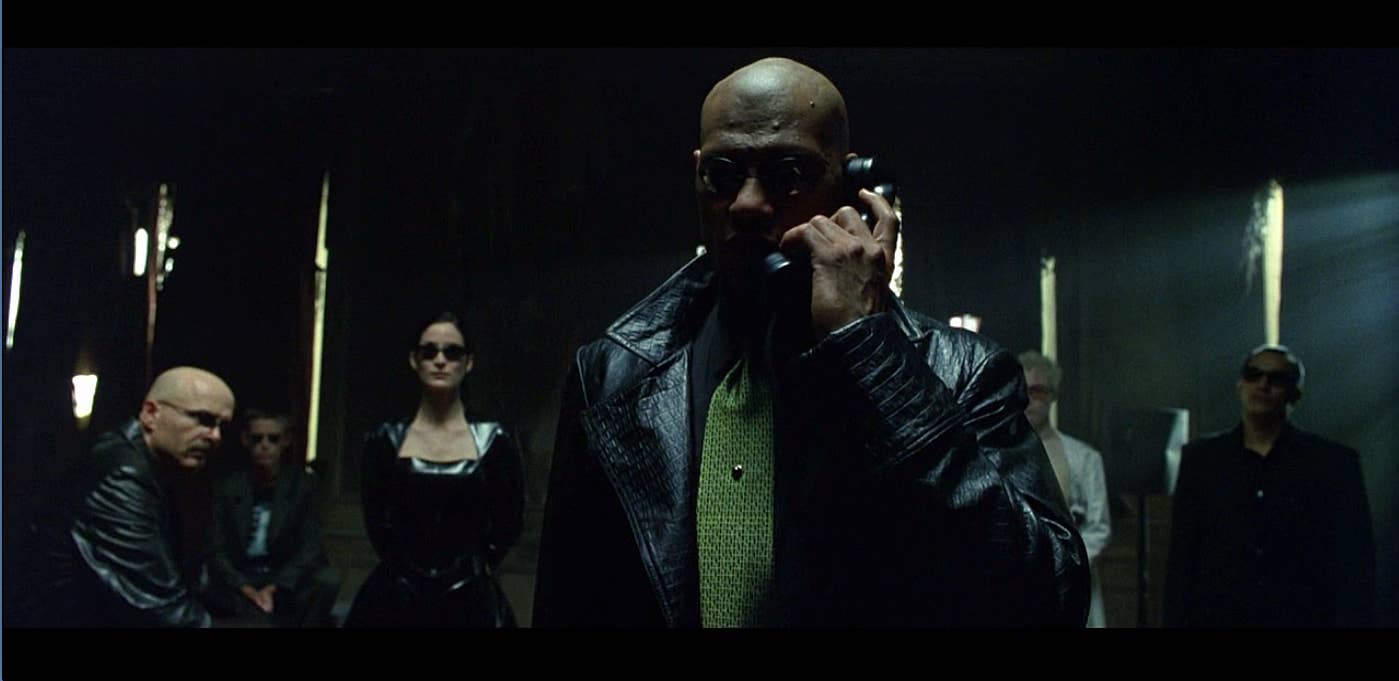
That is quite a lot for a black coat to be doing. The costume helps distinguish worlds, presents a character, and works with a moving body. Lifting its appearance into an outfit photograph preserves only part of that job. It doesn’t mean the resulting outfit is bad. It means the wearer now has to give it something else to do.
This is also why treating cyberpunk as a box of shiny objects can be frustrating. The Academy Museum’s exhibition on cyberpunk cinema examined imagined futures alongside the power structures and marginalization within them. A futuristic surface exists in a story about who gets to use technology, who controls it, and who lives with the consequences. None of that can be guaranteed by a trouser fastening.
But I don’t think the solution is to make someone submit a political reading of Blade Runner before wearing reflective sunglasses. We don’t generally require that much paperwork from a shoe. The more useful distinction is between enjoying an image and assuming the purchase gives you everything the image means. You can want the coat without pretending that ordering it was an act of resistance.
How Did Rave Culture Make Futuristic Fashion Wearable?
There’s another problem with the story that futuristic clothes begin on screen and eventually become wearable: it makes the people who were already wearing them disappear.
In Time Out’s 2023 oral history of Cyberdog, co-founder Terry Davy recalled making clothes for the expanding rave scene in the early 1990s. Staff described the shop’s mixture of music, dancers and UV lighting, as well as customers whose interests later overlapped with goth and streetwear. Here, futuristic dress had a destination. People weren’t waiting for a film franchise to make their clothes make sense.
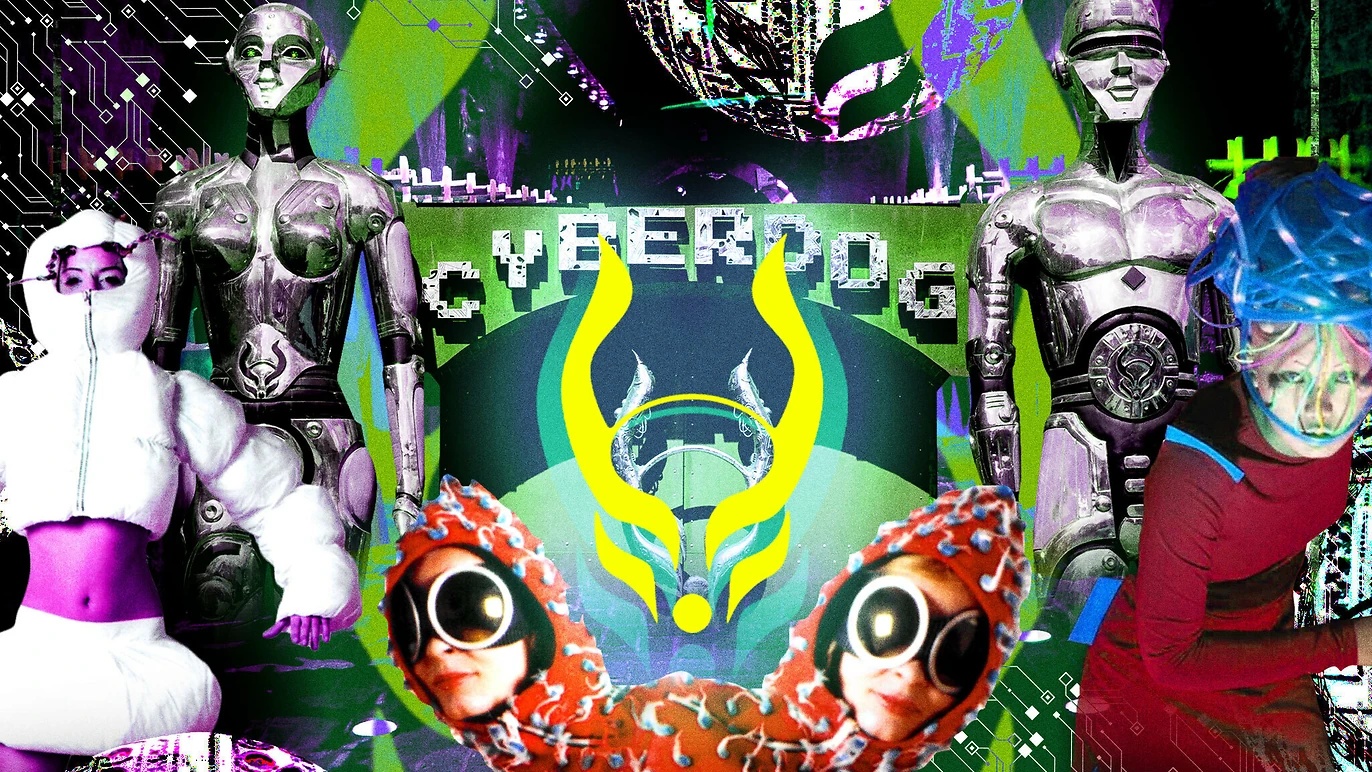
Think about what the difference in setting does. In a hypothetical office outfit, a fluorescent panel might be the disruptive detail. In a room organized around lights and dancing, that same panel belongs to the activity. Calling one outfit wearable and the other a costume tells us as much about which activities we consider normal as it does about the clothes.
I don’t mean that everyone should dress for a club at work. Dress codes, weather, mobility and money are real constraints. But when we talk about making a subcultural style everyday, there’s a tendency to imagine that it has to become quieter before it becomes legitimate. The dance floor was not a rehearsal for an office wardrobe.
That changes the question. Instead of asking how much of a look you need to remove, you can ask what setting you’re bringing it into. Sometimes the answer really is fewer layers. Sometimes it’s a different shoe. Sometimes the outfit is already fine and the person calling it a costume simply wouldn’t wear it.
How Does Cybercore Fashion Rework Y2K Nostalgia?
The cybercore aesthetic complicates the dark-coat version of this story further. In NYLON’s 2022 reporting on cybercore fashion, participants described references including Blaque and TLC music videos, Zenon and Japanese street style. Metallic surfaces appeared alongside bright colors and rhinestones; early digital imagery offered another kind of nostalgia. These references matter because they bring pop performance and playful self-presentation into the picture, rather than treating every shiny garment as dystopian armor.
I wouldn’t make a rigid border here. Someone can like both a severe black silhouette and a sparkly little top. But the emotional difference is useful. One imagined outfit suggests you have survived a hostile system. Another suggests you are going to be the most interesting person on the video call. Both involve technology as an image; they don’t necessarily want the same future.
And there’s something funny about seeking the future in an older idea of the future. A metallic bag can look new and nostalgic at once. You don’t have to believe that technology will save humanity to enjoy a shape associated with an era when a screen still seemed like a promising place to put your personality.
The danger of merging all of this into one cyber mood board is that the references start to lose their people. Black pop artists become a generic shiny texture; club clothing becomes a movie extra’s wardrobe; a specific costume becomes evidence that everyone once dressed a certain way. Naming where an image came from doesn’t ruin the pleasure of using it. It gives you more than one way to use it.
How Does Techwear Combine Function and Style?
Techwear fashion introduces a different claim: the future should improve how the clothes work.
In a Highsnobiety interview, ACRONYM designer Errolson Hugh connected his interest in clothing construction to karate and the freedom of movement it required. He also described looking at technical snowboard clothing and wondering why comparable thinking wasn’t being applied to everyday clothes. Yet he didn’t reduce design to utility. Emotional resonance mattered alongside construction.
That last part is easy to lose when a garment looks engineered. It’s possible to appreciate a useful feature and the drama of appearing exceptionally prepared. Most of us can understand the appeal of an outfit that suggests we have anticipated several situations, including situations in which we will look very good.
Still, there’s a difference between that feeling and a feature you actually use. Picture a pocket placed where your hand naturally goes, then picture a pocket whose main contribution is to complicate the silhouette. Either might be desirable. The problem starts when decoration borrows the authority of function, and the wearer is encouraged to treat a visual preference as an objective upgrade.
It works the other way around too. A clever construction doesn’t stop being useful because it attracts attention. Something can help you carry a jacket and make the jacket look more elaborate. I find that much more convincing than the fantasy that serious technical clothing has somehow escaped fashion.
ACRONYM’s J1W-E puts both impulses on the same jacket: a removable sling for carrying it and removable trim with highly polished studs. One detail deals with the moment you take the jacket off; the other gives you something to look at. I like that they get to coexist. Even an extremely considered jacket is allowed to enjoy being seen.
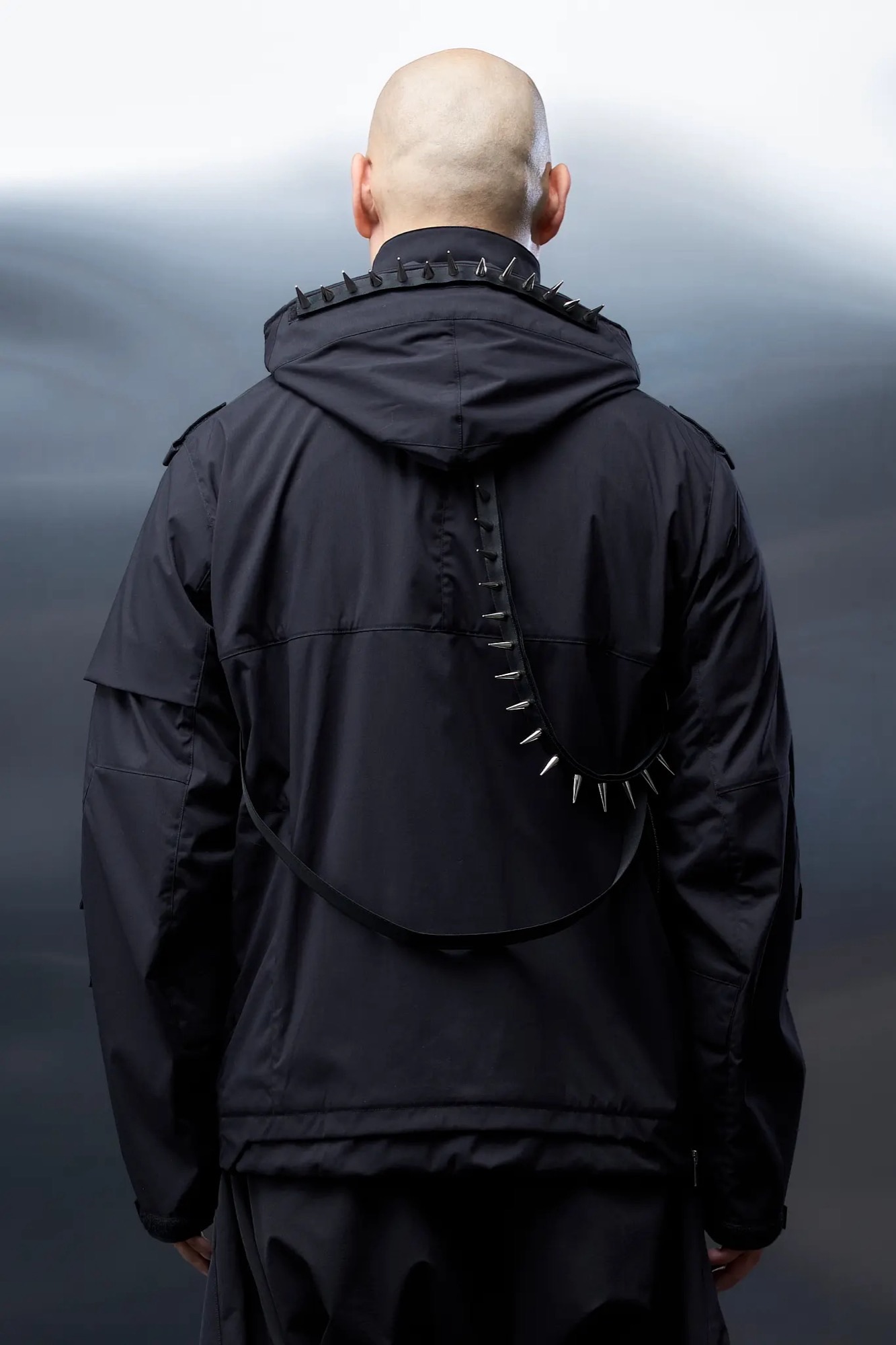
This also gives us a better way to understand the range from heavy techwear to subtle cyberpunk accessories. It isn’t a progress chart where you begin with too many straps and eventually graduate to tasteful minimalism. It is a range of choices about silhouette, sensation, use and visibility. A person might want the full volume of a technical outfit one day and only its unusual fastening the next. There doesn’t have to be an identity crisis about it.
How Can You Wear Cyberpunk Accessories Without Copying a Costume?
For someone who wants the reference without a head-to-toe transformation, I would start by noticing which relationship between objects creates the effect. Take an ordinary knit top and imagine adding a rigid silver cuff. The soft fabric makes the hard surface more noticeable. Put that same cuff beside a metallic sleeve and it becomes part of a larger reflective shape. Neither is inherently more authentic; they are doing different visual work.
Cyberpunk jewelry is especially useful for thinking about scale. An angular ear piece can introduce an industrial association without determining the rest of the outfit. But small doesn’t automatically mean subtle. A shape placed beside the face can be the first thing someone notices, even when it occupies very little space.
This is where luxury design and street dressing can have a more interesting conversation than a price comparison. Imagine a sculptural, deliberately artificial-looking accessory next to a familiar hoodie. The accessory changes how the hoodie reads; the hoodie makes the accessory look less like it requires a special occasion. You aren’t recreating a campaign image. You’re letting a designed object encounter clothes that already have a place in your life.
The Mugler x Gentle Monster Spiral 01 CS1 makes that exercise quite literal: a silver nylon frame, purple mirrored lenses, and a wraparound shape that refuses to disappear into the face. Imagine it above the familiar bulk of a hoodie. The contrast would be the point. You wouldn’t need the rest of the outfit to audition for the same spaceship.
Of course, the expensive version of that object is not automatically the more thoughtful one. Nor does a low price prove subcultural credibility. The useful question is what the shape contributes. Does it make you notice the line of the shoulder, the outline of the ear, the softness of a sleeve? Or are you hoping a recognizable label will do all the explaining?
Avoiding cosplay, if that’s what you want, doesn’t have to mean removing every obvious reference. It can mean loosening the relationship to a particular character. Keep the wraparound shape, change the proportions around it. Keep a bright industrial-looking detail, leave the matching set behind. Let something in the outfit belong to your own habits rather than to the reference image.
And if you do want the matching set, you can wear the matching set. Cosplay isn’t a failure of dressing, and a dramatic personal style isn’t an error that requires correction. The point is having some say in the character you’re being asked to perform.
What Changes When Jewelry Is Also a Wearable Device?
An electronic object adds a slightly inconvenient test to all this. A decorative ear piece only needs to succeed as something you want to wear. An earphone has to live beside that desire while also being something you want to use.
OF HUNGER’s Electronic Gems brings the question right up to the ear. The silver version pairs rhodium-plated copper and zirconia with an open-ear earphone, so the ornament is also the object playing your music. That makes its place in an outfit interesting, but it doesn’t settle the question of fit. Looking like jewelry and feeling right on your ear are different jobs.
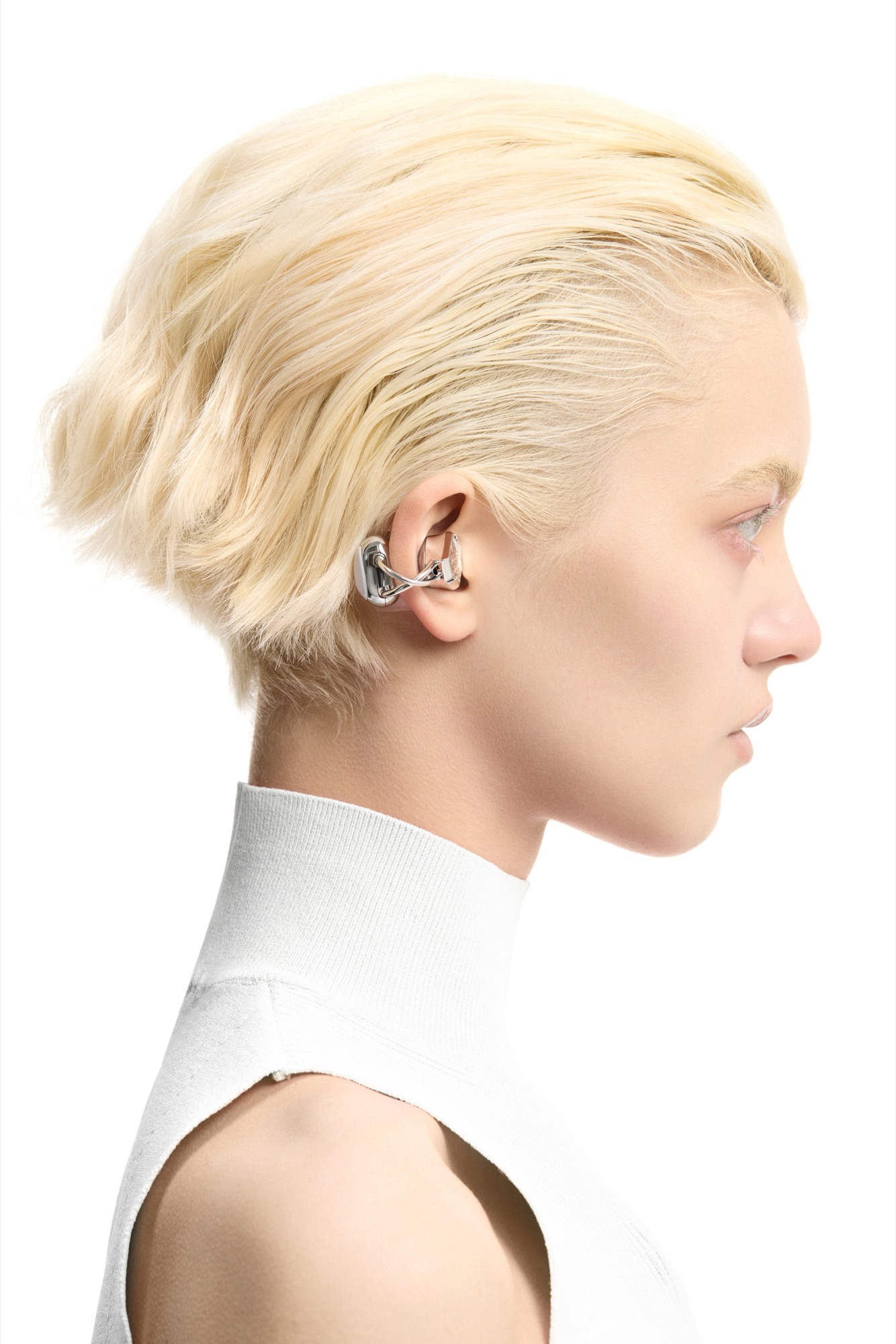
Imagine choosing a device because its shape looks like jewelry. At first, the pleasure might be entirely visual: it belongs with the metal at your neck or gives a plain outfit an unfamiliar outline. Over repeated wear, other questions become difficult to ignore. Does it stay where you want it? Can you reach the controls? Do you like how it feels after the photograph has been taken?
These aren’t arguments against beautiful technology. They’re how beauty gets a chance to become a habit. If using the object is irritating, the resemblance to an imagined future won’t make the irritation disappear. If it fits into your routine, the futuristic detail no longer depends on a complete outfit assembled around it. You might wear it with the clothes you put on in a hurry.
I like that possibility because it doesn’t require choosing between fantasy and ordinary life. It lets ordinary life make decisions about the fantasy. The striking coat gets worn open because you’re warm. The sharp-looking accessory ends up beside an old sweater. The object that looked like a prop becomes the thing you remember to take when you leave the house.
You still get to look a little as though you’re from somewhere else. You just need somewhere to put your groceries.