
Fashion Tech Accessories: What to Look For If You Care About Style First
A six-part scorecard for judging fashion tech accessories — daily task, use friction, claim evidence, outfit range, and how to spot the gadget trap and the cosplay trap.

A good fashion tech accessory is not just a device with a better finish. It is an object that does a real thing you need done every day, does it without creating daily friction, makes claims you can actually verify before buying, and fits into more than one outfit context. If a wearable tech product requires constant explanation, only works inside a single themed look, or lists capabilities that read more like a concept pitch than a feature sheet, it is closer to a gadget with aesthetics than to an accessory with function. This is a framework for telling the difference before you spend the money. e same filter applies when judging luxury tech accessories. This is a framework for telling the difference before you spend the money.
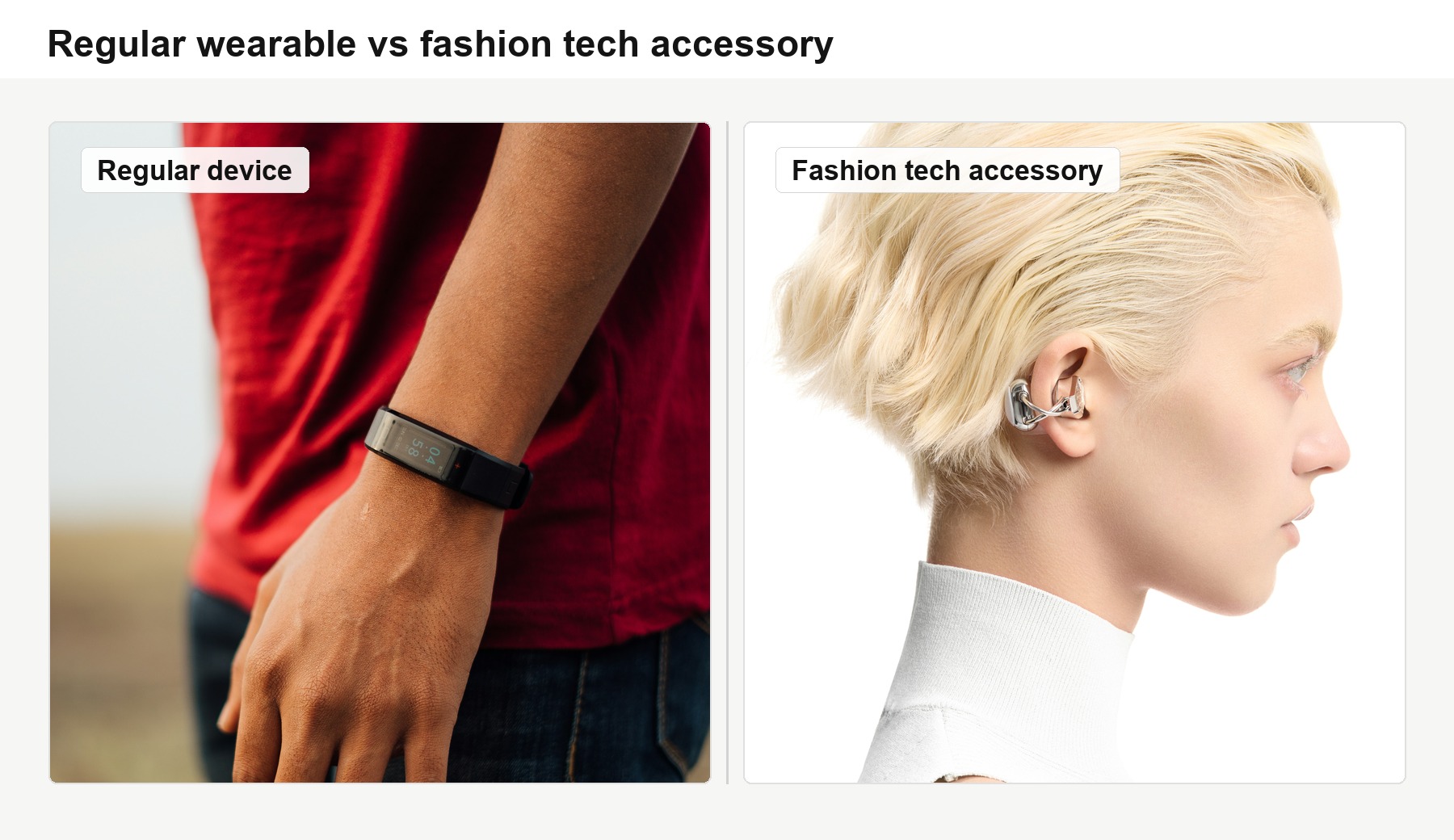
What makes a fashion tech accessory different from a regular device?
The line is not about price or appearance. A USD 400 smartwatch with a leather band is still a device if the wearer only interacts with it as a screen on the wrist. A USD 50 pair of clip-on earphones can function as a fashion accessory if it completes an outfit and handles a daily audio task without drawing attention to itself as technology.
The operational definition: a fashion tech accessory is a wearable object that holds a visible role in the outfit (it looks like it was chosen, not attached) while simultaneously completing a specific, repeatable daily task (it does something useful, not just something interesting). If either half is missing — all style and no function, or all function and no style — it falls into a different category.
For a broader map of where fashion tech accessories sit alongside smart rings, AI glasses, and other emerging wearable categories, see our 2026 wearable tech landscape overview. For a look at how even low-tech objects like wired earphones are becoming fashion accessories again, the comparison is instructive — intentionality matters more than technology level.
The style-first scorecard — six things to check
1. Visual role
Does the piece blend into the outfit, repeat an element already present, or contrast as the single focal point? If it does none of these — if it just sits on the body without a readable relationship to anything else you are wearing — it reads as a device, not an accessory. For a detailed breakdown of how to execute each of these three strategies, see our headphones-as-accessories styling guide.
2. Material credibility
Does the surface behave like accessory material (metal that shifts under light, stone with optical depth, electroplating that warms to the touch) or like device casing (uniform plastic sheen, painted coating, soft-touch rubber)? One sentence is enough here: if the material would look out of place next to the jewelry you already own, the piece will read as tech, not as fashion. For the full set of five material signals that separate high-end from gadget, see our material guide.
3. Daily task
This is where most fashion tech accessories fail the test, and it is the dimension that product marketing most often obscures.
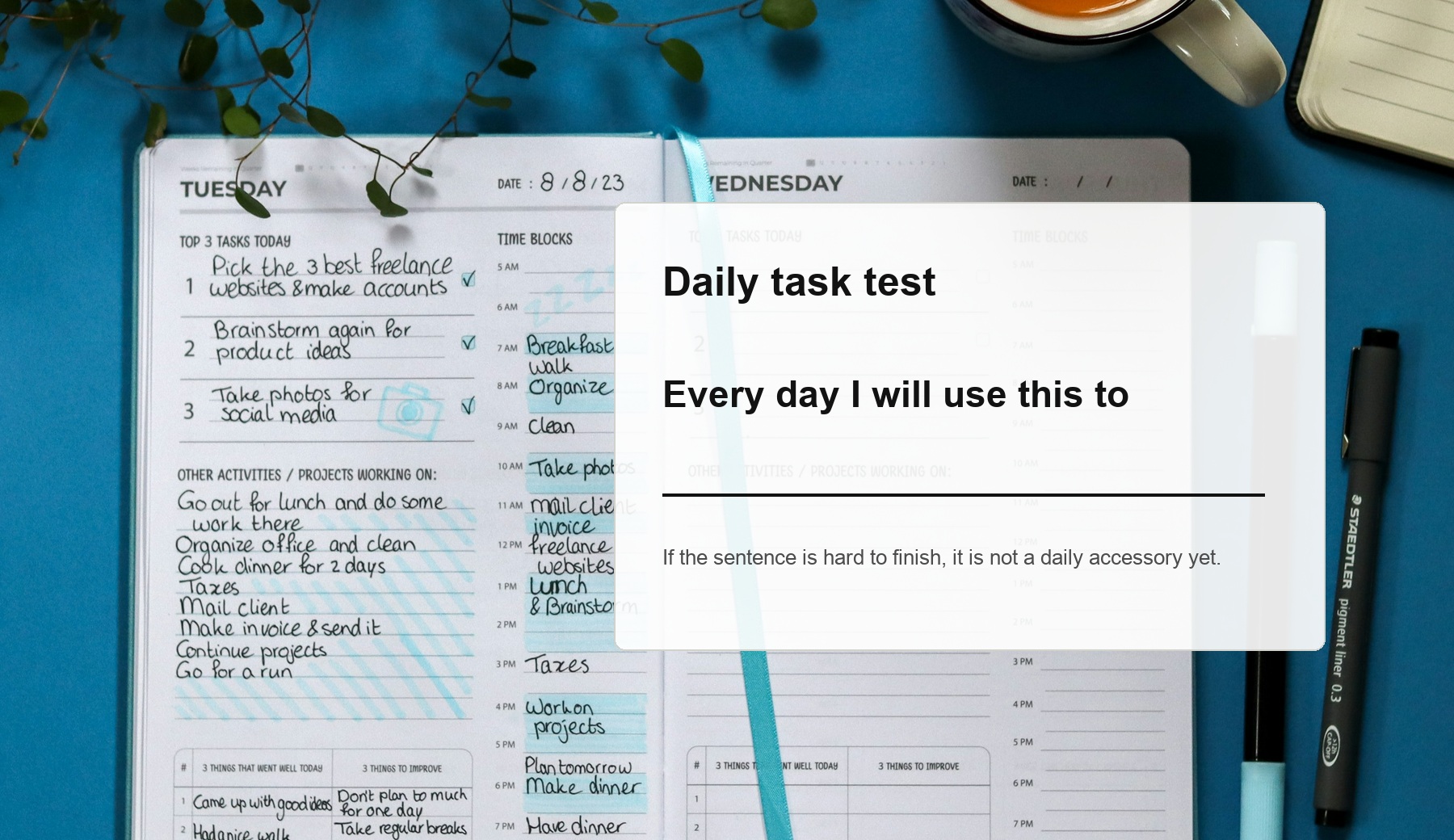
Ask one question: what specific task will I use this for every day? Not “what can it do” — that is a spec sheet. Not “what will it do in the future” — that is a roadmap. What will you, personally, use it for tomorrow morning, and the morning after that?
Clear daily tasks: taking phone calls hands-free, listening to podcasts during a commute, playing music while cooking, hearing navigation prompts while walking. These are concrete, repeatable, and testable before purchase.
Unclear daily tasks: “AI-powered personal assistant,” “biometric wellness companion,” “ambient computing interface.” These may describe real capabilities, but if you cannot translate them into a sentence starting with “every day I will use this to ___,” the product has not yet earned a daily slot in your life.
A fashion tech accessory that does not complete a daily task is a conversation piece. Conversation pieces are valid objects — but they are not daily accessories, and they should not be priced or evaluated as if they are.
4. Use friction
Use friction is the set of small daily costs that determine whether a product stays in rotation or gets shelved after a week. Five checkpoints:
Charging frequency. Does it need charging every night, every few days, or weekly? Nightly charging is the highest friction — it means the product competes with your phone for a cable and must be remembered every evening. Multi-day battery life drops the friction significantly.
Wearing time. Can you put it on in under thirty seconds without a mirror, a manual, or a specific sequence? If putting it on feels like a procedure, it will lose to the earring or the watch that just clicks into place.
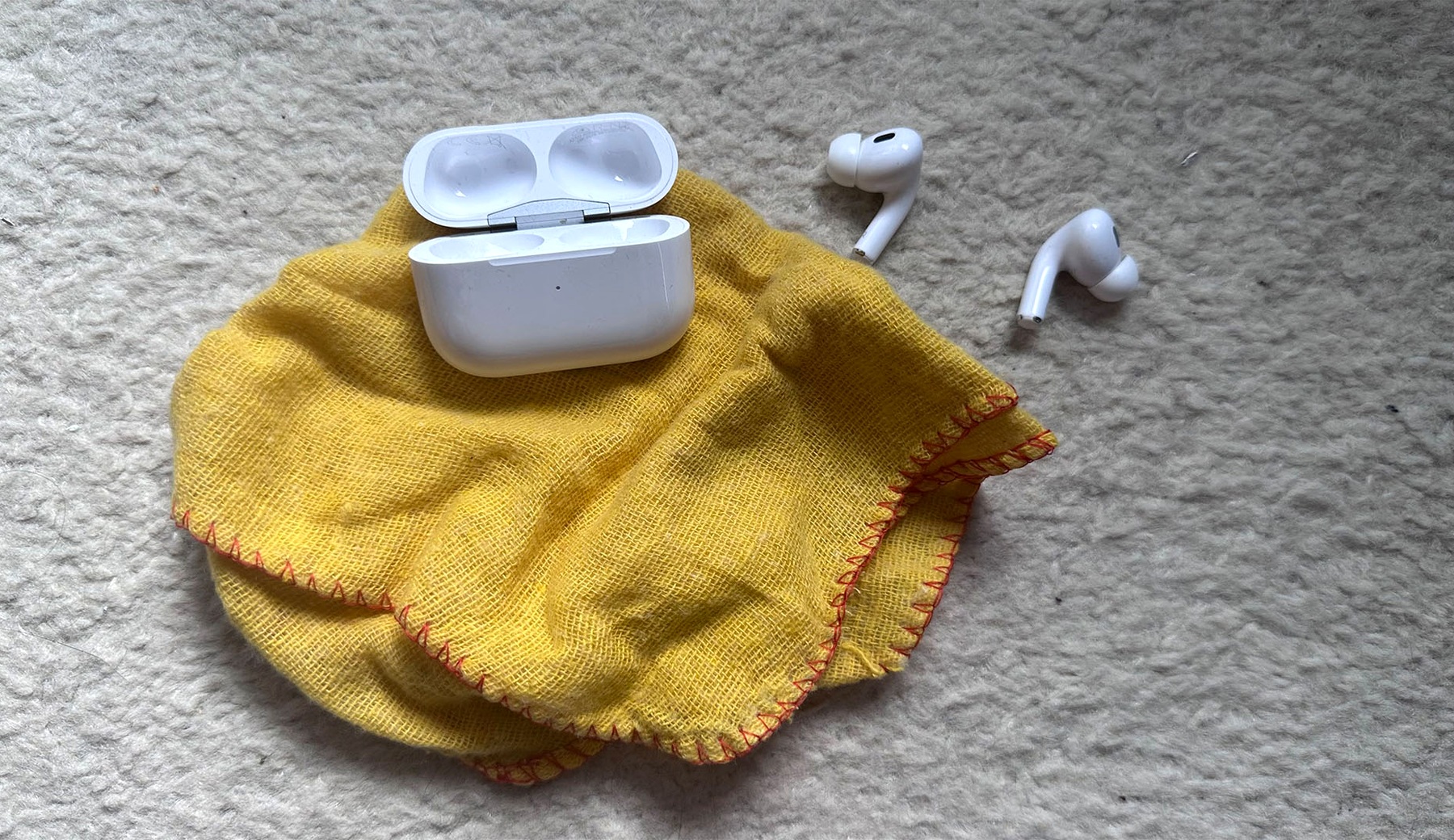
Cleaning. Does it require special tools, specific liquids, or careful handling? A piece you can wipe with a cloth stays in rotation. A piece that needs a special brush, a drying protocol, or a trip to the ultrasonic cleaner does not.
Storage and carry. Does the charging case or storage solution fit in a pocket or a small bag compartment? Does it look like something you would carry, or like something you would leave at home?
Removal impact. When you take it off mid-day, does your outfit still look complete? If removing the piece leaves a visible gap — if the outfit was designed around it — the dependency is too high for a daily accessory.
5. Claim evidence
Product pages for wearable tech are filled with capability language. Not all of it is equally reliable. Before buying, sort claims into three tiers:
Tier 1 — verifiable function. The feature is currently active, described with specific parameters, and testable by the user. Example: “open-ear audio driver, Bluetooth 5.3, 6-hour battery life.” You can test all of these on day one.
Tier 2 — enhancement. The feature is listed on the product page and may be currently available, but has limited real-world validation from independent users. Example: “AI-powered voice assistant,” “real-time translation.” The capability may exist, but its daily reliability and practical usefulness are not yet confirmed by a broad user base. Treat tier-2 features as bonuses, not as buying reasons.
Tier 3 — concept language. The description uses vision-level language without specific parameters or a clear current use case. Example: “redefining the relationship between body and technology,” “the future of personal computing on the ear.” This is marketing narrative, not a product feature. It may reflect genuine ambition, but it cannot be tested, compared, or relied upon at the point of purchase.
The rule: Buy based on tier 1. Be curious about tier 2. Ignore tier 3 when making the purchase decision.
6. Outfit range
A daily accessory must work across multiple contexts without requiring a costume change or a styling excuse. Test the piece against four scenarios:
| Context | What the piece needs | Red flag |
|---|---|---|
| Office | Low visual conflict, no distracting logos, stable material that does not look out of place in a meeting | You would need to explain “it is not a toy” to a colleague |
| Streetwear | Visible silhouette, form that echoes the outfit’s energy | It only works inside a full themed look — remove the theme and the piece looks random |
| Night out | Reflective or statement-level finish that holds up under artificial light | The material looks different under warm bar light than it did in daylight — flat, dull, or plasticky |
| Daily avant-garde | Fixed color system, repeatable across a consistent personal uniform | Every day it feels like “the first time wearing it” — no familiarity, no routine |
If a piece clears three or more of these contexts, it has genuine outfit range. If it only works in one, it is a context-specific object, not a daily accessory. For how a piece integrates into a fixed-palette daily rotation, see our capsule wardrobe compatibility guide. For the techwear and streetwear context specifically, see our ear cuff styling guide.
How to spot the gadget trap and the cosplay trap
Two failure modes catch style-first buyers more often than bad sound quality or weak battery life.
The gadget trap
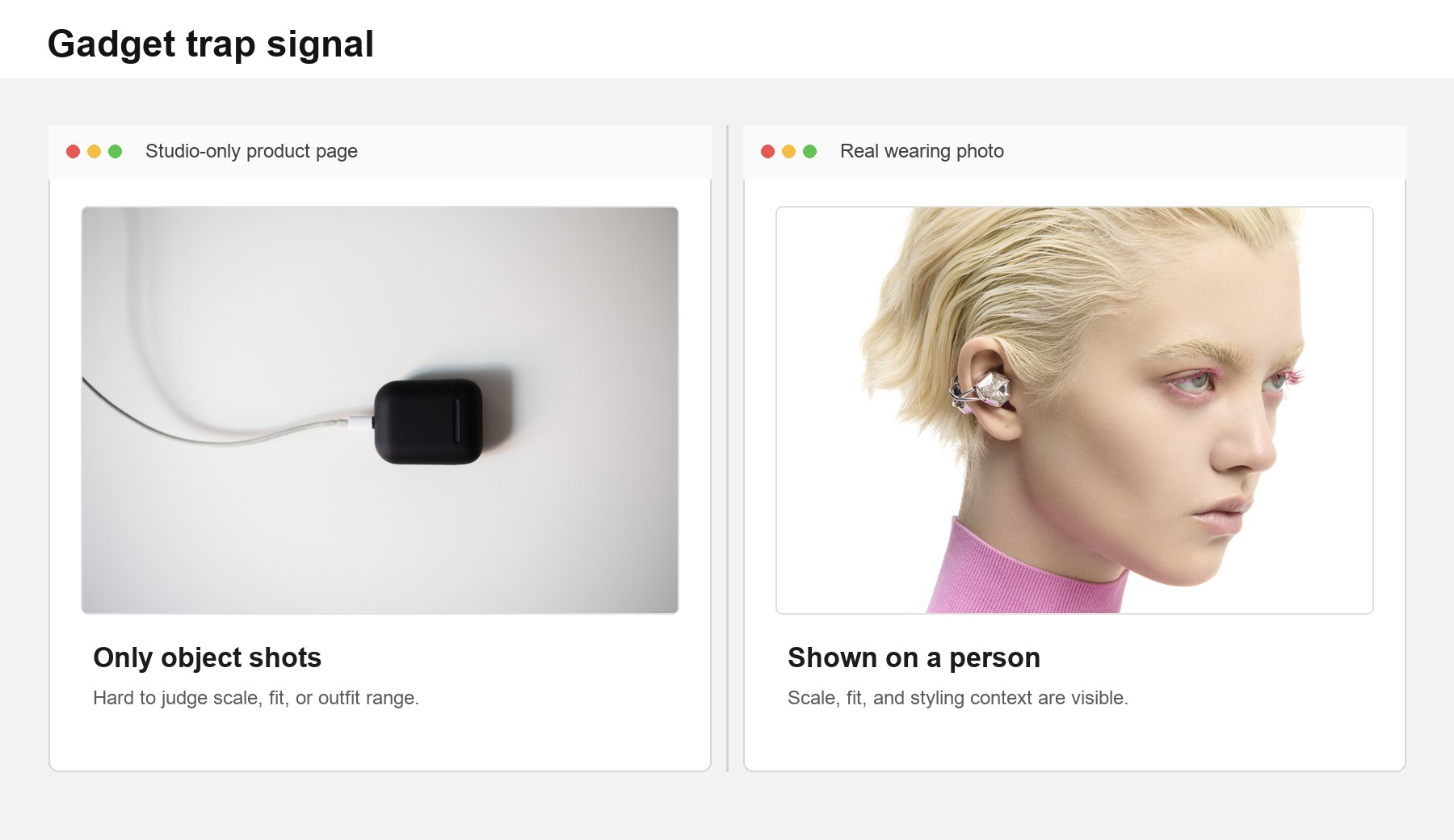
The product looks futuristic and lists impressive capabilities, but does not function as a daily accessory. Signals:
- No real-person wearing photos. The product page shows only concept renders, 3D models, or studio shots on mannequins. No one has photographed it on an actual ear, wrist, or face in an actual outfit.
- Future-tense features. The capability section reads “will support,” “coming soon,” or “planned for Q3” rather than “currently available.” You are buying a promise, not a product.
- Vague material language. The description says “premium materials” or “aerospace-grade alloy” without specifying the actual metal, plating method, or stone type. Specificity is the signature of real manufacturing; vagueness is the signature of concept products.
- LED-first design. The primary visual feature is a light effect, a screen animation, or a color-changing surface. Light effects age faster than material finishes and often look different in person than in video.
The cosplay trap
The product has genuine presence and real craftsmanship, but only works inside a specific visual universe. Signals:
- Context dependency. The piece looks intentional in a full themed outfit (cyberpunk, mecha, fantasy armor) but reads as a costume fragment in jeans and a T-shirt. If it cannot survive the simplest outfit in your closet, it is a costume piece.
- Explanation required. When someone asks “what is that?”, the answer requires a cultural reference, a brand story, or a subculture explainer rather than a simple description (“it is an earphone” / “it is an ear cuff”). If the object cannot be understood without context, it cannot be worn without context.
- Single-scene range. The piece works at a convention, an editorial shoot, or a themed event, but you would not wear it to buy groceries. Daily accessories survive mundane contexts.
For a thoughtful example of how armor-style wearables are navigating the distance between cosplay and daily fashion, see EZ mecha armor and wearable fashion.
When fashion tech can take a jewelry slot — and when it cannot
If a fashion tech accessory passes the scorecard — it has visual role, material credibility, a real daily task, low friction, verifiable claims, and outfit range — it can potentially occupy a slot that previously belonged to a piece of pure jewelry. For the detailed scene-by-scene conditions under which that works (casual, evening, formal, existing ear stack), see our earbuds-as-earrings occasion guide.
The dimension that guide does not cover is budget. When you buy a fashion tech accessory to replace a jewelry slot, you are paying for two things in one object: the accessory value (how it looks, what it is made of, how it sits on the body) and the function value (what it does). Both halves need to justify their share of the price independently. If the audio quality is not worth half the price as a standalone earphone, or the material and form are not worth half the price as a standalone earring, the combined object is overcharging on one side. The fairest test: would you buy this as a piece of jewelry at half the listed price? Would you buy it as an earphone at half the listed price? If either answer is no, reconsider.
Two ear-worn examples at different points on the scorecard
OFHUNGER makes wearable tech designed as everyday accessories — open earphones built as ear jewelry. They are a useful scorecard test case because they sit clearly in the fashion-tech-accessory space rather than in the pure-device or pure-jewelry space.
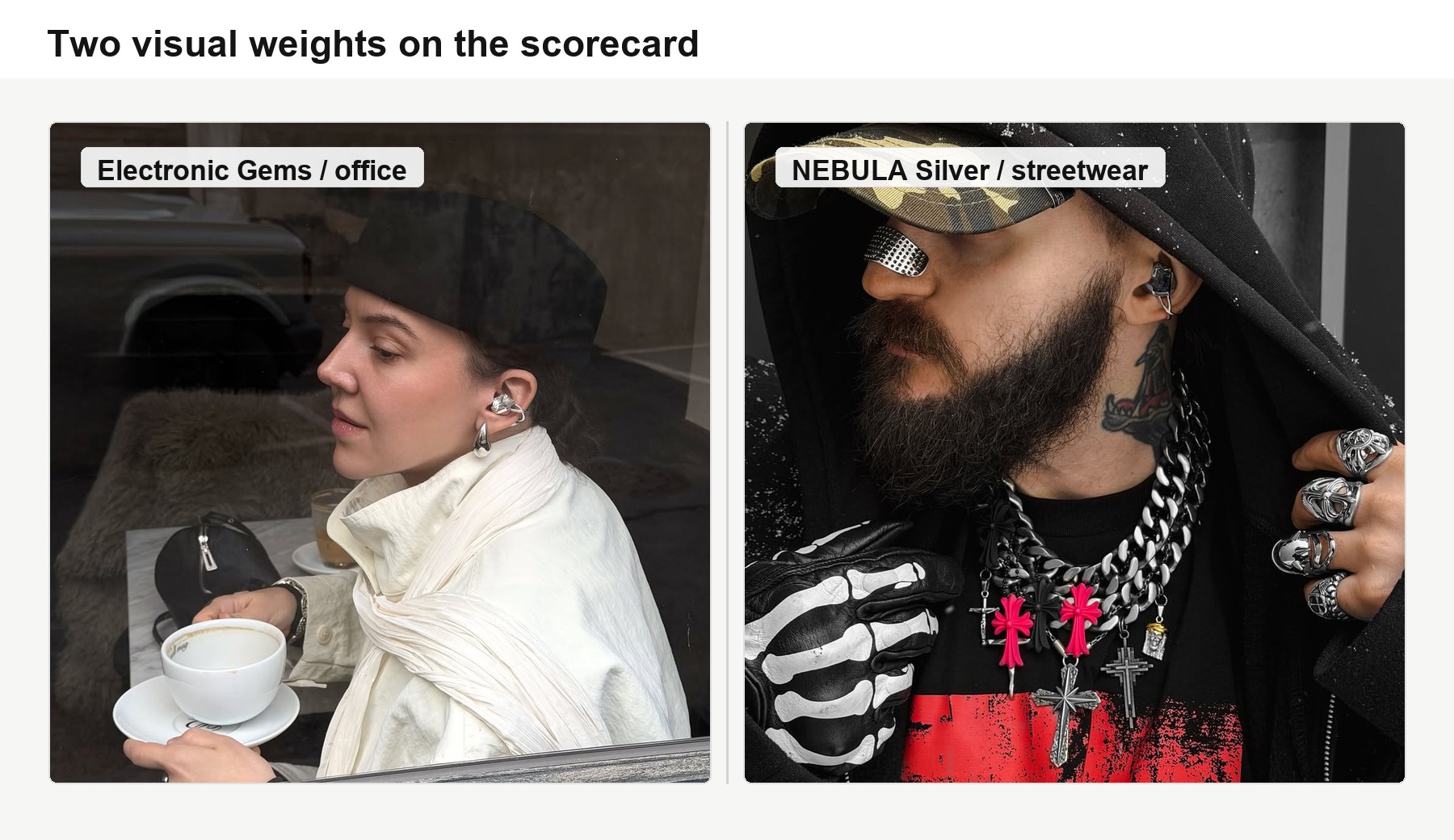
Electronic Gems White Zircon — the daily rotation piece. The White Zircon at USD 290. Visual role: jewelry-scale drop earring silhouette, silver-toned, reads as repeat or blend with existing silver accessories. Material: 18K white gold plated copper, faceted zircon — real electroplating and real stone, not coating. Daily task: open-ear audio for calls, podcasts, and music — tier-1 verifiable. Use friction: clip-on wearing, compact charging case, no special cleaning tools. Claim evidence: AI features listed on the product page sit at tier 2 — treat as enhancement, not buying reason. Outfit range: office, casual, evening, daily uniform — clears three or more contexts.
NEBULA Silver — the statement piece. The NEBULA in Silver at USD 360. Visual role: sculptural, design-fiction silhouette that reads as contrast or focal-point repeat. Same tier-1 audio function and same open-ear format. Higher visual volume, which means the outfit range shifts: strong in streetwear, editorial, night out, and Y3K-adjacent aesthetics; less natural in conservative office settings. Neither a gadget-trap product (real materials, real function, real wearing photos on the Style page) nor a cosplay-trap product (works outside a themed outfit — but the wearer should be comfortable with a visible statement).
For a structured test of whether either piece genuinely reads as jewelry on the ear, see the five-part jewelry earbud test. To browse all variants, visit the full collection.
Quick buying checklist
Before purchasing any fashion tech accessory, run these questions:
- ☐ Can you name the specific daily task you will use it for — in one sentence?
- ☐ Is the primary feature currently available and testable, or is it a future promise?
- ☐ Can you put it on in under thirty seconds without instructions?
- ☐ Does the material specification name actual metals, stones, or processes — not just “premium”?
- ☐ Does the product page include real-person wearing photos in more than one outfit and setting?
- ☐ Can you wear it to at least three different contexts in your actual weekly routine?
- ☐ Would you buy it as a piece of jewelry at half the price? As a device at half the price?
- ☐ When you take it off, does your outfit still look complete?
If a product clears all eight, it has earned the label fashion tech accessory. If it fails on daily task, claim evidence, or use friction, it may still be interesting — but it is not yet ready to replace a slot in your daily rotation.
FAQ
What counts as a fashion tech accessory vs a regular gadget? A fashion tech accessory holds a visible role in the outfit while completing a specific daily task with low friction. A regular gadget completes a task but does not integrate visually — it sits on the body as a device, not as a chosen accessory. The distinction is not about price or brand; it is about whether the object has a readable relationship with the rest of what you are wearing.
How do you verify a wearable tech product’s claims before buying? Sort the claims into three tiers. Tier 1: currently available, specific, testable (buy based on these). Tier 2: listed but not widely validated by independent users (treat as a bonus). Tier 3: vision-level language with no specific parameters (ignore for purchase decisions). If the product page mostly contains tier-2 and tier-3 language, wait for real-world reviews before buying.
Is screenless wearable tech easier to style than screen-based? Generally, yes. A screen introduces a visual element that reads as “technology” regardless of the surrounding material. Screenless wearable tech — audio earphones, smart rings, sensor-embedded jewelry — can more easily pass as a traditional accessory because the technology is invisible from the outside. The styling challenge shifts from hiding a screen to ensuring the material and silhouette read as intentional.
Can fashion tech accessories work in an office setting? Yes, if the piece has low visual conflict: no distracting logos, no LED effects, stable material that does not look out of place next to a blazer or a collared shirt. Jewelry-scale earphones and minimal smart rings clear this bar most easily. Sculptural or high-volume pieces may require a workplace culture that is comfortable with visible personal expression.