
9 Cyborg Movies to Watch for Body Augmentation Design
Explore nine live-action cyborg movies through mechanical bodies, neural implants, artificial organs, and prosthetic design, plus a Tetsuo body-horror detour.
TL;DR
- Alita, Ghost in the Shell, and RoboCop offer three distinct approaches to mechanical bodies: ornamented, humanlike, and armored.
- Upgrade makes an internal modification visible through movement; Elysium exposes the frame attached to the body.
- Johnny Mnemonic and Repo Men turn the modified body into data infrastructure and recoverable property.
- The list covers nine live-action films, with Tetsuo as a separate body-horror extension. The Marcus Wright section includes a major spoiler warning.
Alita’s first mechanical hands have the delicacy of decorated porcelain. Murphy’s armored shoulders suggest something considerably less gentle. Both belong to people whose bodies have been rebuilt, but even before either character does anything, their designs invite entirely different expectations. One asks us to admire the care lavished on a small joint; the other looks capable of breaking through a wall.
That’s a good place to start exploring cyborg movies. These nine live-action films offer artificial bodies, replacement limbs and organs, neural implants, and an exoskeleton fixed to flesh. Some are rich sources of mechanical detail; others make an interesting mess of what an altered body can actually do, or who gets to use it. If you’re gathering Y3K references, there’s plenty here beyond polished metal: ornament, imitation skin, exposed supports, and machines whose presence is revealed through movement. The boundary between a body and its equipment is also a recurring question in posthuman fashion.
Alita: Battle Angel (2019): Two Mechanical Bodies
Start with Alita if you want to see how changing a mechanical body can change its entire visual vocabulary. Her delicate first body and later Berserker form offer unusually clear points of comparison, with the same character carrying us between them.
I particularly like the ornament on the first body’s cream-colored hands. The curling patterns follow surfaces that are already divided into little articulated segments, so decoration and construction keep drawing attention to each other. The fingers aren’t simply a human shape painted silver; their joints make their separate manufacture apparent, while the care taken over them suggests something cherished. A raised hand becomes worth examining all by itself.
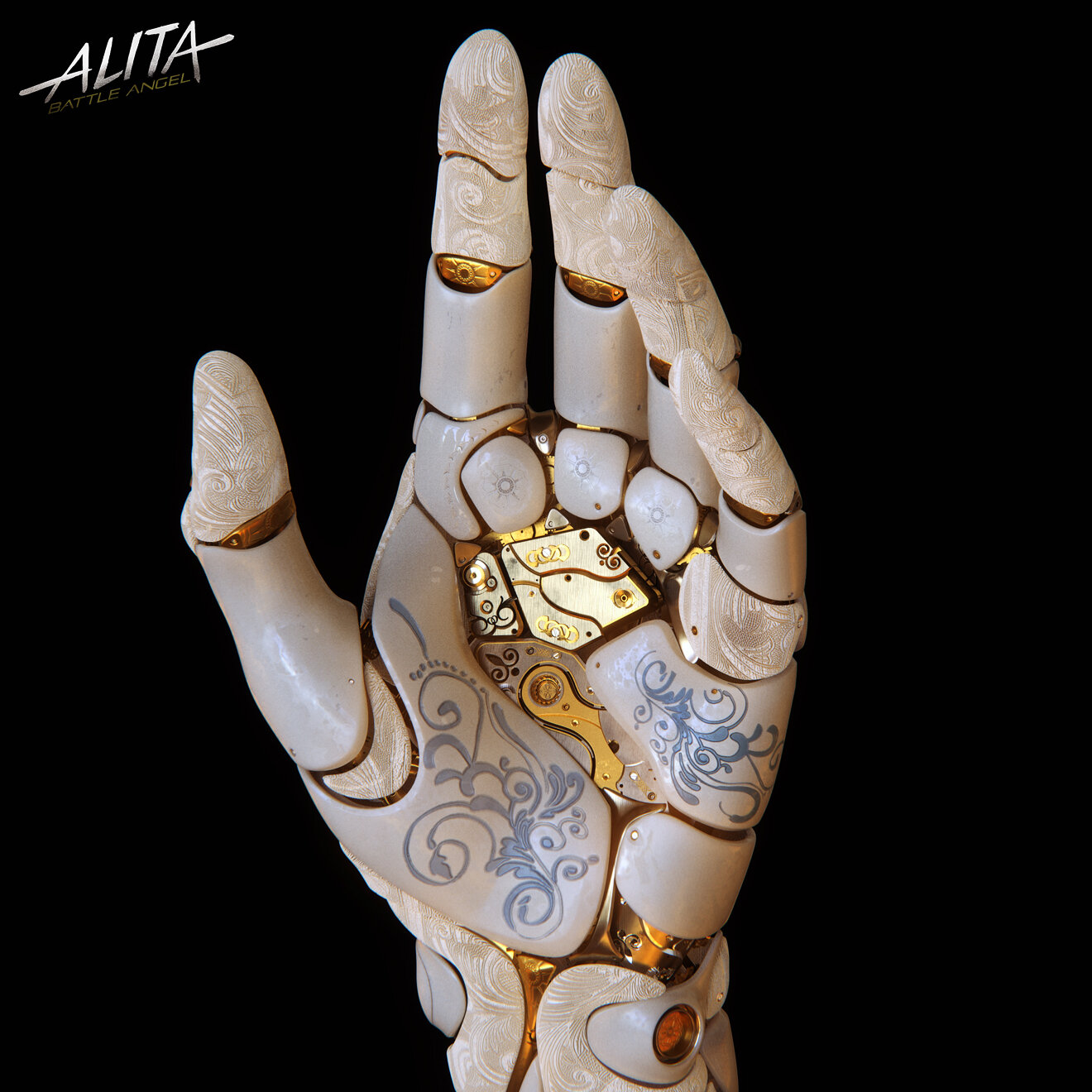
Concept art: Alita’s doll-body hand.
Designer Vitaly Bulgarov’s work makes the contrast with the Berserker especially vivid. His combat-body concepts favor darker, ribbed surfaces that follow the pull of musculature, shifting the emphasis from a fragile constructed object toward a body capable of tremendous exertion. These are development images within a larger collaborative production, and rewarding companions to the film rather than exact substitutes for its final designs. Together, the two bodies offer far more to investigate than a simple increase in power. Alita’s continued personhood gives us a reason to notice how differently each form presents her.
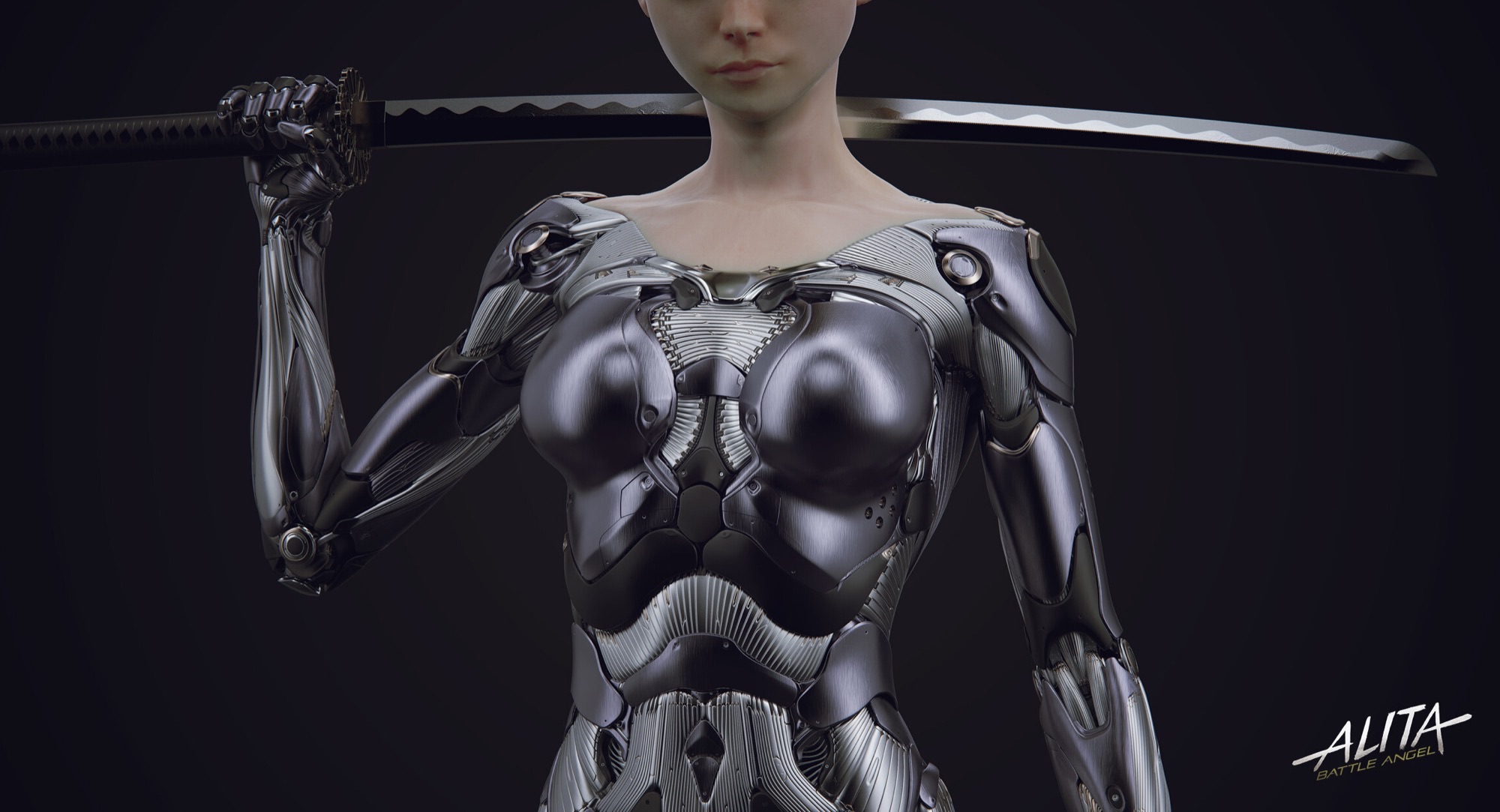
Concept art: the Berserker body.
Ghost in the Shell (2017): A Manufactured Human Body
For an artificial body that approaches the appearance of human skin, turn to the 2017 live-action Ghost in the Shell. Its Major is a human mind housed in a manufactured body, and the distance between her finished appearance and her construction is where its most intriguing images reside.
The opening manufacture sequence lets the human silhouette arrive in layers. Wētā’s physical work included a skeleton proportioned to Scarlett Johansson, muscle forms, and gel used in building up the body. There is something wonderfully unsettling about anatomy becoming an assembly process: the layers are familiar enough to recognize, yet their fabrication makes that familiarity feel provisional. A surface can look reassuringly human after we’ve already been shown what supports it.
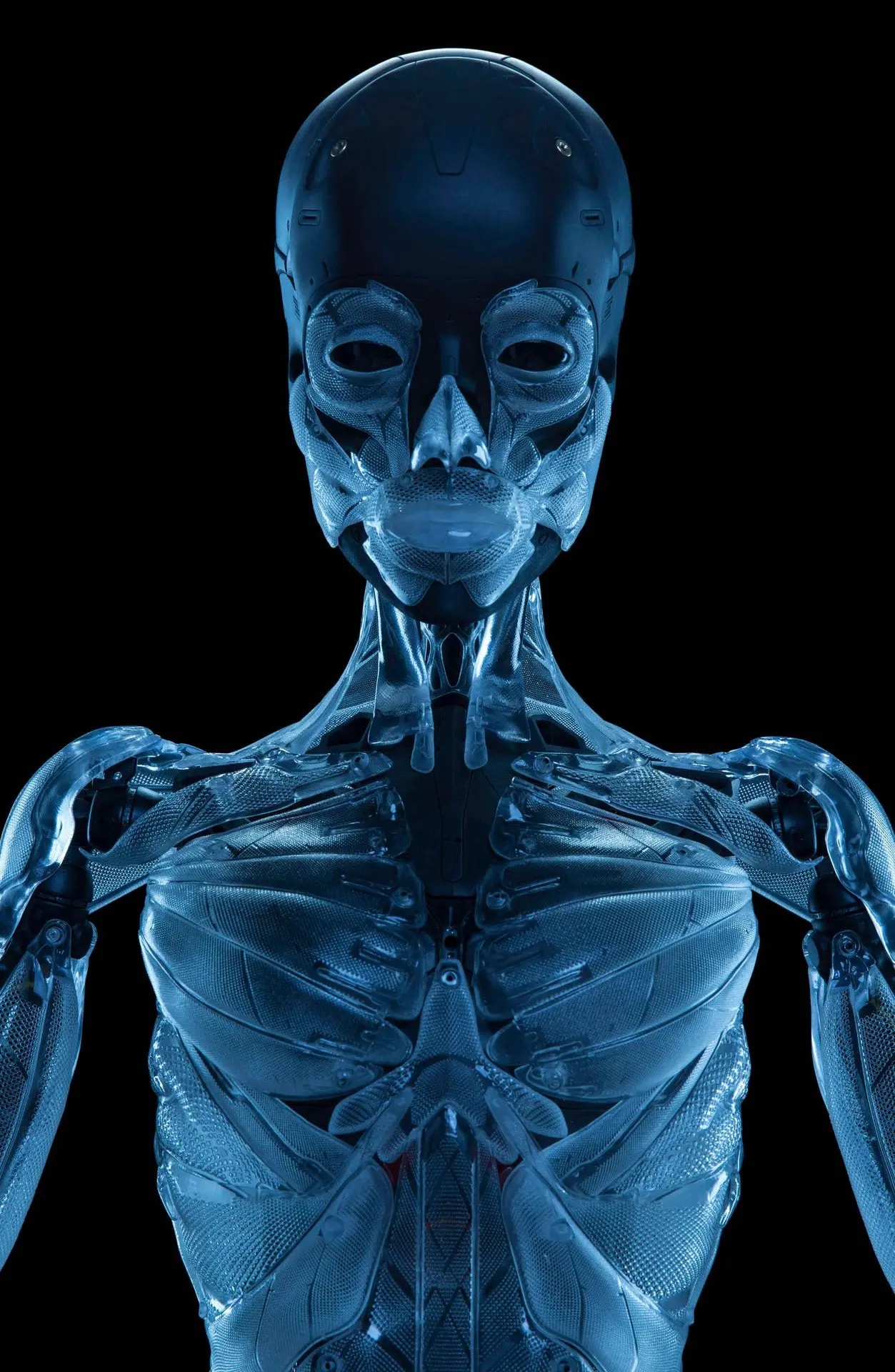
Physical production model for the live-action film.
That effect also informs the smooth thermoptic costume, made in silicone to follow the actor’s form like another skin. Its imprinted panel lines belong to the suit’s design; they shouldn’t all be read as breaks in the Major’s body. The distinction is worth keeping visible, because the film offers several ways of manufacturing a human outline. Alongside its account of an imposed past, those outlines make bodily resemblance an uneasy form of reassurance. Looking like yourself offers little comfort when someone else can supply your history.
RoboCop (1987): An Armored Cyborg Body
Among movies about cyborgs, RoboCop is the armored-body reference to choose when you want the remaining human features to trouble the machine’s outline. Alex Murphy, a police officer reconstructed after catastrophic injury, becomes a cyborg whose bulk seems designed to announce a function before it permits us to recognize a person.
Just look at the helmet. The visor takes away the eyes, while the mouth and lower face remain visible beneath it. Above that small exposed area, the broad shoulders and angular chest plating establish the authority of a heavily equipped law-enforcement machine. There is enough human face to make the covering feel consequential. We can recognize the person-shaped absence where his eyes ought to meet ours.

Official promotional poster.
That makes this a particularly useful contrast with Alita’s fine articulation. Murphy’s design concentrates its attention on an imposing outline and the uneasy survival of a human face inside it. His reconstruction also gives that outline an employer and a job. The disturbing prospect is that saving someone’s life can become a way of deciding what that life is for. Even without following every turn of the police story, there is plenty to consider in a body that has been built to make its owner’s assigned purpose so immediately legible.
Upgrade (2018): A Neural Implant That Controls Movement
For a bodily transformation that becomes visible through movement, Upgrade is the most immediately exciting choice here. Grey Trace receives the artificial-intelligence implant STEM after being paralyzed. His limbs haven’t been replaced with gleaming machinery; their new capacity emerges in how they move.
The terrific complication is that his face can remain appalled while his body deals efficiently with an attacker. In discussing the fight in Serk’s kitchen, director Leigh Whannell and actor Logan Marshall-Green describe finding comedy in that separation: Grey is horrified by the violence he is carrying out. Marshall-Green’s physical preparation sought supple, economical movement rather than the familiar stiff-limbed robot routine. That distinction matters. A body can look less human because it moves with too little uncertainty, rather than because its joints appear difficult to operate.

For anyone collecting body augmentation movies as visual references, this opens up a whole territory that a still image can barely communicate. The modification is internal, but the resulting motion makes the body strange to its inhabitant. Grey can benefit from its competence and recoil from its actions within the same exchange. There is no need to disclose the final reversal to appreciate how uncomfortable, and unexpectedly funny, that divided response can be.
Elysium (2013): An Exoskeleton Attached to Flesh
Elysium offers the roughest practical counterpoint to Alita’s decorated shell: Max’s fixed exoskeleton looks like industrial equipment made to accommodate a person. Its supports remain outside his body, with connections that make the attachment to flesh part of the design’s discomfort.
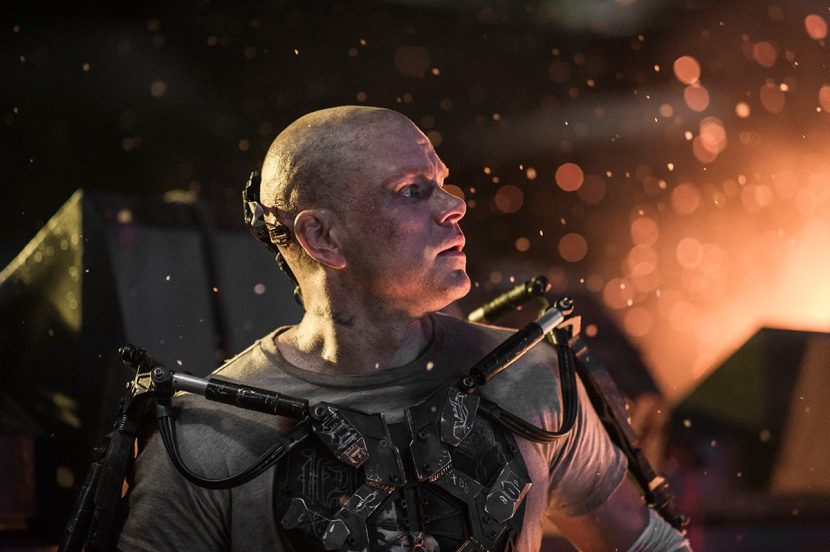
After radiation exposure, Max undergoes the fitting of this strength-enhancing apparatus. It does not cure the radiation damage. Nor is it a set of replacement limbs: the distinction matters visually, because his own body remains present inside the system that reinforces it. The production’s HULC design follows the shoulders and collarbone, with joints and pistons arranged to preserve a usable range of motion.
The fabrication is a delight in its own right. The effects team’s account describes lightweight urethane and plastic components, with costume work concealing the points where the machinery appears to meet bone. A painful-looking apparatus had to remain wearable enough for action. That practical negotiation helps explain why the frame feels attached to a vulnerable body rather than simply surrounding an indestructible one.
Set against the pristine orbital home of the wealthy, such blunt bodily engineering takes on an additional ugliness. Max’s route toward greater capability requires invasive adaptation to an apparatus. The world above him has made comfort look effortless.
Johnny Mnemonic (1995): Data Storage Inside the Brain
Johnny Mnemonic is worth seeking out for a smaller, nastier change in the job description of the human body: Johnny’s brain has been adapted to carry data. Keanu Reeves’ courier transports information within himself, making a neural storage implant the center of the recommendation.

The trailer’s question about his storage capacity has an agreeable bluntness. It treats a person as a device whose usefulness can be expressed as an available amount of space. In a film full of electronic environments, that exchange keeps the technology attached to a particular worker. Someone has to carry this information, and the carrying is happening inside his head.
This makes it a different kind of design reference from the visibly rebuilt bodies earlier in the list. The interest lies in the relationship between a human figure and the equipment through which information is transferred, rather than in an elaborate artificial limb. For a designer, even the premise suggests a change in where attention should fall: toward the interface and the vulnerable person connected to it. Johnny has become part of the delivery mechanism. The cargo cannot be neatly separated from its courier, and an apparently abstract information economy acquires a body that can be put in danger.
Repo Men (2010): Artificial Organs and Debt
Repo Men makes artificial organs frightening through their conditions of ownership. Remy works repossessing expensive replacement organs, then receives an artificial heart himself. He acquires both a means of staying alive and a debt that can place his life back in someone else’s hands.
The grotesque appeal is in how directly the arrangement joins ordinary payment obligations to bodily survival. An organ can be sold as a medical marvel and treated as recoverable merchandise afterward; the person who needs it must somehow remain solvent through all of this. Remy’s change of position makes the arrangement particularly vicious. The work he understood as a job becomes a threat taking place inside his own chest.
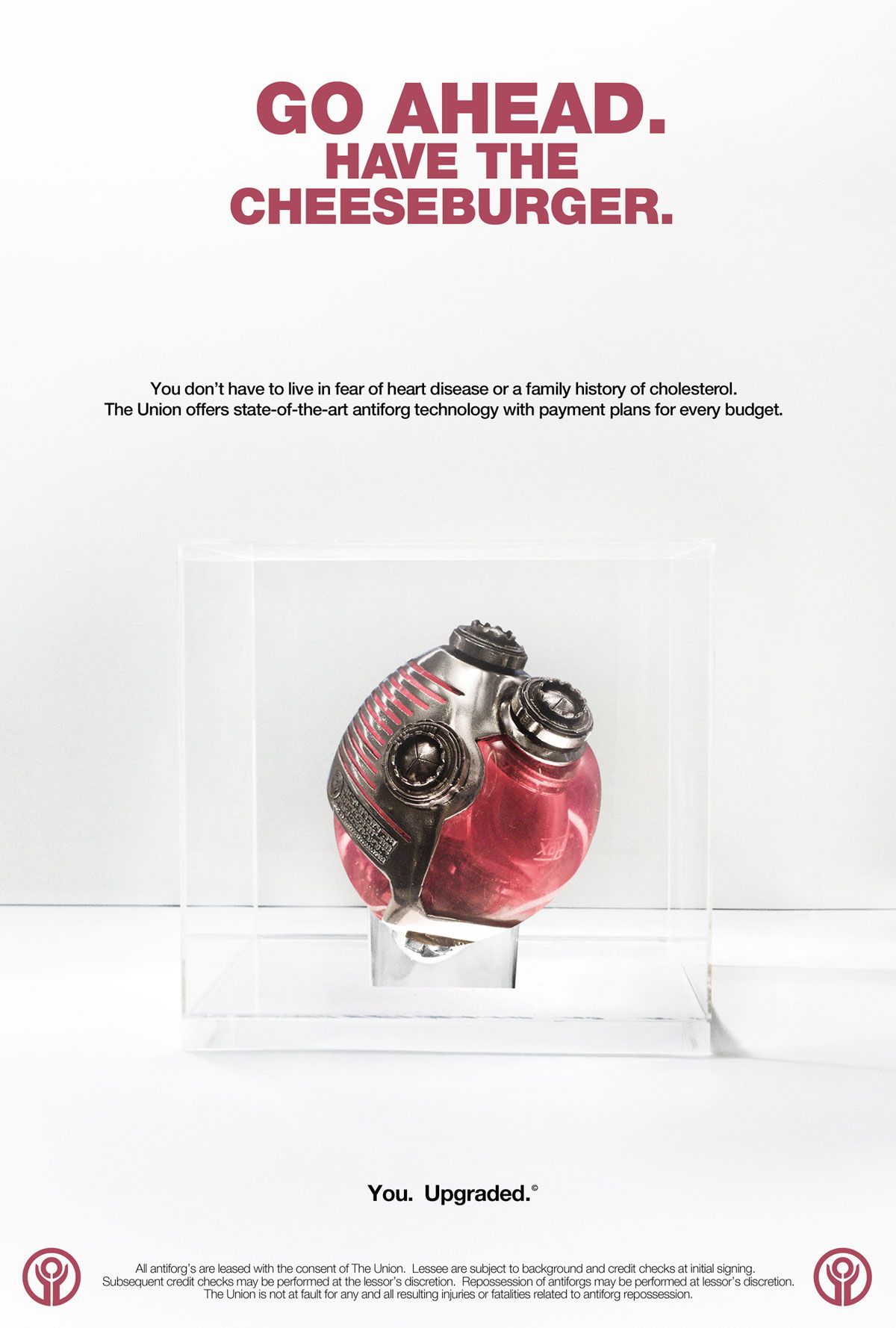
A fictional organ advertisement from the film’s promotional campaign.
This is a much stronger recommendation for the commercialization of artificial organs than for elaborate exposed-limb design. Its mechanical components belong to a medical and commercial world, with removal providing the brutal visual consequence of treating them as possessions. There is substantial bloody violence and grisly imagery, so don’t mistake the medical premise for a restrained speculative drama. The attraction is that ugly collision of lifesaving technology and a business prepared to take its products back. Watching the collector become the debtor gives the transaction an unpleasant intimacy.
Terminator Salvation (2009): Marcus Wright
Major character-reveal spoiler follows. Skip this section if you want to discover Marcus Wright’s condition during the film.
Terminator Salvation earns its place through Marcus, whose human appearance conceals a mechanically rebuilt interior. His heart and brain remain human. This is a particular hybrid character, rather than a claim that every Terminator began as a person.

The striking design relationship is between the exterior that lets Marcus understand himself as human and the machinery that lets others classify him as an enemy. Because he initially doesn’t know what has been done to him, the reveal forces a reassessment of a body he already inhabits. Familiarity offers no protection from someone else’s judgment once the concealed structure becomes known.
For visual reference, that makes the contrast between human covering and internal mechanism more useful than an isolated image of a robot skeleton. The recognizably human exterior has an active role: it sustains Marcus’ understanding of himself until knowledge of the interior disrupts it. His continued human heart and brain complicate any easy division by material. You can follow that conflict without spoiling his final choice, and without reducing the recommendation to another inventory of metal parts. Here, a rebuilt body becomes alarming because of what its discovery does to an existing relationship between a person and everyone around him.
The Creator (2023): Joshua’s Prosthetic Arm
The Creator offers a quieter reference in Joshua’s prosthetic arm and the clothing and military equipment surrounding it. The larger story concerns a war between humans and artificial intelligence; Joshua’s arm gives us a smaller design question to follow within that enormous setting.
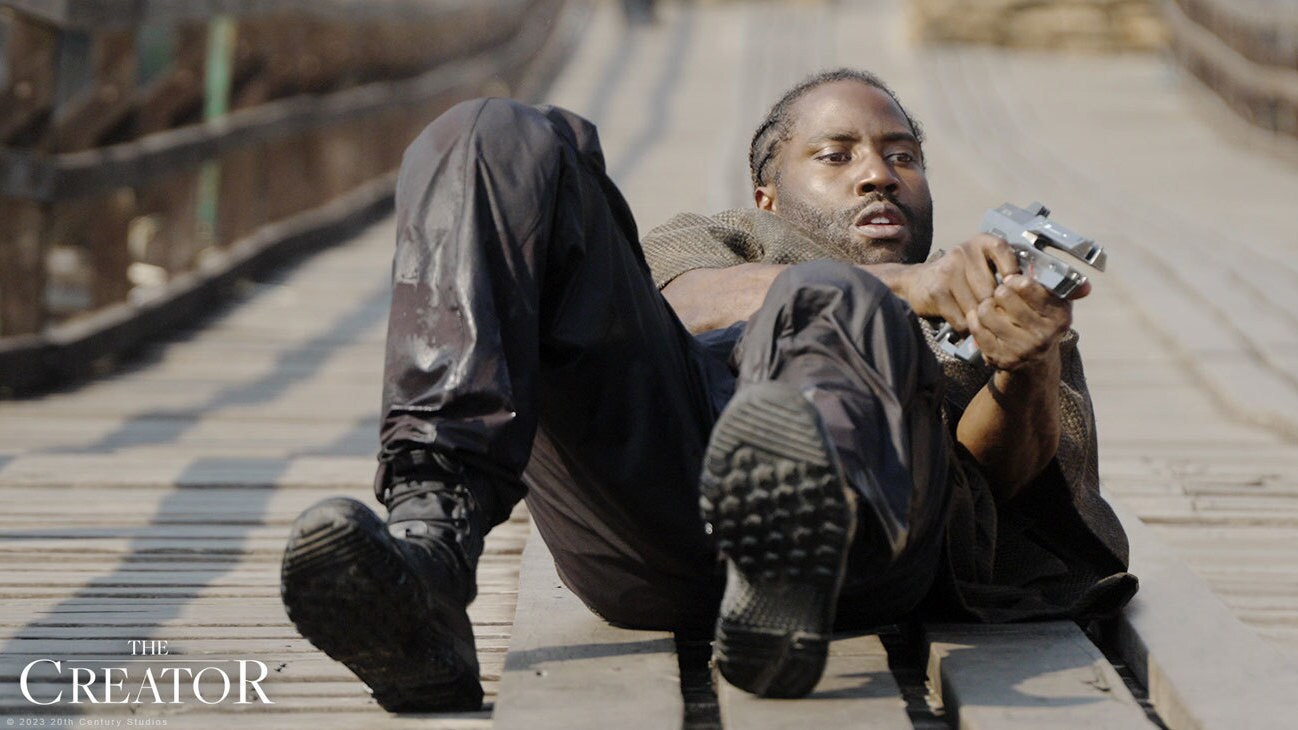
Wētā produced the prosthesis alongside specialty costumes, props, and weapons. The team’s approach to military equipment emphasizes adaptation and wear, while Joshua’s look carries less equipment than the soldiers around him. That context is useful: an artificial limb shares the figure with garments, straps, and the practical demands of a military world. It doesn’t have to monopolize his silhouette.
For this one, keep enough of the person in view to consider how the arm fits the whole design. Cropping down to a mechanical hand can lose the relationship that makes the example valuable. Joshua is the modified human of interest here; the film’s manufactured AI characters belong to a different discussion.
Body-Horror Extension: Tetsuo: The Iron Man (1989)
Outside these nine recommendations, Shinya Tsukamoto’s Tetsuo takes flesh and industrial material somewhere considerably more hostile. Metal invades and transforms a salaryman’s body, with harsh black-and-white imagery and rapid stop-motion making the mutation feel painfully unstable. This is intense body horror, far removed from a desired medical replacement. Seek it out if the roughness of the fusion interests you more than the appeal of a finished, usable mechanical body.
Which Movie Should You Start With?
For a first look at human augmentation movies, I’d start with Alita’s two bodies or Upgrade’s divided physical responses: both make their particular fascination immediately clear. Move toward Ghost in the Shell for manufactured skin, Elysium for an exposed supporting frame, or Repo Men if the most disturbing component is the one its owner still has to pay for.