
5 Anime to Watch for Biomechanical Body Design
Explore how Genocyber, AKIRA, Evangelion, Ghost in the Shell, and BLAME! depict flesh, machinery, mutation, and artificial bodies.
TL;DR
- The five works distinguish cybernetic fusion, biological mutation, living mecha, and manufactured bodies rather than treating every design as the same process.
- Evangelion makes restraint and armor central to its living giants; Ghost in the Shell makes an artificial body look ordinarily human.
- Genocyber and AKIRA are the most confrontational starting points for gore. Ghost in the Shell and BLAME! offer quieter visual relationships while retaining violence.
A ribbed tube can look uncomfortably like a windpipe. Give it a few hard-edged neighbors and it becomes machinery again, until the whole arrangement resolves into something with a jaw. This is the particular pleasure of biomechanical anime: the moment when looking more closely makes a body harder to understand. The details are perfectly visible; it’s their relationship that keeps getting away from us.
Of course, several very different processes can produce that confusion. An artificial body might preserve an ordinary human outline, while an organic creature wears enough armor to pass as a robot. A replacement limb can be precisely bounded; a mutation might destroy the very possibility of a stable outline. Cyborg anime and body horror anime overlap, but a constructed body doesn’t have to be a horrifying one, and a horrifying transformation doesn’t require a single implant.
These five productions offer markedly different pleasures within that territory. We’ll begin with the nastier end, where bodies become difficult to look at as well as difficult to classify, before moving towards figures whose apparent composure conceals stranger arrangements. There’s plenty here to admire without wanting any of these bodies for yourself.
Genocyber (1994 OVA): Psychic and Cybernetic Fusion
Extreme gore, mutilation, and violence involving children.
Koichi Ohata’s five-part OVA begins with a wonderfully unpromising proposition for everyone involved: corporate interests want to turn two sisters into a weapon. One sister is largely mechanical, the other possesses extraordinary psychic power; their combination produces the cybernetic creature of the title. Psychic energy is essential to this arrangement. Trying to read Genocyber as a plausible assembly of replacement parts would lose much of its monstrous appeal.
The designs make that appeal wonderfully unpleasant. Ribbing can suggest either a hose or an exposed organic passage, while hard projections refuse to settle into the reassuring outline of a wearable suit. A jawlike shape grants the tangle the beginnings of an animal identity, then all those crowded mechanical surfaces interrupt it again. There’s a great deal of information to look at, yet surprisingly little comfort in being able to identify individual pieces. You can follow a contour without discovering where the creature stops and its equipment begins.
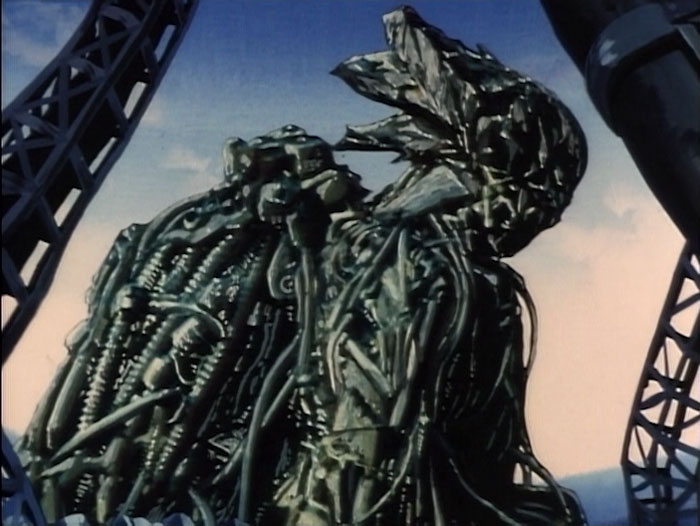
That uncertainty gains an ugly charge from the human bodies surrounding it. Genocyber’s violence treats flesh as catastrophically vulnerable, even as its engineered bodies promise overwhelming force. The fantasy of acquiring a stronger body becomes pretty difficult to enjoy when the production is this eager to demonstrate how bodies come apart. This is an abrasive recommendation, and its visual interest shouldn’t be mistaken for a promise of a comfortable evening.
The use of practical models alongside animation adds another useful friction. An already bewildering organism can acquire the stubborn presence of an object, something that occupies space rather than simply illustrating a concept. I find that material awkwardness far more interesting than a clean diagram of what the monster contains. Genocyber offers the sensation that someone’s weapon project has developed a physical existence much too terrible for its proposed purpose.
AKIRA (1988 Film): Mechanical Replacement and Mutation
Graphic violence and severe body horror. The following discusses a major late-film bodily transformation.
Tetsuo’s changing body gives us a much clearer starting point. After a collision brings him into military custody, his psychic abilities awaken, and eventually his growing power becomes impossible for his body to contain. Along the way, the film gives him a mechanical replacement arm. That replacement and the later eruption of flesh are separate events, and the difference between them is where the design becomes so compelling.
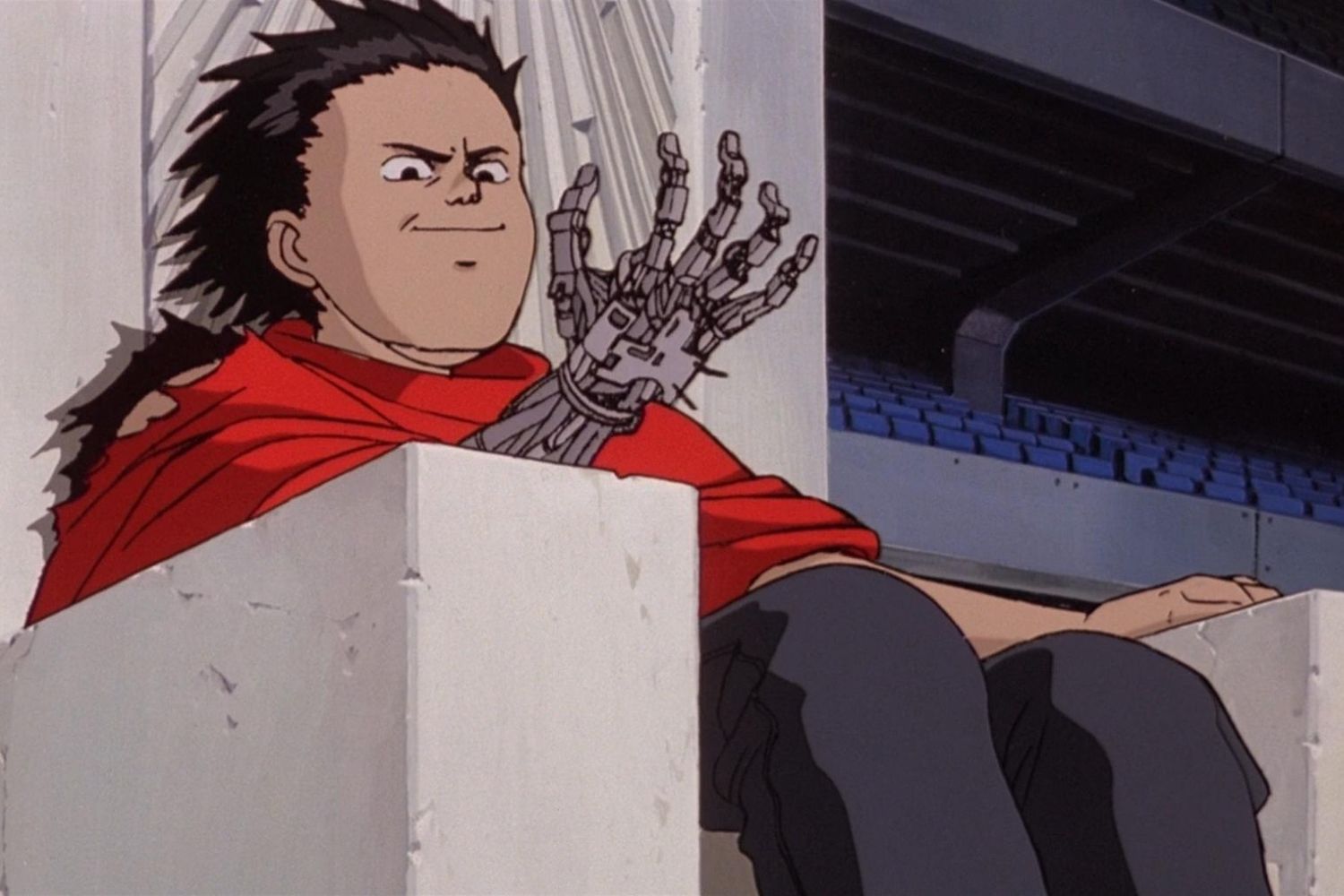
An arm still offers an intelligible shape. It occupies a familiar place on a human figure, and its altered material can be understood in relation to the body beside it. The later mutation destroys that easy reading. Flesh expands until the individual figure becomes difficult to recover from the mass, taking up the surrounding stadium as if the environment itself has become available building material. Greater power brings less control over the basic task of remaining a person-shaped thing.
What impresses me here is the changing demand placed on the eye. The replacement arm invites us to inspect a local difference; the mutation makes the whole figure unstable. Looking for the boundary between natural and artificial materials starts to feel inadequate when the boundary of the body itself won’t hold. The spectacle keeps expanding beyond the scale at which an individual modification would be legible.
That makes AKIRA an especially rich recommendation for anyone interested in silhouettes and their destruction. A familiar human contour gives the spreading mass something to violate, while the stadium offers an equally recognizable scale for its growth. The horror depends on that remaining human reference: however enormous this becomes, it is still happening to Tetsuo. Otomo’s film finds something genuinely distressing in the distance between possessing an extraordinary ability and being able to endure it. The mechanical arm can look like a new possession; the mutation makes possession of his own body increasingly doubtful.
Neon Genesis Evangelion (1995 TV): Biological Giants in Armor
Violence, disturbing bodily imagery, and psychological distress. This discusses the Evas’ broad biological nature without detailing their origins.
After AKIRA’s destruction of the human outline, Eva-01’s apparently orderly design offers its own sort of trap. Purple armor, sharp green accents, and that long horn give it an immediately coherent identity. You could pick it out from a great distance. The colors make its various surfaces exceptionally easy to read, which only makes the relationship between those surfaces and the organism underneath more unsettling.
The Evas are giant biological beings with mechanical components and restrictive armor, connected to pilots through neural synchronization. Shinji isn’t simply putting on a larger suit, and the figure before us isn’t an empty metal vehicle. There is another body involved in the arrangement, one whose containment matters as much as its deployment.
I particularly like how much work the surrounding equipment does. The power cable provides a visible connection to the infrastructure controlling this enormous figure. The cages give its humanoid outline an uncomfortable context; an upright body can look ready for action, but an upright body held in place can also look captive. Nothing about that effect requires a detailed account of where its tissue came from. The equipment is already telling us how the people responsible wish to handle it.
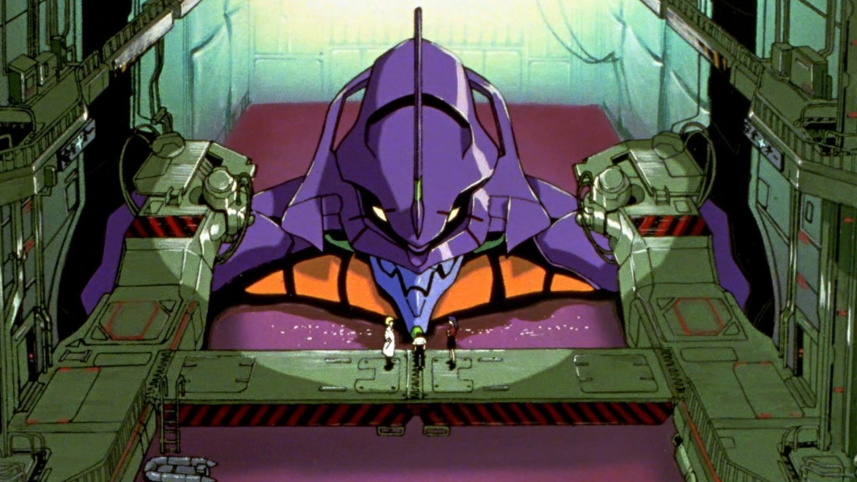
The mouth sharpens this tension. Once we understand that the covering is restraining a living creature, its controlled exterior becomes difficult to see as merely protective. Designer Ikuto Yamashita’s account of a giant barely held under human control feels entirely appropriate to the resulting image. Every apparent mark of technical mastery invites us to wonder how well that mastery is actually working.
For body-design purposes, the fascinating relationship is therefore spread across several scales: a child, an enormous organism, and the machinery that tries to make their connection usable. The human figure has been multiplied without becoming reassuringly familiar. Eva offers a particularly strong alternative to stories where bodily change is confined to one person’s skin. Here, even standing beside the body and connecting a cable to it can become part of its disturbing visual logic.
Ghost in the Shell (1995 Film): A Manufactured Human Body
Graphic violence, nudity, and damage to artificial bodies.
Motoko Kusanagi’s artificial body gives us a very different surface to study. Her human brain persists within a manufactured shell, yet her skinlike exterior supplies an ordinary human contour. Black hair, a bare shoulder, a hand raised towards equipment at her head: these familiar shapes make the artificial body approachable before any explanation of its construction enters the picture. The design’s composure is part of its appeal.
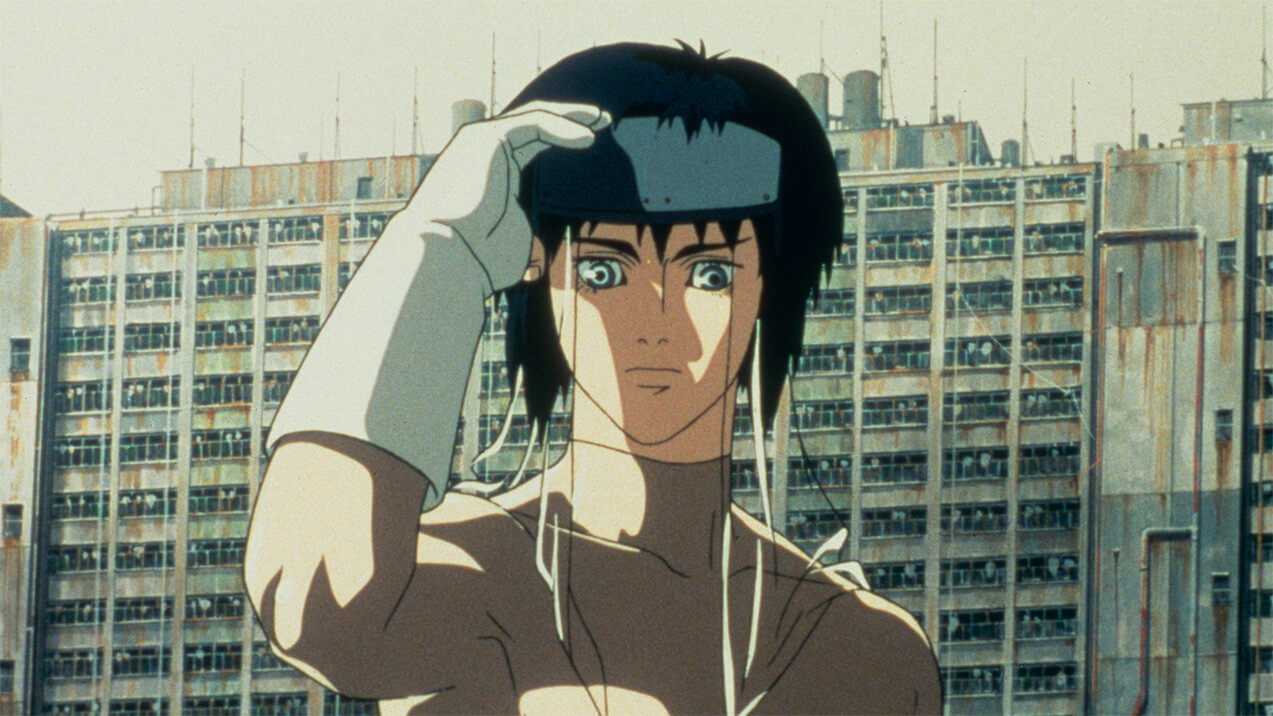
In Mamoru Oshii’s film, that composure becomes stranger through repetition. The wordless journey through the city places human figures, manufactured likenesses, and a shop-window mannequin within the same field of attention. A face that might ordinarily anchor our recognition of one person becomes a form that can recur elsewhere. The disturbance comes from seeing something apparently intimate become reproducible.
This is a lovely shift in the work the setting performs. AKIRA gives a swelling body a stadium to overwhelm; Ghost in the Shell gives a composed body a city full of surfaces that make its apparent individuality uncertain. Worn buildings and commercial displays gather around a figure whose smooth exterior could suggest either a person or a product. The body doesn’t need to sprout something extra for the image to become disquieting. Another version of a familiar shape can do it.
Calling this biological engineering simply because the shell resembles flesh would miss that distinction. Motoko’s body is artificial; the natural-looking surface is precisely what allows the film to put pressure on our habit of recognizing a person by appearance. Its appeal extends beyond the revelation of machinery under skin. Even when the surface remains intact, the surrounding images can change how we read it.
For anyone who wants this subject approached through quieter visual relationships, Ghost in the Shell would be my starting point. That recommendation comes with the violence warning intact. The gentler pace of looking at a city does not make its bodies invulnerable; it gives their apparently settled forms more time to become unfamiliar.
BLAME! (2017 Film): Modified Bodies in an Automated City
Violence, bodily injury, and threatening mechanical creatures.
Hiroyuki Seshita’s film places its modified bodies inside a manufactured environment that has long since exceeded a human scale. The City keeps expanding, its automated systems treating surviving humans as illegal occupants. Killy passes through it with a near-human appearance and a body capable of surviving injuries that would kill an ordinary person. Cibo, a cyborg scientist, adds another bodily arrangement to a setting where a recognizable face offers very little certainty.
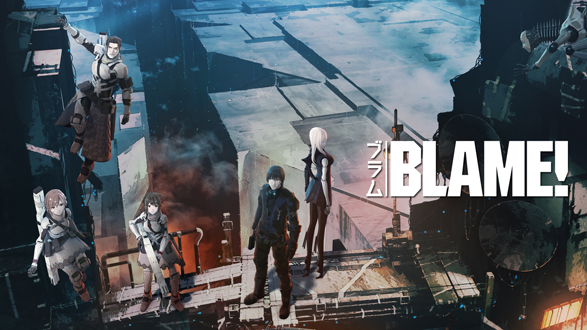
The contrast becomes particularly effective beside the Electro-Fishers’ worn equipment and the vast Builders. Protective gear looks like the result of trying to survive a place, whereas the City’s machinery seems to belong to an order that no longer has any need to accommodate people. Those towering structures and mechanical creatures keep pushing the figures towards insignificance. A modified body might endure more damage, but endurance doesn’t make the world fit it any better.
Polygon Pictures’ 3DCG gives this relationship a useful chill. The imposing architecture and unnatural movement of its mechanical inhabitants offer pleasures distinct from the tactile confusion of Genocyber. Here, the body can remain comparatively readable while the space around it makes that readability seem irrelevant. The image has room for a human figure; the system has no obligation to recognize one.
That distinction becomes unusually concrete through the Net Terminal Gene, which permits access to the City’s systems. Biological inheritance matters to an automated classification process, while someone who looks human can still be marked for extermination. There’s no need to turn Killy into a cutaway anatomy lesson to appreciate this particular unease. His altered resilience and the City’s decisions already make the familiar outline feel precarious. BLAME! is the choice for anyone who wants bodily ambiguity to spread outward into architecture, machinery, and the rules governing whether a person is allowed to remain there.
Which Anime Should You Start With?
If gore is the attraction, Genocyber and AKIRA offer the most confrontational starting points here, though their violence has very different visual rhythms. If you’re after something less relentlessly focused on flesh coming apart, I’d begin with Ghost in the Shell’s manufactured appearances or BLAME!’s bodies against impossible spaces. Neither is a bloodless recommendation. Evangelion, meanwhile, rewards attention to all the apparatus holding its giant figures in place, before any grand revelation supplies an explanation. Pick the image that bothers or fascinates you most, then give it time to work: a cable leading away from a captive giant, a familiar face recurring across a city, a person standing where no person is supposed to be.