
Should Your Earphone Look Like an Earring?
A close look at future body fashion, open-ear audio, and OF HUNGER's Electronic Gems as ear-worn technology becomes part of personal style.
TL;DR
- Future body fashion treats visible audio technology as part of an outfit rather than a device that should disappear.
- Earlier AirPod jewelry decorated an existing product, while Electronic Gems develops its clip, surface, sound, and wearability as one object.
- Open-ear design keeps the wearer connected to the surrounding world, but it also makes fit, sound leakage, and public attention part of the decision.
- The real test is whether a visible earphone earns a place in the wearer’s silhouette and daily life.
Why Are Earphones Starting to Look Like Jewelry?
The recent story of earbuds becoming fashion objects is not really about technology suddenly discovering taste. It is about the ear becoming too visible to keep treating as a neutral place to hide a speaker. Open-ear clips, jewelry collaborations, and ear adornment now occupy the same small area of the body, where a device has to negotiate with the face, the hair, and whoever is standing close enough to notice it.
The earlier AirPod jewelry experiments made the distinction especially clear. Chains, hoops, rings, and holders were fitted around an existing device. The AirPod remained mostly itself. The jewelry was added around it, like a very expensive escort.
One particularly clear version used a hoop or a diamond-stud-like ring on the visible end of an AirPod, replacing a conventional earring with an earring that happened to contain a wireless earbud. The device did not have to rethink its shape, its acoustic logic, or its relationship with the ear. It simply got dressed.
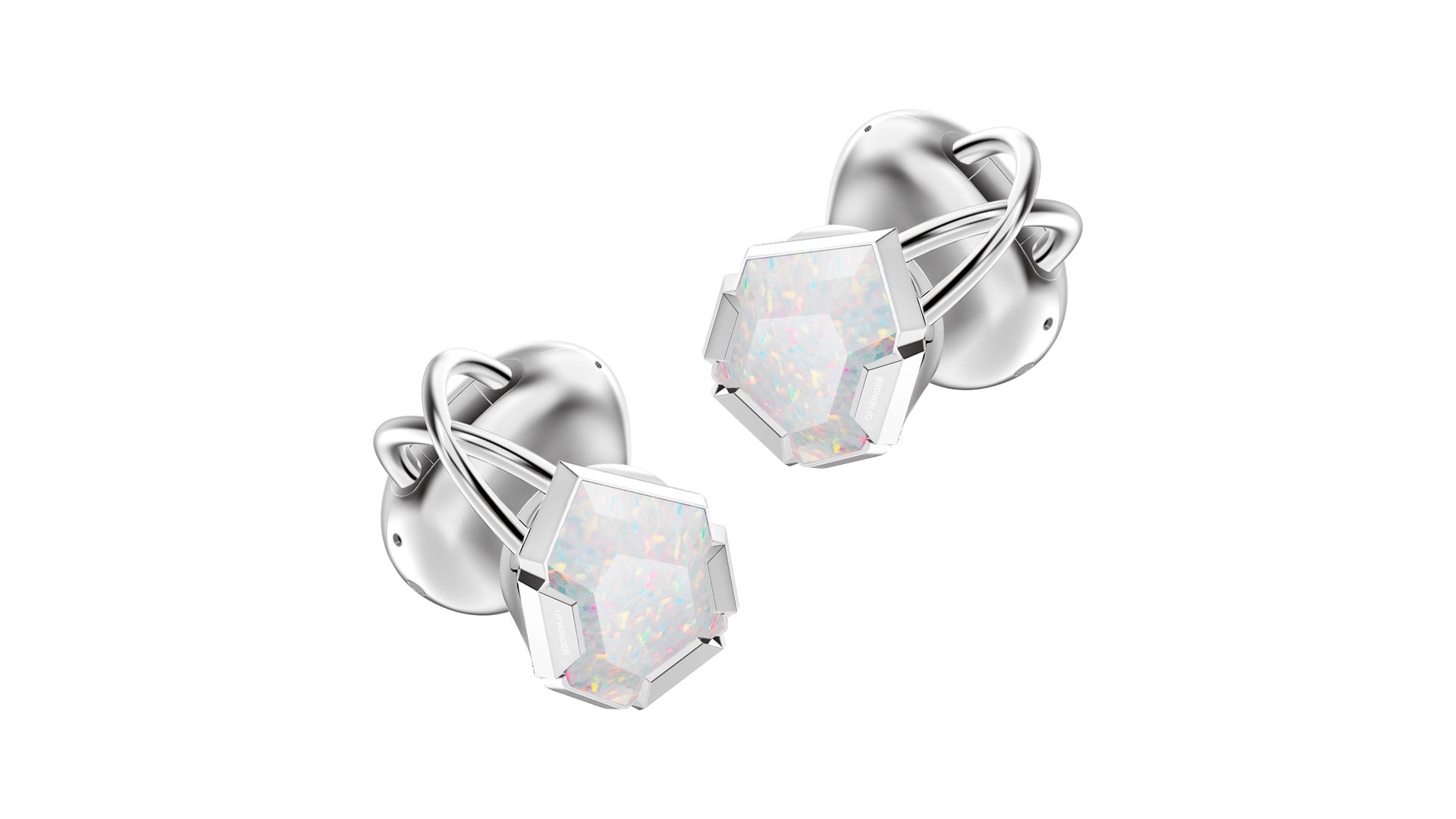
OF HUNGER’s Electronic Gems begin from a different proposition. Their clip-on form, faceted surfaces, gemstone names, open-ear acoustics, and jewelry-like materials are developed as one object. The question is no longer, “What can I hang on my earphone?” It is, “What happens if the earphone was designed from the beginning as something that has to live in the same visual and social world as an earring?”
That is where the body starts becoming an interface, which is a phrase that sounds like it ought to be printed on a very expensive black t-shirt but is, in this case, actually describing something.
How Does the Ear Become a Visible Design Surface?
The ear is already a busy little country. It has piercings, cuffs, hearing aids, hair, glasses, headphones, collars, and the unavoidable expressive work of turning toward someone in a conversation. Jewelry has understood for a long time that the ear is not simply a hole for receiving sound. It is a visible edge of the body, a place where a small object can alter the proportions of the whole face.
Technology has mostly treated it as a hiding place.
The first generation of truly ubiquitous wireless earbuds wanted to vanish. They went into the ear, became two white or black commas, and made listening look like a private administrative task. This was convenient. It was also aesthetically timid. You put them on to hear something and, ideally, nobody had to think about them again.
Electronic Gems have no interest in this arrangement. They clip onto the outside of the ear. The Electronic Gems product page lists rhodium-plated jewelry copper, zirconia, ABS composite materials, a 13 mm dual-magnet dynamic driver, SBC audio, and an OWS open-ear air-conduction architecture. Those are good facts to have. They are simply not the reason the object is culturally strange.
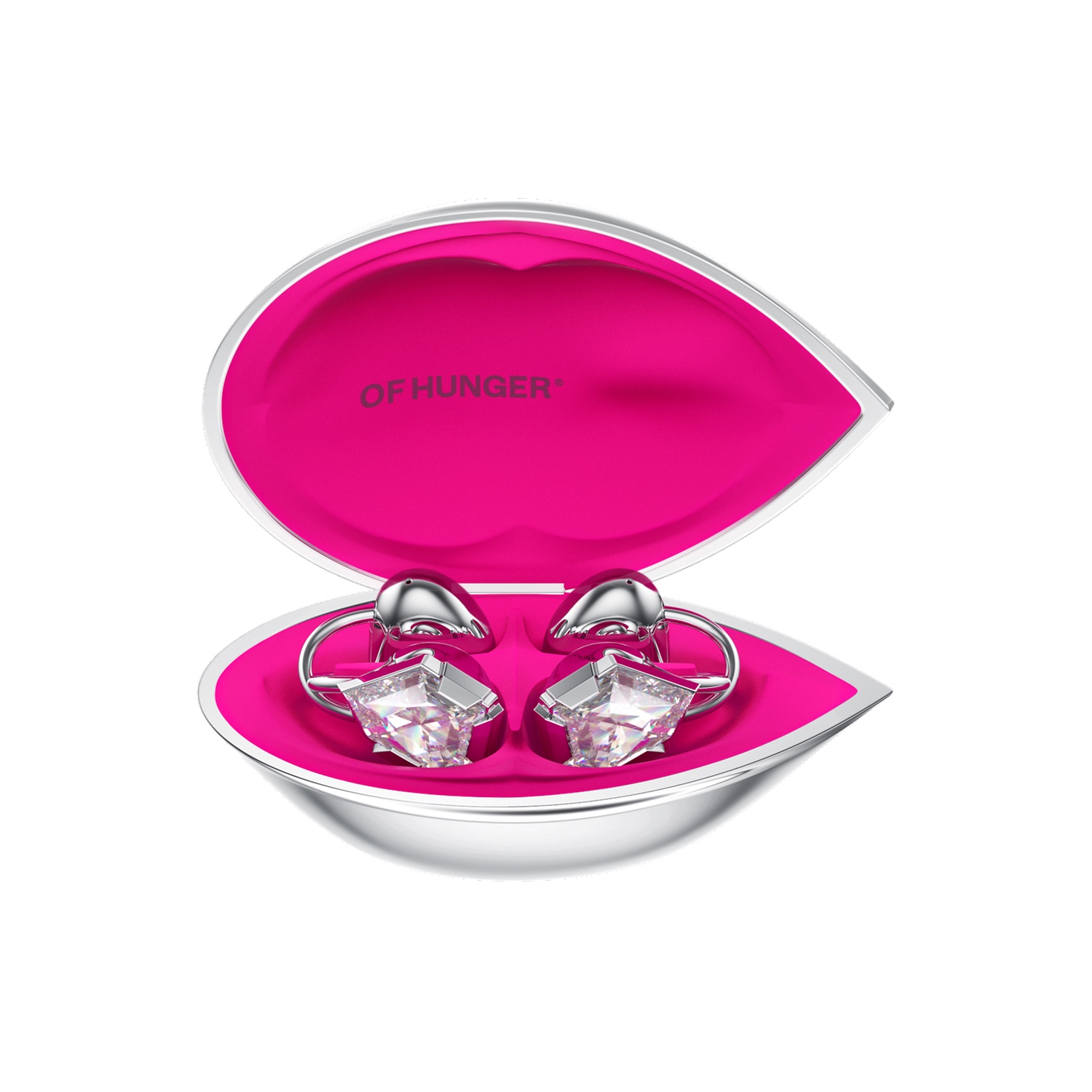
The strange part is the pairing. A stone-like surface is doing the work of a sound object. A clip mechanism has to be considered alongside the curve of the ear. The product is audio hardware, but it is also trying to become a personal artifact, which means it has to negotiate with the face, the hairstyle, the coat collar, and the person standing three feet away wondering whether they are looking at an earring or a tiny determined mineral.
This is not the same thing as putting a charm on an AirPod. The decoration is no longer an accessory to the device. The device has entered the accessory problem.
What Makes Future Body Fashion More Than Decoration?
People reach for phrases like future body fashion and future body accessories when they want to describe technology that changes how the body is seen. A less settled branch calls these objects body tech accessories or asks what electronic body aesthetics might look like once the hardware is designed to be noticed.
The more material phrases, including body technology fashion and body metal accessories, insist that the object has to deal with weight, surface, contour, and contact. The phrase body aesthetics technology sounds more clinical, but it points to the same problem: the body is not a passive display stand. It changes the meaning of whatever is placed against it.
Even ear worn objects is a useful phrase because it refuses to decide too quickly whether the thing belongs to electronics, jewelry, fashion, sound, or some fifth category that will eventually have a showroom with very dim lighting. The pileup of language points to a genuine difficulty. We are still deciding what kind of object this is.
The most convincing answer is not to decide too quickly.
Can the Ear Become a Communication Channel?
An ear-worn research prototype called ActivEarring asked an unexpected version of this question. It treated the ear not only as an auditory organ but as a place for tactile information. The outer ear is sensitive, the two ears are symmetrical, and the ear has a long history of being decorated. The researchers were asking what kinds of information the ear could receive through touch, and how a device like that might be incorporated into ordinary jewelry design.
This is a much stranger future than a diamond AirPod hoop. It suggests that the body is not merely a place where a device can be displayed. The body can change what the device is capable of doing. The ear is no longer just where you put the speaker. It becomes a communication channel with its own tactile geography, its own history of ornament, and its own peculiar social visibility.
OF HUNGER describes this territory through its Future Body and Electronic Body language and the idea of Body Electronification. The brand says technology changes the body culturally before it changes biology, altering listening, communication, movement, memory, and self-presentation. This is a lot of language for a thing that clips onto your ear, but it is better than the more familiar promise that we are all about to receive a software upgrade.
The Tuesday version of body electronification is simpler. You put an object on your ear. You walk into a room. Somebody decides whether it is jewelry, an earphone, a hearing device, a prop, or an especially ambitious piece of industrial design. You have not become a cyborg. But the body has acquired a new social punctuation mark.
This is what an interface actually is: not only a screen with buttons, but a place where two systems meet and have to agree on what happens next. In the case of a visible wearable, the systems are sound, material, clothing, attention, etiquette, and anatomy. The product does not simply deliver audio to a user. It asks the user to make room for it in a face, a hairstyle, a meeting, a walk down the street, and a conversation where pretending not to listen is no longer quite possible.
How Does Open-Ear Design Change Wearability?
The open-ear choice makes that request more obvious. Electronic Gems do not seal the ear canal. OF HUNGER describes the design as a way to remain connected to the outside world rather than retreat from it. The company also states the trade-offs: bass is lighter than with an in-ear design, sound leakage and fit vary, the product is not noise cancellation, and heavy exercise is not the intended use case.

This is where the future body has to stop floating above the human body and fit an actual ear.
Very small ears and unusually flat ear ridges may not get the same secure fit. This is not a minor note at the bottom of a product page. It is the entire drama. The body is not a blank mounting surface. It is irregular, sweaty, asymmetrical, and occasionally opposed to the ambitions of product designers. It has a bad day. It moves when you chew. It has a coat collar to contend with.
The open ear is doing two jobs at once. It lets the wearer hear the world, and it lets the world see the technology. A hidden earbud can pretend that listening is a private act. A visible clip turns listening into part of the person’s public silhouette. It announces that sound is happening and that the wearer has accepted some extra visibility in exchange for a different relationship with the device.
Can Jewelry and Audio Hardware Work as One Object?
This is also why the old ornament-versus-utility fight starts acting confused around the ear. The object is ornamental because it wants to alter the silhouette. It is utilitarian because it carries sound. But these categories have always been less separate in clothing and jewelry than designers like to pretend. A jacket pocket is useful, but its size and placement also shape the jacket’s personality. A ring may be a sign of marriage, a family object, a piece of metal, or just a very good way to make a hand look more like itself.
The use does not cancel the pleasure. The pleasure does not cancel the use. That is the arrangement.
Electronic Gems are most interesting when they do not ask us to pretend that the split between device and adornment has disappeared. The product is still an earphone. It has an app, a driver, a codec, a charging case, and the ordinary unromantic requirements of a piece of consumer electronics. It also has Opal, Tiger’s Eye, White Zircon, and Champagne Zircon, which sounds less like a list of audio variants than a small mineral cabinet assembled by somebody who wants to listen to music in a space opera.
There is a risk here, obviously. Any product can call itself an artifact. Any brand can say that technology is personal, expressive, and deliberate. “Join the future body” is a good line, but a line is not a body. The object has to make contact. It has to create a silhouette that feels worth keeping. It has to survive the unglamorous parts of being worn, when the person wearing it is not standing in a luminous installation but is crossing the street, taking a call, adjusting a collar, or trying to remember where they left the charging case.
Why Are Visible Earphones Becoming Part of the Outfit?
The earlier AirPod jewelry offered a useful standard. It was funny because it understood the social life of the earbud. It allowed the AirPod to behave like an earring without pretending it had stopped being an AirPod. Those objects did not solve the category. They made the category visible.
Electronic Gems tries to make the category structural. The jewelry-like surface, the clip, the open-ear sound, the fit, and the app-based intelligence are not separate layers applied in sequence. They are all competing to decide what kind of thing can sit against the body.
That competition is the actual design.
The electronic body is not a body with more gadgets attached to it. It is a body whose gadgets have started to participate in its visual and social grammar. Sometimes they will do that beautifully. Sometimes they will look too loud, fit badly, or become more interested in their own mythology than in the person wearing them. This is normal. The history of personal objects is mostly the history of things trying and failing to become part of a life.
But the attempt matters. Once a piece of audio hardware is designed to be seen, it has to answer questions a hidden earbud could avoid. What does it do to the face? What kind of attention does it request? Does it make listening feel more public or simply more decorated? Does the wearer become more legible, or does the wearer become a mannequin for the object’s future tense?
The future body may not arrive as an implant, a neural interface, or a glowing silver bodysuit. It may arrive as an earphone that refuses to hide, an earring that knows what it is carrying, or a piece of jewelry whose most important stone is actually a communication channel.
The first step is not becoming electronic.
It is letting the object be seen.
Frequently Asked Questions
What is future body fashion?
Future body fashion describes wearable technology that becomes part of how the body is seen, moved, and understood. It treats the device as part of personal style and social presence rather than as hardware that should disappear.
How are Electronic Gems different from AirPod jewelry?
AirPod jewelry adds chains, hoops, rings, or holders to an existing earbud. Electronic Gems develops the clip, jewelry-like surface, open-ear sound, and wearability as parts of one body-worn object.
Are Electronic Gems open-ear earphones?
Yes. They do not seal the ear canal, which allows the wearer to remain connected to the surrounding world. The trade-offs include lighter bass than an in-ear design, variable sound leakage and fit, and no noise cancellation.
Are visible earphones suitable for everyone?
Fit depends on the wearer’s ear structure, and the product is intended for everyday wear and light movement rather than heavy exercise. Very small ears or unusually flat ear ridges may not receive the same secure fit.