
How Archaic Futurism Connects Jewelry, Deep Time and Technology
Explore how talismans, fossil beads and electronic jewelry connect ancient-looking surfaces with future technology, and why appearance alone is not enough.
TL;DR
- An ancient-looking surface can be deliberately manufactured; it does not establish an object’s age or personal significance.
- Archaic futurism brings mineral textures, planetary forms and talismanic objects into contact with working electronics.
- Real fossils and objects styled as future relics offer different ways to represent time, even though both involve design decisions.
- An electronic object intended to be kept must be considered as a working instrument, not only as an attractive relic.
There is a point in making a piece of Alighieri jewelry when the wax has to disappear. The form has been carved, surrounded by investment material, and put in an oven. Heat removes the wax. Metal takes its place. The irregularities that might eventually make someone think of an excavated object have survived an extremely deliberate manufacturing process.
I like that complication. An object can look as though something has happened to it when what actually happened was that somebody designed it. Looking old is a decision, and it can be a very good one. But once we start calling objects ancient, futuristic, talismanic, or some combination of the three, it is worth asking where those impressions come from. A surface? A material? Something the object does?
What Makes Jewelry Feel Like a Talisman?
Consider the talisman first, including Alighieri’s modern heirlooms. Alighieri’s Il Leone Medallion is made in gold-plated bronze from a hand-carved wax form. The brand connects its lion to Dante and courage. Its textured finish can suggest a recovered object, but the more interesting possibility is what happens after someone begins keeping it. A pendant given at a difficult moment might acquire an importance that has very little to do with the age of the metal.
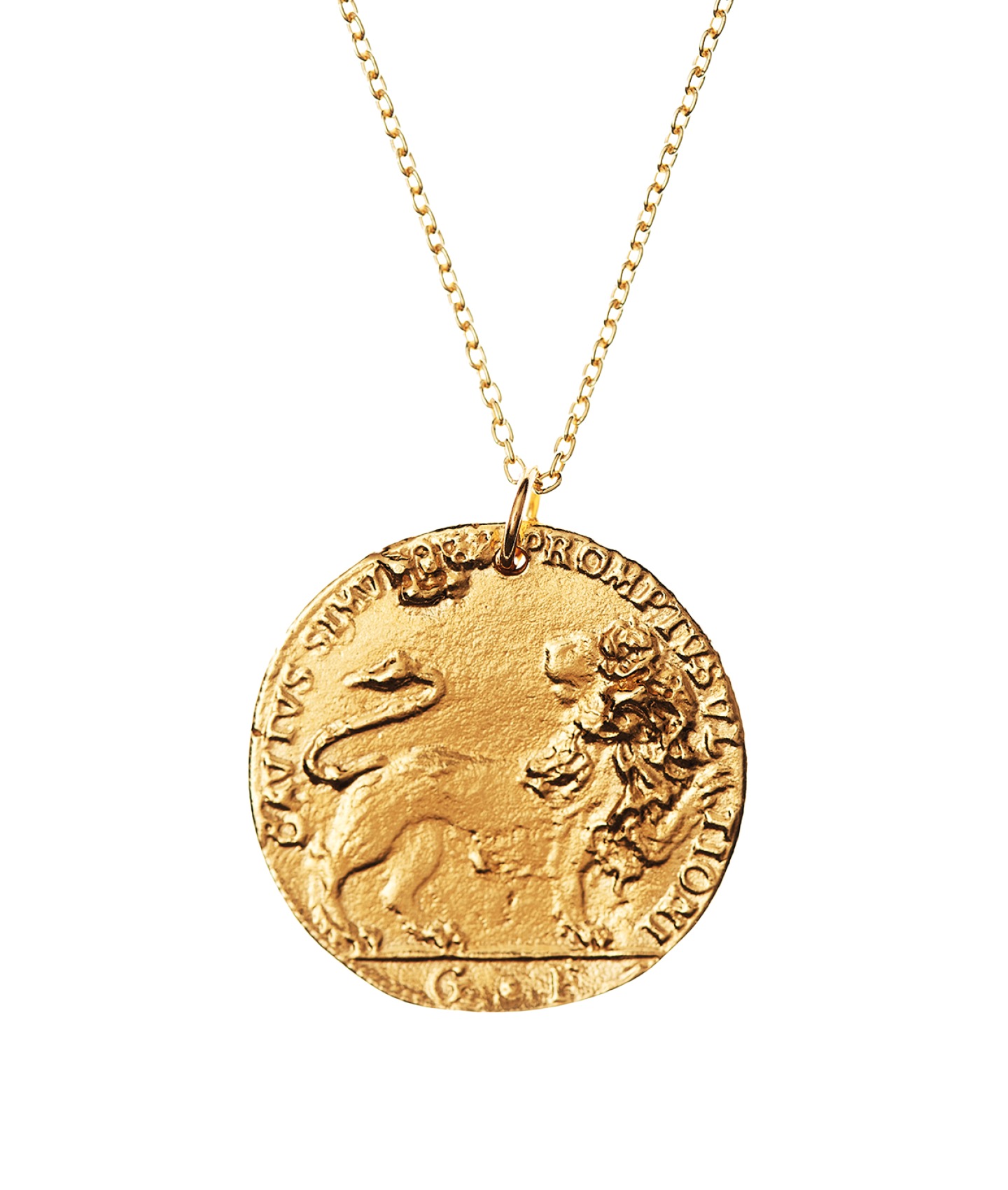
That is what I find useful about talisman jewelry as a comparison, and why Nathalie Schreckenberg’s modern talisman forms keep returning to the same question. The attachment does not have to be manufactured along with the surface. Someone can supply that part themselves. And no amount of convincing distressing guarantees it. You could make an immaculate little pendant that someone keeps for the rest of their life, or a spectacularly ancient-looking one that they stop caring about next month.
How Does Archaic Futurism Bring Jewelry and Electronics Together?
Now add electronics.
OF HUNGER uses the term archaic futurism for a design language that brings mineral textures, planetary forms, and talismanic objects into contact with electronic precision. The interesting word there is precision. An irregular surface suggests one kind of making; a working instrument demands another. Put them close enough together and you get a more demanding design problem than simply deciding what color the future should be.
OF HUNGER’s Electronic Gems puts that encounter on the ear. These are clip-on, open-ear audio devices with gem-like surfaces. The published material list includes rhodium-plated copper, zirconia, and ABS. A cross-arm spring mechanism holds the object in place. There is jewelry language here, but there is also a mechanical problem being addressed: how to attach an audio device to a body.
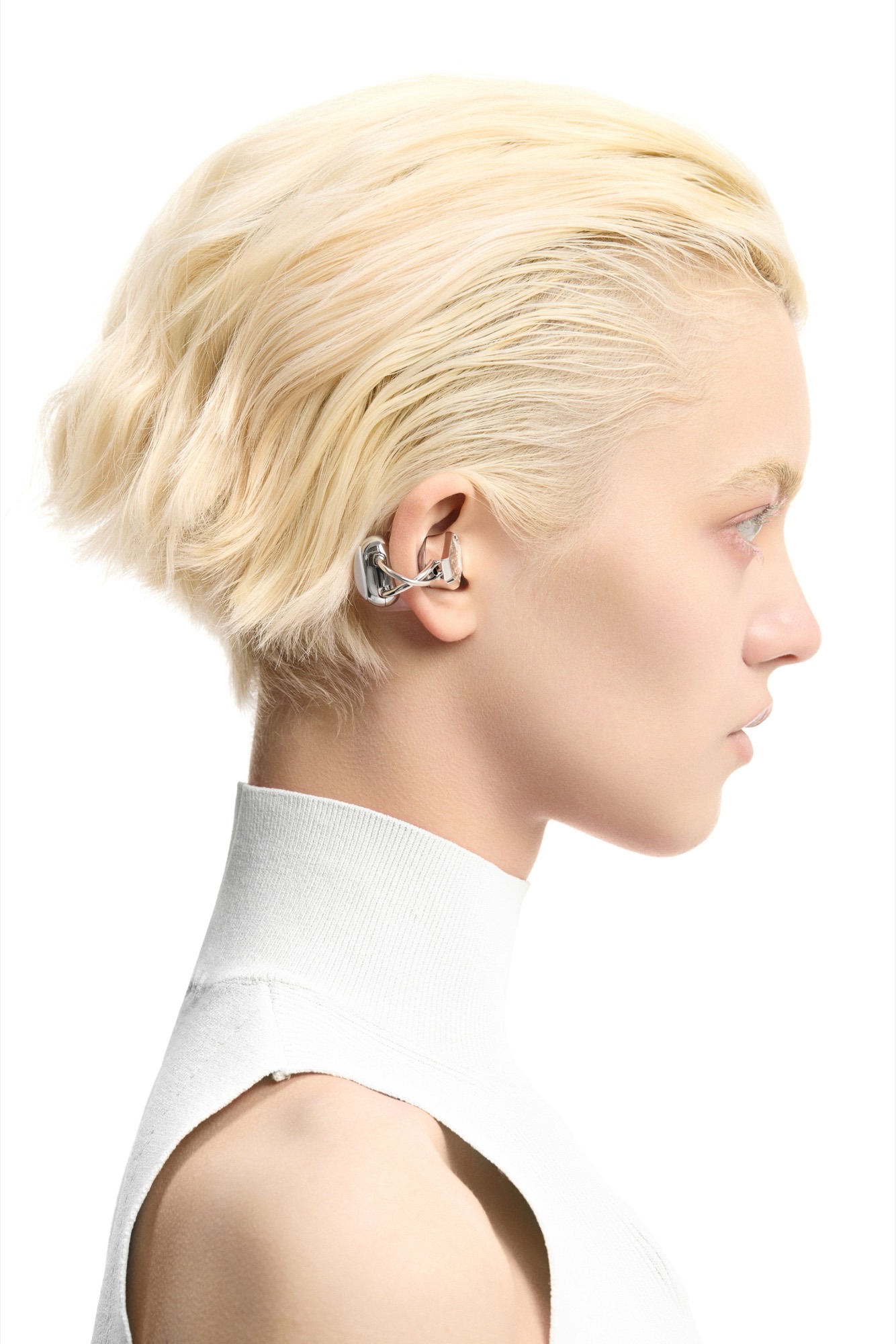
The contrast matters because futuristic jewelry can get by on a suggestion. A shape can imply a technology that does not exist. An earphone has an additional obligation. It has to work. I am more interested in that obligation than in treating every reflective surface as proof that we have arrived in the future. A detail that has to accommodate a working component can produce a much more particular object than a generalized science-fiction silhouette.
And the fiction has somewhere else to go. OF HUNGER describes a world in which minerals are recoded into electronic life forms, while explicitly treating that transformation as fiction. Its planetary references also change the imagined scale of these small objects. Read an orb as a bead and it belongs to a necklace; read the same form as a planet and suddenly a body becomes the support for an entire world. The shape need not become larger for that shift to happen.
How Is Mineral-Inspired Jewelry Different from an Actual Fossil?
This is where I would be careful about treating mineral inspired jewelry as a single material category. A mineral association might reside in a cut, a texture, a name, or an invented story. Those decisions can be compelling without implying that the object carries the history of an actual geological specimen. There is a difference between depicting deep time and putting some of its material in front of us.
Katie Paterson’s Fossil Necklace, from 2013, makes that difference unusually tangible. It comprises 170 fossils carved into spherical beads, with each bead representing an event in the development of life across geological time. Here, the necklace format gives a succession of very different histories a common scale. As deep time art, it does something a fake ruin cannot: the fossils themselves belong to the history being invoked.
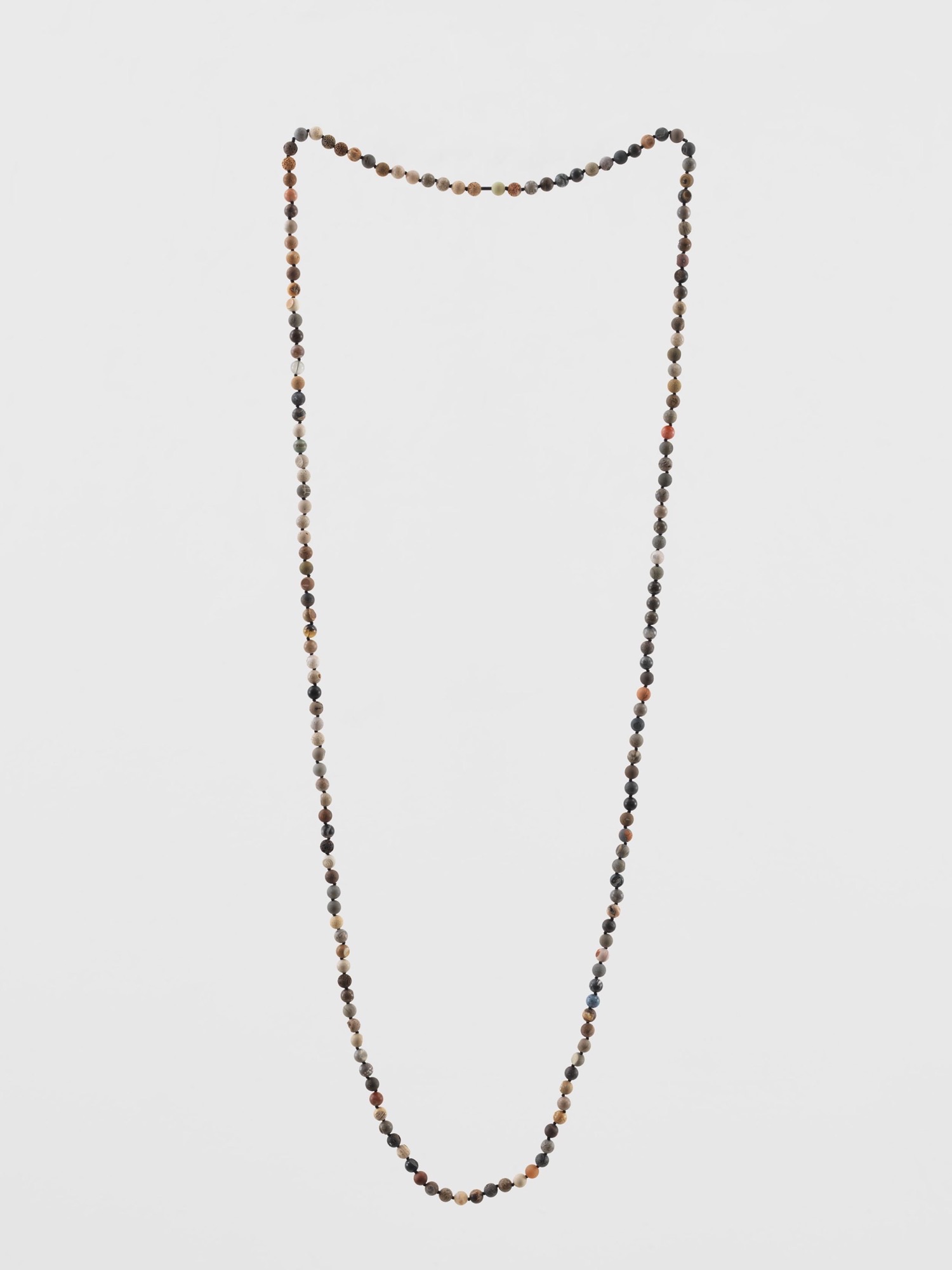
But even here, the object has been made. Those spheres did not arrive already arranged as a necklace. I think that is the most useful part of the comparison. Actual ancient material still undergoes a designer’s ordering. The fact that something is geological does not mean its final appearance is inevitable, any more than a manufactured surface means its emotional effect is false. We are looking at different kinds of decisions, not sorting the objects into an authentic pile and a dishonest pile.
How Can a New Object Look Like a Future Artifact?
Then there is the stranger proposition: make something new look as though its future has already happened.
Tiffany and Daniel Arsham’s Bronze Eroded Penny Vessel does this through a container. The patinated bronze sculpture, set with polished crystals, opens to reveal a HardWear necklace in white gold with diamonds and tsavorites. The distinction between the outside and what it holds is important. The necklace has not been excavated. The vessel supplies the imagined history around it.
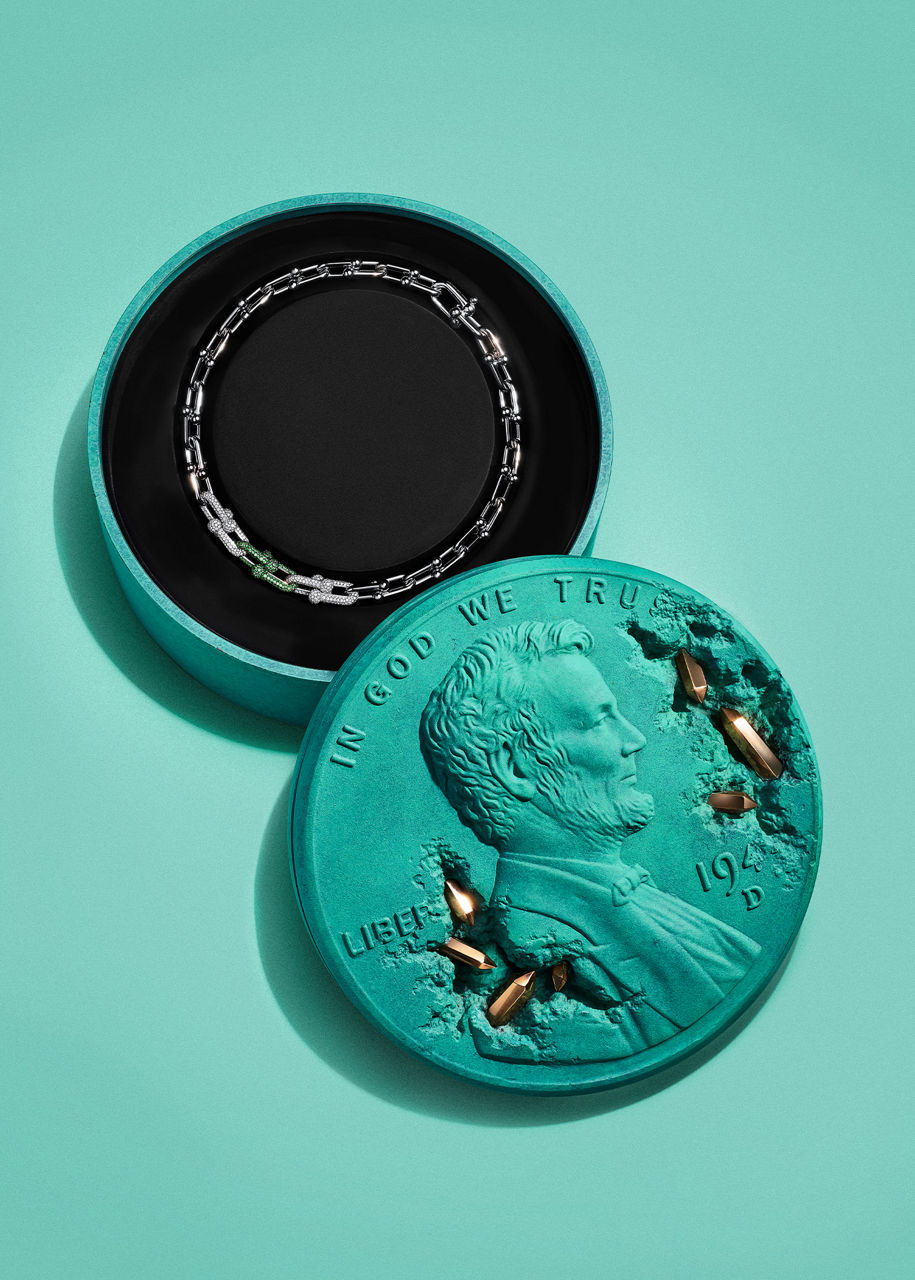
I find that arrangement more interesting than simply weathering the jewelry. Opening the sculpture makes you perform a little discovery. You encounter a present-day luxury object through something styled as a remnant. Future artifacts work on that peculiar reversal: we imagine somebody after us encountering what we have now. The future is no longer only a place where everything looks new. It becomes a vantage point from which our new things look old.
The physical separation also exposes a choice that is easy to miss in a photograph. You can take the necklace out. The sculptural fiction stays behind. With an electronic object that wears its mineral or talismanic associations on its own casing, the function and the imagined history occupy the same thing. Neither arrangement is automatically better. They ask different things of the person using them.
What Does Electronic Jewelry Need Beyond a Relic-Like Appearance?
Go back to the Electronic Gems charging case. It has a flying-saucer form and charges through USB-C. That is a pleasingly specific meeting of an imagined world and an ordinary connection. You can build a miniature spacecraft, but somebody still has to plug it in.
It also changes what I would ask of this whole approach. A surface that looks weathered is one thing; an object that remains worth keeping is another. Bringing the talisman close to the instrument makes their different expectations harder to ignore. We can keep caring about a pendant without asking it to perform a task. With an earphone, retaining its usefulness is part of retaining the object we originally wanted.
For me, that is where archaic futurism becomes more than a treatment applied to a shell. If a designer wants an electronic object to feel like something a person might keep, the ambition should extend beyond making it resemble a relic. What would it take to keep the instrument working for as long as someone wants to keep the object?