
Threeasfour Put the Future in Denim. It Still Looks Like the Future.
Threeasfour's Spring 2027 return pairs reworked denim with sculptural forms to ask how familiar materials can make fashion's future feel wearable.
TL;DR
- Threeasfour’s Spring 2027 return pairs reworked denim with illuminated geometry, bubble helmets, and sculptural forms.
- The collection makes denim carry unfamiliar silhouettes instead of relying on a new-looking material to signal the future.
- Threeasfour’s denim drop turns the runway idea into reversible, limited-edition products with visible construction.
- The central wearable fashion tech question is whether design can make the future desirable to wear.
Why Does Threeasfour Put Futuristic Shapes in Denim?
$544
That’s what Threeasfour lists for the ganeshaPANT.
It is a pair of jeans. It is also fully reversible, cut with a continuous spiral seam that maps a leg-in-motion silhouette, and limited to an edition of 50.
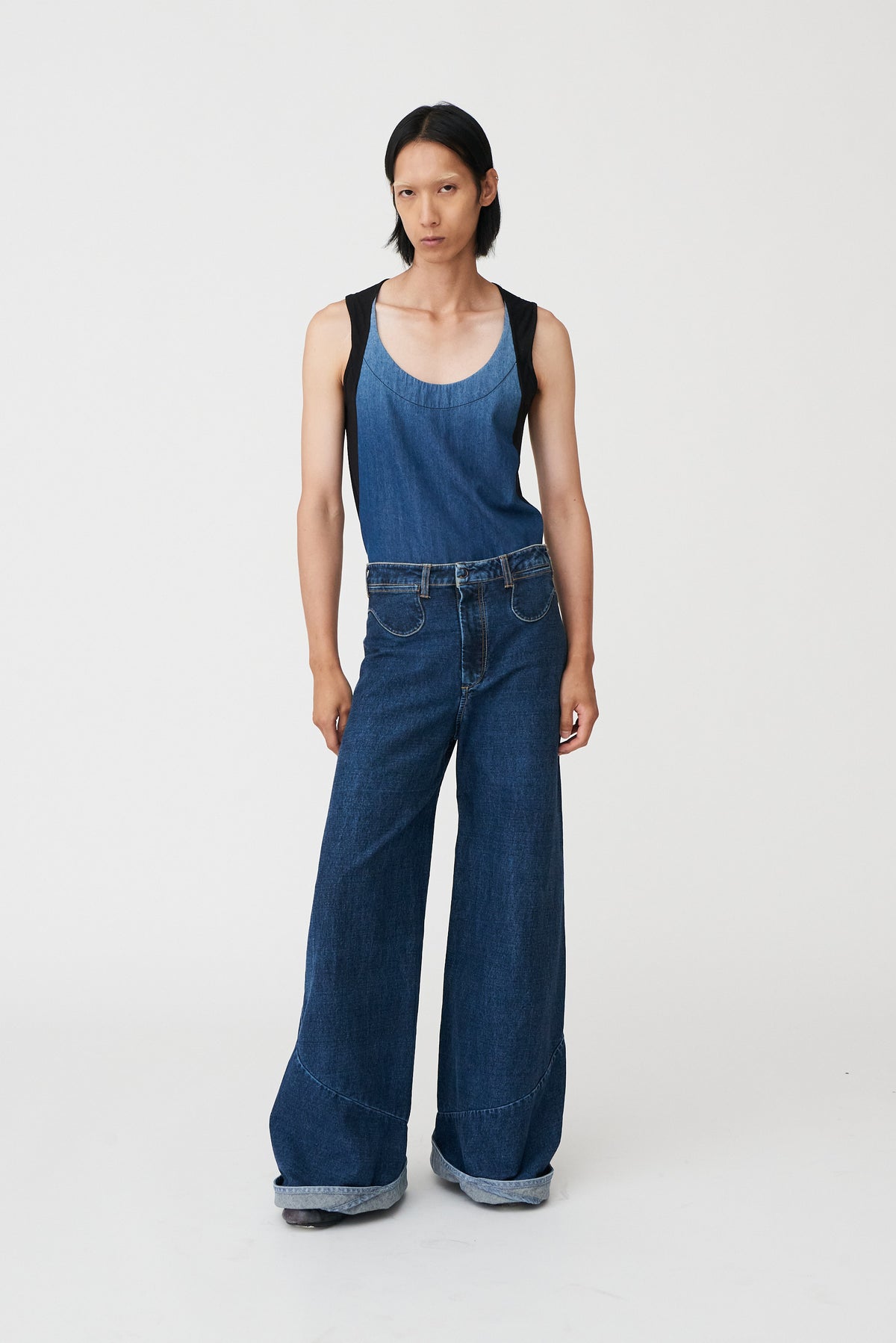
The price is interesting. The jeans are more interesting.
After a five-year absence from the runway, Threeasfour came back for Spring 2027 with a collection that put vintage and reworked denim next to the things fashion usually uses to announce the future: illuminated geometric structures, bubble helmets, a 3D-printed butterfly-wing dress, and a Möbius form that refused to behave like ordinary clothing.
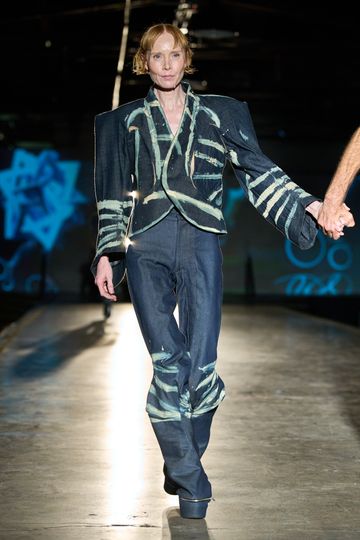
Then the denim walked out.
That is the part I keep coming back to.
The question is not whether old jeans can look new. The question is whether the future still needs to arrive in a material that looks like it has never touched the past.
What Does This Fashion Tech Case Study Cover?
-
Why Threeasfour’s denim is doing more than a sustainability story
-
What bubble helmets, illuminated geometry, and a butterfly-wing dress have to do with a pair of jeans
-
How a runway idea becomes an actual product
-
Why the next wearable future may be built from something people already recognize
Why Does Future Fashion Usually Want a New Surface?
The fashion version of the future is easy to recognize.
It is silver. It is transparent. It is molded, printed, reflective, or made from a material that seems to have arrived from somewhere without a past. That is the same reflex as avant garde fashion reaching for a new silhouette, or Iris van Herpen’s accessories inventing a new body.
Threeasfour’s Spring 2027 return did include those signals. The collection had tetrahedron and icosahedron structures, illuminated geometry, bubble helmets, a 3D-printed butterfly-wing dress, and a Möbius dress. The images are strange in the best way. They make the body look less like a person wearing clothes and more like a new form being tested.
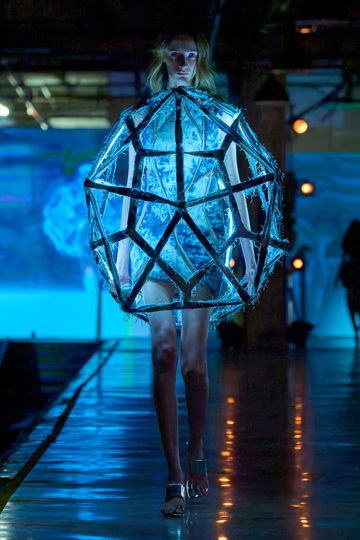
But the show was also built around denim. Archive pieces were reworked in indigo cotton. Vintage Levi’s seams were repurposed. There was hand bleaching, archetypal denim, and spiral-cut reversible jeans.
At first, it looks like a contrast between the old and the futuristic.
I think that is the wrong read.
The denim is carrying the futuristic pressure.
A material with decades of social memory is being asked to hold shapes that look engineered, anatomical, and almost architectural. The surface stays legible while the body underneath starts to feel unfamiliar.
That is more interesting than making another garment from a material nobody recognizes.
Threeasfour’s own design language connects couture craft to cutting-edge technologies, biomimicry, 3D printing, digital fashion, and virtual environments. The point is not that the brand suddenly discovered technology. The point is that its return makes the relationship visible again.
A futuristic silhouette does not need a futuristic surface.
How Does Threeasfour Turn Clothing Into an Interface?
I usually use a simple test for Wearable Fashion Tech™.
You should want to wear it because of how it makes you feel and how it changes your presence, not because someone handed you a list of functions.
The category is often discussed through devices: glasses, rings, watches, pendants, and whatever the next startup wants to put on a chain. The product is expected to explain its value through a chip, a camera, an assistant, or a battery.
Threeasfour is working on the other side of the same problem.
There is no app to download here. The technology is in the construction, the geometry, the printing, the cut, and the way the garment changes the body’s outline.
The bubble helmet matters because it changes the boundary between the person and the room.
The illuminated geometric structures matter because they make the body look like it is carrying a live diagram.
The 3D-printed butterfly-wing dress matters because the garment stops behaving like a flat surface and starts behaving like an object with its own logic.
The Möbius form matters because it makes front, back, inside, and outside feel less stable.
These are not product features. They are design decisions that make the future desirable to inhabit.
That is the test most wearable technology still fails.
A product can be technically impressive and still ask the body to accommodate it. The better product makes the body feel like the reason it exists.
Threeasfour’s runway return is useful because it shows a different route into the future: change the silhouette first, then let the material and construction prove that the change can be worn.
How Does Threeasfour Turn Runway Design Into Denim Products?
A runway can make almost anything look convincing for seven minutes.
The harder test is what happens when the idea has to become something a person can actually buy.
Threeasfour’s first denim drop gives the runway argument a commercial body.
-
charroPANT is listed at $399, in an edition of 100. It is reversible, built from a one-piece leg pattern, and held together by a continuous seam.
-
ganeshaPANT is listed at $544, in an edition of 50. Its reversible elephant-leg shape and spiral seam turn the idea of movement into the construction itself.
-
deltoidJACKET is listed at $522, in an edition of 50. The seams map the ribcage, arm, elbow, cuff, and deltoid anatomy.
This is where the collection stops being only a runway image.
The seam is no longer decoration placed on top of a denim jacket. It is the argument. The garment does not simply cover the body; it maps the body, redirects it, and makes the construction visible.
That matters because a strange silhouette is easy to admire and difficult to distribute.
Threeasfour’s US products are sold through its own website, with international retail partners, and its preorder model gives the pieces a delivery window rather than pretending they are ordinary mass-market basics. The future gets an edition number, a price, and a way to enter someone’s wardrobe.
That is the commercial pressure behind the visual experiment.
A concept that stops at the show is an image.
A concept that becomes a reversible jean with a continuous seam is a product.
Is Reworked Denim a Sustainability Proof?
There is a temptation to turn every use of vintage denim into a morality badge.
I do not think that is what makes this collection work.
Reworked material does not automatically make a product sustainable in every sense. A runway show is not a lifecycle assessment, and circularity should not be used as a shortcut around questions of production, volume, longevity, or access.
The more useful point is strategic.
Threeasfour is using a familiar material to carry an unfamiliar body.
That reverses the usual logic of futurism. Instead of making the surface look new so the wearer can appear to be moving forward, the construction makes the body look new while the surface keeps its memory.
This is why the denim does not read as nostalgia.
Nostalgia asks the past to comfort you.
This denim asks the past to carry something it has never carried before.
That is a much stronger fashion proposition than “old material, new trend.”
What Does Threeasfour’s Collection Say About Wearable Fashion Tech?
The next generation of wearable technology will not be won only by whoever builds the smallest chip or the most capable assistant.
It will be won by whoever understands that the body is a distribution channel for identity.
People do not just wear a device. They wear a signal about who they are willing to become in public.
That is why familiar materials matter.
A new material can show technical progress, but it can also create distance. It asks the consumer to imagine a new world before they have found a place for themselves in it.
Denim already has a place. Everyone knows what it means, even if they style it differently.
Threeasfour’s move is to keep that recognition while breaking the silhouette around it.
The future becomes easier to enter when the material gives you one foot on familiar ground.
This is the same category question I keep seeing across fashion tech: are we asking people to wear technology, or are we designing something they want to wear that happens to carry a new kind of intelligence?
Threeasfour does not answer that with electronics.
It answers it with desire.
Why Can Familiar Materials Make Future Fashion Easier to Wear?
Threeasfour did not make denim futuristic by adding a gadget to it.
It made the body unfamiliar while keeping the material legible.
That is the part worth watching as fashion and technology continue to move toward each other. The future does not have to look sterile, metallic, or untouched. It can be cut from something that already carries memory, then pushed into a shape the body has not learned yet.
The most convincing future is not always the one with the newest surface.
Sometimes it is the one that takes something you already know, makes it strange again, and gives you a reason to put it on.