
Is Iris van Herpen Designing Accessories or Inventing a New Body?
A closer look at how Iris van Herpen uses movement, anatomy, natural forms, 3D printing, and collaboration to rethink what an accessory can do.
TL;DR
- Iris van Herpen’s accessories are best understood as part of her wider investigation into movement, anatomy, materials, and the body’s boundaries.
- Her use of technology matters when it changes how a form is made or experienced, not simply when an object looks futuristic.
- 3D-printed and sculptural work can create new relationships between digital shape and the body while also introducing limits around movement, durability, and preservation.
- Her work shows how an accessory can become a small extension of a design system rather than a decorative finishing touch.
What Makes Iris van Herpen Accessories Different?
When people say Iris van Herpen accessories, what are we actually talking about? Jewelry? Headpieces? Shoes? Some small futuristic thing that sits on the body and makes everyone at the party ask where you got it?
That last one is probably the least interesting answer.
Iris van Herpen is one of those designers where the object in front of you is never just the object in front of you. A dress is a body, an environment, a piece of architecture, a scientific diagram, and sometimes a very expensive argument about what clothing is allowed to do. So when accessories show up in her world, they are not automatically the little decorative extras that come after the real work is finished. They can be the compressed version of the whole system.
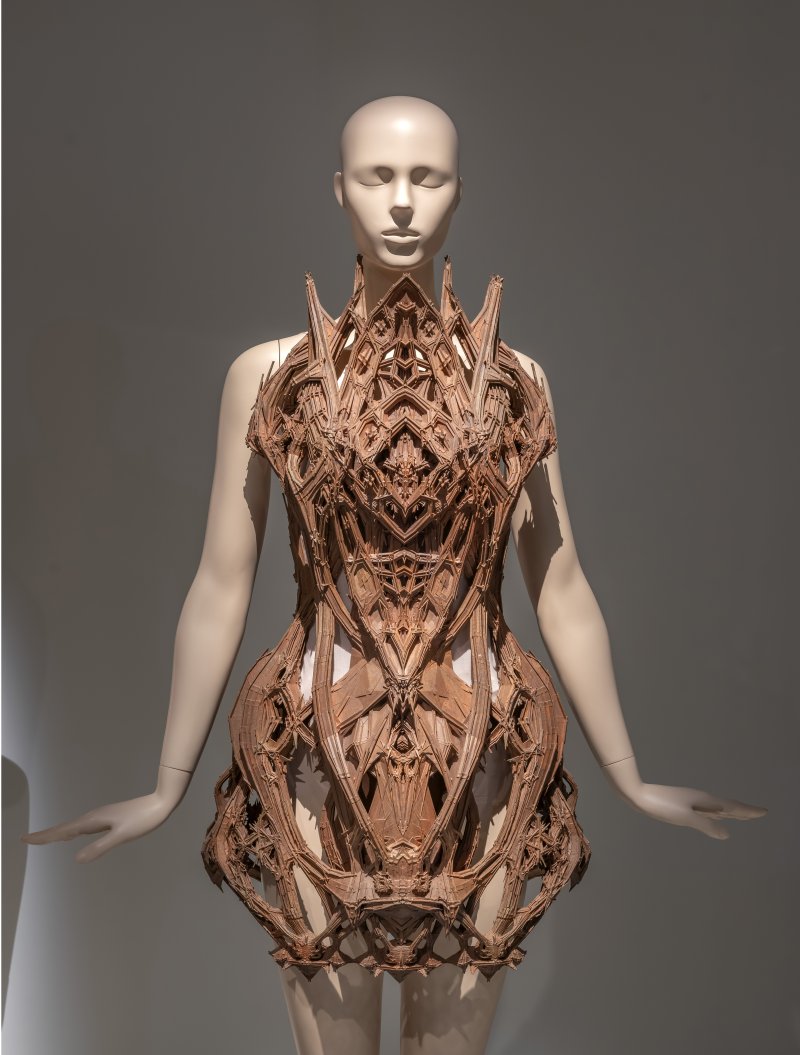
This is why talking about couture tech accessories or wearable sculpture jewelry through van Herpen is so useful, even though those phrases can become unbearable very quickly. A lot of things get called futuristic because they are silver, transparent, vaguely insect-like, or because somebody put a piece of plastic on a model and used the word “biomorphic.” That is not a design philosophy. That is a mood board having a medical emergency.
Van Herpen gives us a better test. What is the thing doing to the body? How does it move? What kind of force does it suggest? Is technology actually changing the shape, the making, or the experience, or is it just being used as a visual sticker? And, crucially, does the object remain connected to a person, or does the person disappear inside the concept?
How Does Iris van Herpen Use Technology in Her Designs?
Van Herpen’s own account of her practice starts with movement. She trained in classical ballet and movement, and the body in her work is not treated as a mannequin that happens to be wearing something. It is a moving structure. The language around her work talks about fluidity, anatomy, and movement extending the body into multidimensional silhouettes, which sounds very grand, but you can see the point immediately when you look at the clothes. The forms do not just sit on top of the body. They seem to continue it, interrupt it, or produce a second body around it.
This is where the accessory question gets interesting. A conventional accessory usually frames the body. It says: here is the outfit, and here is the thing that finishes it. A van Herpen object often asks a more annoying question: where does the body stop?
The earliest technology stories around her work make that question very literal. In 2010, her Crystallization top was described as a 3D-printed garment inspired by shell structures and made from white polyamide. Her Water dress came out of a collaboration with architects. The Voltage show involved Carlos van Camp and a performance in which movement became tangible through three million volts. These are not random technology references pasted onto a runway. They show a designer trying to make forces, structures, and movement visible on a person.
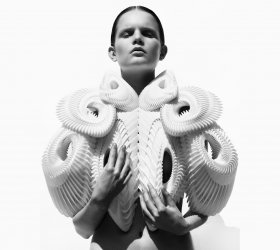
And yes, “make forces visible on a person” is the kind of sentence that can get you banned from a normal dinner. But look at what it means in practice. The body is no longer just carrying an accessory. It becomes the place where an outside force is rendered as shape. The accessory is not necessarily a jewel that points at the body. It can be a little piece of the world pressing back against it.
How Does Nature Shape Her Wearable Designs?
This is also why the idea of organic tech accessories is more complicated in van Herpen’s work than a leaf-shaped earring. Nature is not there only as a source of decoration. Shells, plankton, jellyfish, bones, waves, and other biological structures give her ways of thinking about growth, pressure, repetition, transparency, and connection. The natural form is useful because it already contains a relationship between structure and movement.
The difference matters. A flower printed on a handbag is an image of nature. A form that behaves like a shell, a membrane, or a skeletal structure is using nature as a design problem. Those are not the same thing. One is a picture. The other is asking why a body has the shape it has and what might happen if that shape were built differently.
Her Magnetic Motion collection is a particularly clean example of this. The collection is described through magnetic forces, attraction and repulsion, and the fusion of nature and technology. Again, the phrase can sound like a university lecture delivered by a chandelier, but the idea is extremely visual. Clothes and body are not static. Something is pulling. Something is pushing. Something is suspended, stretched, gathered, or held away from the skin.
That changes how you read a wearable object. You are not only asking whether it is beautiful or whether you would wear it with jeans. You are asking what invisible relationship it has turned into a visible one. Is the object clinging to the body? Is it orbiting the body? Is it protecting the body? Is it making the body look soft, armored, skeletal, aquatic, or temporarily not quite human?
This is where van Herpen’s accessories can feel more important than the category suggests. An accessory does not have to be a supporting actor. In the right hands, it is a diagram of the designer’s entire argument.
What Does the Skeleton Dress Reveal About 3D-Printed Fashion?
But this is also where we need to stop giving technology automatic credit. One of the most useful objects in this conversation is van Herpen’s Skeleton ensemble from the Fall 2011 Capriole collection, now in The Metropolitan Museum of Art. It was made with selective laser sintering, a 3D-printing process, from nylon. The Met describes the garment as a rigid, carapace-like form around the body. It does not flex for the moving body in the way ordinary clothing does.
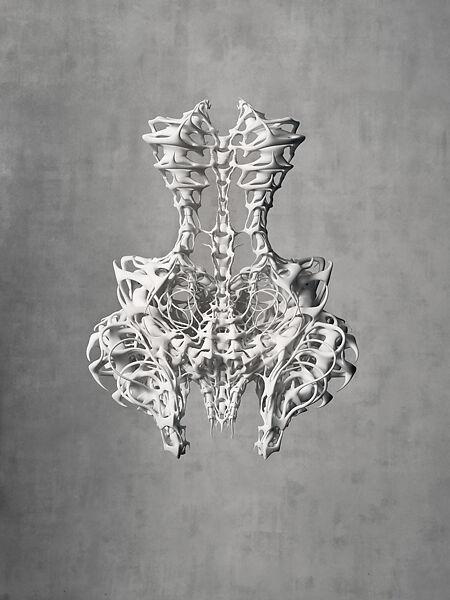
That is a spectacular object. It is also a problem.
The same material and process that make the shape feel like it arrived from a future civilization create problems when the museum tries to preserve it. The Met’s conservation account describes yellowing, dirt embedded in the porous surface, losses to fragile tips, and uncertainty about how long the material will last. That is not a side note. That is part of the meaning of the object.
We have this bad habit of describing 3D printing as if the technology is a magic portal. You draw something on a computer, you press a button, and suddenly the future has arrived in a little powdery pile. But a technology does not remove material limits. It gives you different limits. In the Skeleton dress, the technology makes a radically new relationship between digital shape and body possible, while also producing an object that is difficult to move in and difficult to keep alive.
That tension is much more interesting than saying that 3D printing is innovative. Innovative in what way? For whom? At what scale? Does it create a form the body could not otherwise have? Does it change how the garment is assembled? Does it make the object more adaptable, or more fragile? These are the questions that keep the technology from becoming a shiny adjective.
How Does the Infinity Dress Work With a Kinetic Sculpture?
Van Herpen’s work also refuses to keep the object’s meaning entirely on the surface of the garment. Take the Infinity dress, made with sculptor Anthony Howe and connected to the 2019 Hypnosis runway show. The V&A describes the dress and Howe’s kinetic Omniverse sculpture as things designed to be experienced together. The dress passed through the sculpture like a portal. The object on the body was not complete without the moving object in the room.
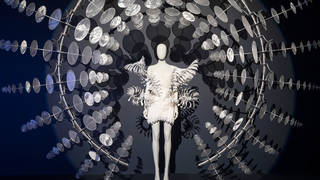
That is a very different idea of an accessory. It is not just something attached to a person. It is part of a changing spatial relationship around the person. The body enters a field of movement, scale, and light, and the garment is one participant in that situation.
There is an argument that this is no longer fashion. People make this argument about van Herpen constantly, usually right before calling something else “wearable art” and moving on. But I think the better question is not whether it counts as fashion. The better question is what fashion is doing here that a sculpture in a room cannot do.
The answer is the moving body. The dress bends the scale of the sculpture back toward a person. It forces the idea to deal with balance, surface, proportion, and the fact that a human being has to occupy the thing. Even if the object is not an everyday accessory, it is still testing the conditions that an accessory normally hides: how close it sits, how it changes a silhouette, how it behaves as the body moves through space.
Is Iris van Herpen’s Technology Always Electronic?
This is why calling van Herpen’s work “futuristic” is both accurate and not very helpful. Yes, the objects can look like they came from a future body. But the future is not only the surface effect. The future is in the way the object makes you reconsider the body’s boundaries, the relationship between handcraft and computation, and the amount of space a person is allowed to take up.
The exhibition Sculpting the Senses makes this connection unusually explicit. Its description includes a cabinet of curiosities presenting van Herpen’s accessories, alongside natural-science material and moving-body videos. That placement matters. The accessories are not presented as a separate shopping category. They sit inside the same ecosystem as the material samples, anatomical investigations, scientific references, and experiments with perception.
Van Herpen has described her studio approach as a combination of craftsmanship and new technologies. This is one of the places where the word “tech” needs to be handled carefully. The interesting technology in her work is not always an electronic component. Sometimes it is the process that lets a material behave differently. Sometimes it is the collaboration that brings architecture, engineering, sculpture, dance, or scientific research into the same object. Sometimes it is simply a new way of cutting, forming, layering, or suspending a surface.
That is good news for anyone interested in conceptual wearable tech, because it means the concept of wearable technology does not have to begin with a screen. It can begin with a change in how a body is shaped, sensed, protected, or made visible. It can be an object that does not look like a piece of consumer electronics because it is asking a question about the body before it is asking you to check a notification.
A consumer-scale version of that problem appears in OF HUNGER’s Electronic Gems AI Clip Earphones. They are not couture, and they do not turn van Herpen’s material experiments into a product lineage. But they do make the question tangible: what happens when an electronic device is designed to be read as a jewelry-like object, an accessory, and a piece of everyday technology at the same time? The interesting part is not that the product looks futuristic. It is that the electronics are being asked to enter personal style without disappearing into the language of a gadget.
What Do Iris van Herpen’s Accessories Say About Wearability?
But we should not pretend this makes the objects practical. A couture object is not automatically a product. A runway accessory is not automatically an everyday accessory. You cannot infer comfort, durability, price, or commercial availability from a photograph of a model walking through a room. This is not a failure of the design. It is simply the boundary of what the object is doing.
Actually, that boundary is part of why the work is useful. Van Herpen’s clothes and accessories let us see the design questions before the market turns them into a product category. They show what it would mean for technology to become less visibly technological, for a wearable object to belong to personal style instead of looking like a gadget, and for a piece of jewelry to act less like decoration and more like a small extension of anatomy.
The risk is that all of this becomes another collection of pretty images with a paragraph about the future underneath. Van Herpen is too specific for that. The shell structure, the printed nylon, the magnetic forces, the kinetic sculpture, the anatomical forms, the recycled plastic, the handwork: these are not interchangeable symbols. Each one puts a different pressure on the body and on the idea of making.
So, is Iris van Herpen designing accessories or inventing a new body?
Both, but not in the way the question first suggests. She is not making a new body by giving us a finished replacement for the human one. She is making the body unstable enough that we can see its construction again. The accessory becomes the place where that instability is easiest to notice because it is small, close, and impossible to ignore once it starts changing the outline of the person.
That may be the real future of wearable sculpture jewelry. Not that every earring becomes a machine, or that every bracelet needs a biomaterial story. It is that the thing we put on the body can stop being an afterthought. It can change the way we understand movement, force, and personal space.
And then, of course, somebody still has to wear it.
For the practical, everyday side of this language, see our organic-tech accessory guide and introduction to posthuman fashion.
Frequently Asked Questions
What makes Iris van Herpen accessories different from conventional accessories?
They are treated as part of a wider design system involving the body, movement, material, and technology. They can change how the boundary and silhouette of the body are perceived rather than simply finishing an outfit.
Does Iris van Herpen use 3D printing in her designs?
Yes. Her work includes documented 3D-printed garments, including a Crystallization top inspired by shell structures and the Skeleton ensemble made from 3D-printed nylon.
Is Iris van Herpen’s work designed for everyday wear?
Not automatically. Couture and runway objects can test new relationships between material, form, and the body without being everyday commercial products.
Is wearable technology always electronic in Iris van Herpen’s work?
No. In her practice, technology can refer to the processes, collaborations, and material techniques that change how a wearable form is made or experienced, not only to electronic components.