
Iris van Herpen Accessories and the Organic-Tech Aesthetic: How to Wear Sculptural Forms in Real Life
8 types of organic-tech accessories you can actually wear — from biomorphic ear cuffs and skeletal chains to liquid metal hair clips and parametric shoe hardware.
The organic-tech aesthetic — biomorphic surfaces, skeletal transparency, forms that look grown rather than assembled — is one of the most visually powerful design languages in fashion. It lives in the work of designers like Iris van Herpen, in biodesign labs, in computational architecture, and increasingly on Pinterest and Instagram boards filed under Y3K aesthetic and posthuman style. The problem is that most of it stays on the runway. The garments are unwearable outside a show. The jewelry is one-of-a-kind. The price is couture-tier.
But the visual principles — curves from anatomy, chrome as body extension, volume that casts shadow, surfaces that shift between organic and industrial — do translate into accessories you can actually buy, wear, and integrate into a daily wardrobe. The trick is knowing which everyday objects carry the organic-tech DNA without crossing into costume. Adjacent to wearable armor experiments like EZ mecha, this guide covers eight types that make the translation — four worn on the body, four woven into your outfit.

What makes something “organic-tech” rather than just futuristic
Three visual signals separate organic-tech from generic futurism:
Biomorphic form. The curves reference anatomy — bone cross-sections, vein networks, shell spirals, muscle contours — rather than geometry. Circles, hexagons, and sharp angles belong to industrial or cyberpunk design. Organic-tech form tapers, branches, and flows. It looks like it could have been grown, not milled.
Chrome as body extension. Polished metal that follows the body’s contour creates ambiguity: is it armor, prosthetic, or jewelry? That ambiguity — the boundary between skin and surface dissolving at a distance — is the defining visual effect of chrome body accessories in this tradition.
Shadow as proof. A piece with real three-dimensional presence casts a shadow on the skin beneath it. That shadow is what separates sculptural presence from surface decoration. If the piece sits flat and casts no shadow, it is a printed pattern in a sculptural shape, not actual sculpture. This bodily, engineered reading is central to posthuman fashion.
On your body — 4 organic-tech accessory types
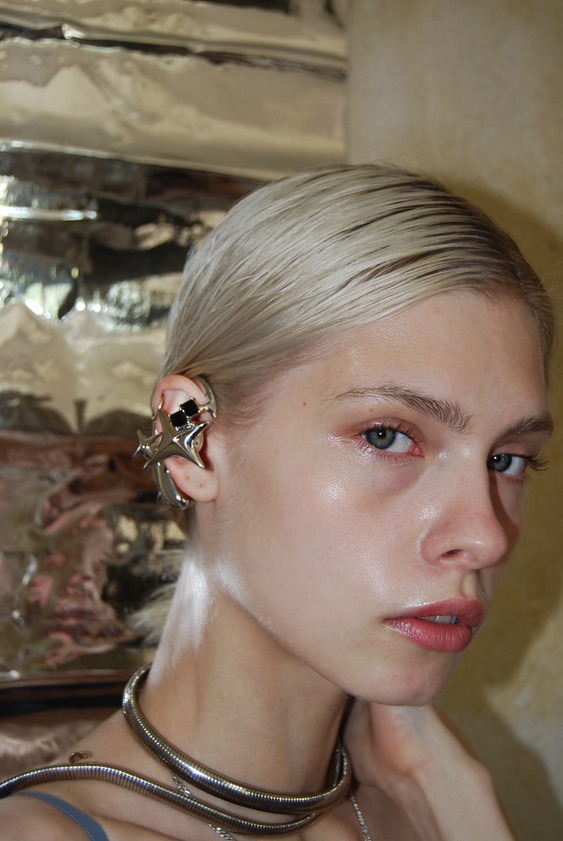
1. Biomorphic chrome ear cuffs
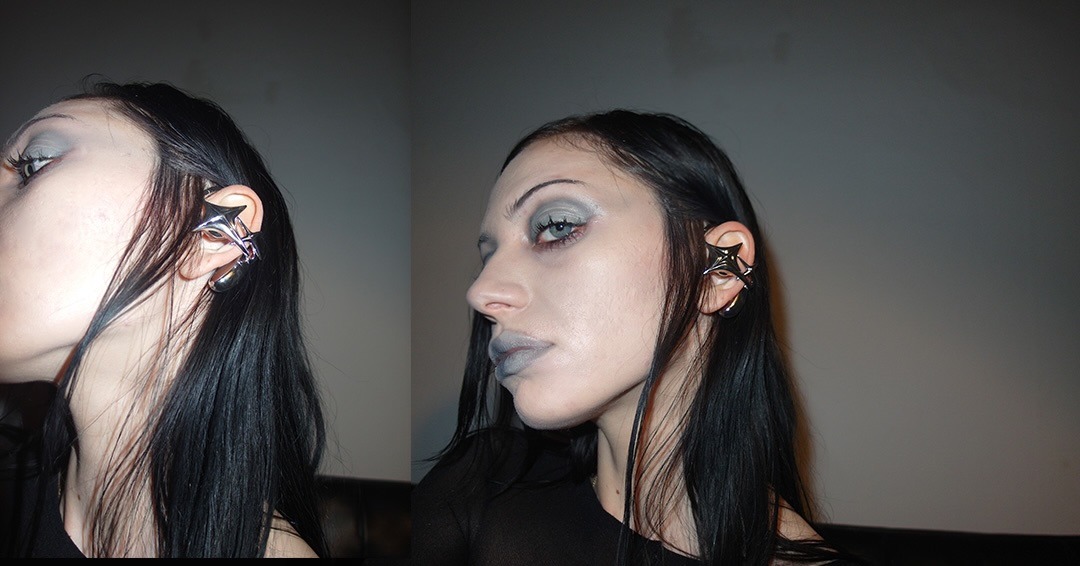
Skeletal, rib-like, or spinal-form ear cuffs in polished chrome, brushed silver, or oxidized metal. No piercing required — they clip to the cartilage and follow the ear’s natural curve. The organic-tech signal is the form: instead of a smooth band, the metal branches, tapers, or wraps like a bone fragment that grew around the ear.
What to look for: Lightweight alloy or sterling silver with enough spring tension to stay put. The form should echo the ear’s helix rather than fighting it. One ear cuff is a statement; two is editorial; three is a commitment.
Where it works: Gallery openings, editorial shoots, avant-garde daily wear, cyberpunk ear styling. Passes the black-T-shirt test — it reads as intentional on a plain outfit without requiring a themed look.

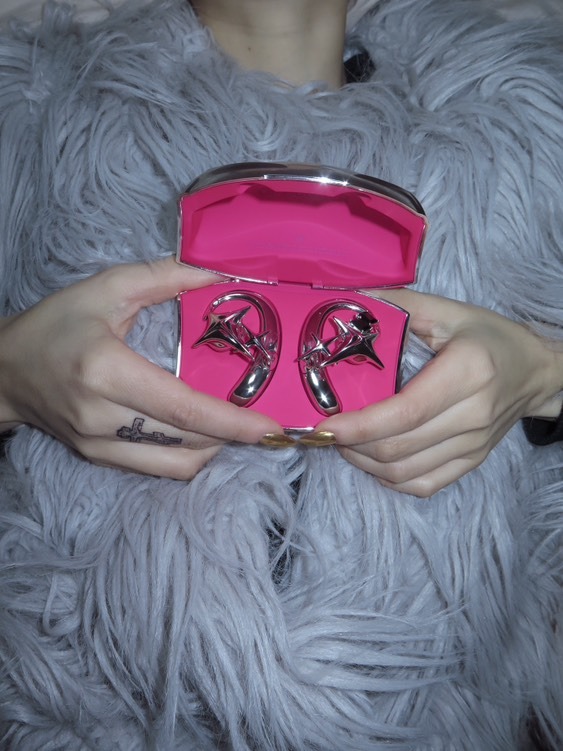
2. Faceted gemstone open earphones
Mineral-cut surfaces set in electroplated metal, worn as drop earrings with audio function. The organic-tech signal is the stone itself: a faceted zircon, opal, or tiger’s eye refracts light the way a natural crystal does — not the uniform sheen of plastic. The form sits at the intersection of geological specimen and ear jewelry.
What to look for: Real stone (not resin or printed pattern), real electroplating (not paint), and a proportion that matches a drop earring rather than a conventional earbud. The audio is a daily-use bonus — calls, podcasts, playlists — but the visual reads as mineral jewelry first. For a deeper comparison of gemstone, chrome, and mineral finishes, see our finish guide.
Where it works: Daily wear, office, evening, portrait and editorial photography. The quietest organic-tech entry point — a single piece that references the aesthetic without requiring the rest of the outfit to follow.

3. Organic-form statement rings
Asymmetric, fluid, or skeletal rings in sterling silver, titanium, or plated brass. The organic-tech signal is the profile: instead of a symmetric band, the metal flows around the finger like a tendon, a root, or a coral branch. Some are stacked; some are single-statement. The best ones look different from every angle — the form reveals itself as the hand moves.
What to look for: Rings where the form feels cast from an organic mold rather than stamped from a die. Weight matters — a substantial ring in real metal reads as sculpture, while a hollow ring in painted alloy reads as costume. Look for designers who reference biodesign, parametric modeling, or natural morphology.
Where it works: Any context. Statement rings are the most socially accepted form of avant-garde jewelry — they travel from gallery to grocery store without triggering the costume question. For statement jewelry brands that layer easily, see our brand guide.
4. Skeletal chain necklaces and body chains
Spine-like, rib-cage, or vertebral chain structures in chrome, oxidized silver, or blackened steel, worn against the collarbone, across the chest, or draped from the shoulder. The organic-tech signal is the articulation: each link references a skeletal joint rather than a conventional chain link. The piece moves like a body part — bending, draping, and conforming to the wearer’s posture.
What to look for: Articulated joints that move fluidly without catching or pinching. Sterling silver or plated brass with a dark patina adds the organic-industrial tension the aesthetic requires. Avoid chains that are so rigid they sit like a collar rather than flowing like a spine.
Where it works: Editorial, performance, high-commitment avant-garde. This is the highest visual volume in the body-worn category — it requires confidence and minimal competing accessories. One skeletal chain replaces all other necklaces for the night.
In your outfit — 4 organic-tech pieces you can wear every day
The real power of the organic-tech aesthetic is not in special-occasion jewelry. It is in upgrading everyday functional objects — a bag, a belt, a hair clip, a shoe detail — with biomorphic form. These five types bring the couture-sculpture DNA into daily rotation without requiring anyone to ask “is that from a runway?”
5. Biomorphic hard-shell clutches and crossbody bags
3D-printed or injection-molded hard-shell bags shaped like sea-snail spirals, water-droplet cascades, or wave collapses. The form is sculptural — faceted or organic surfaces with hidden magnetic closures — while the function is a normal bag: phone, cards, keys, lipstick. The material is typically lightweight polymer or resin, sometimes backed with leather or microfiber interior.
What to look for: A form that reads as a small sculpture when set down, not just a bag with an unusual texture. Hidden closures (magnetic, press-fit) preserve the surface integrity. The interior should be lined and functional — a beautiful shell with a raw plastic cavity inside signals prototype, not finished product.
Where it works: Evening, date, gallery, any outfit where a clutch or small crossbody is appropriate. The bag becomes the outfit’s accent piece — pair it with quiet clothing and let the form do the talking.
6. Skeletal belt buckles and liquid metal belts
Irregular liquid-metal, branch-vein, or biological-skeleton buckles in cast metal, replacing the standard rectangular belt clasp. The belt itself can be conventional leather or woven textile — the buckle is the design intervention. Some versions extend the organic form into the belt’s keeper or tip, creating a continuous flow from leather to metal.
What to look for: A buckle that looks like it was cast from a natural mold — tree bark, coral, flowing metal frozen mid-pour. Real cast metal (brass, zinc alloy, stainless steel) rather than lightweight painted plastic. The buckle should feel heavy enough to anchor the belt and sit flat against the body without rotating.
Where it works: Daily wear with jeans, layered under a blazer, cinching a midi dress. The belt buckle is one of the most underused accessory positions — organic-tech form here upgrades the entire outfit’s silhouette from the waist without adding visible jewelry.
7. Molten liquid metal hair accessories
Shark clips, claw clips, hair pins, and barrettes in lightweight aluminum alloy or chrome-plated resin, shaped as molten metal splashes, neuron branches, or flowing mercury frozen in motion. The organic-tech signal is the surface: it should look like the material was liquid a moment ago. Conventional plastic clips read as functional; molten-metal clips read as design objects that happen to hold hair.
What to look for: Lightweight but with tactile density — chrome-plated resin or aluminum alloy rather than painted ABS plastic. The grip mechanism should actually hold hair securely (organic form that cannot grip defeats the purpose). Matte chrome or satin finish ages better than mirror polish, which shows fingerprints and scratches quickly.
Where it works: The highest-frequency organic-tech entry point. Hair accessories are used daily, tolerate bold form without triggering the “is that costume?” question, and are visible in every selfie, video call, and side-profile photo. A single molten-metal claw clip does more for a daily organic-tech look than a full jewelry set.
8. Parametric shoe hardware and sculptural heel caps
Removable exoskeleton lace locks, shoe-face clips, or clip-on heel caps in parametric lattice or organic-flow forms. These micro-accessories attach to existing shoes — sneakers, loafers, heeled pumps — and transform a basic silhouette into a design statement. The form is typically 3D-printed nylon, sintered metal, or cast alloy, designed as a modular attachment rather than a permanent shoe component.
What to look for: A secure attachment mechanism (clip, strap, or friction fit) that does not damage the shoe. The lattice or organic form should be rigid enough to hold shape while walking — floppy parametric structures look broken, not designed. Look for designers working in computational design or parametric modeling who offer small-batch production.
Where it works: Any shoe-visible context — which is most of them. A parametric lace lock on a plain white sneaker, or a sculptural heel cap on a black pump, introduces organic-tech language from the ground up. The advantage is modularity: remove the hardware and the shoe returns to its default identity.
The costume line — and how to stay on the right side
Organic-tech accessories cross into costume when they require the rest of the outfit to justify them. If the piece only works with coordinated makeup, specific hair, and matching clothing, it is a costume element. If it works with a black T-shirt and clean skin, it is an accessory with a point of view.
The black-T-shirt test: Put the piece on with the most neutral outfit you own. If it reads as an intentional choice, it is wearable. If it reads as a fragment of a missing costume, adjust the volume downward.
The one-piece rule: Start with one organic-tech piece per outfit. A biomorphic ear cuff OR a skeletal buckle OR a molten hair clip — not all three. Once you are comfortable with one, you can layer — but the aesthetic is strongest when one object carries all the weight and the rest of the outfit stays quiet.
Quick translation check
Before adding any organic-tech accessory to your look:
- Biomorphic or geometric? If the silhouette is a circle, square, or cylinder, it belongs to a different design language. Organic-tech form tapers, branches, and follows anatomy.
- Shadow or no shadow? Hold the piece against your body under a side light. If it casts a shadow, it has sculptural presence. If it sits flat, it is surface decoration in a sculptural shape.
- Black-T-shirt test. Put it on with your most neutral outfit. If it reads as a choice, it is wearable. If it reads as a costume fragment, lower the volume.
The organic-tech aesthetic does not require a runway budget or a couture label. It requires a form that references anatomy, a surface that interacts with light, and a volume that knows exactly when to stop.