
5 Movies to Watch If You Like Y3K Aesthetics
Explore five films for Y3K visual inspiration, from TRON’s glowing suits and Alita’s mechanical bodies to Blade Runner 2049’s monumental architecture.
TL;DR
- These five films offer visual starting points for Y3K inspiration; they are not a shared genre or a ranked list.
- Start with TRON: Legacy for illuminated clothing and digital environments, or Blade Runner 2049 for monumental architecture.
- Compare Alita: Battle Angel and Ghost in the Shell for exposed mechanical joints and machinery concealed beneath human surfaces.
- Choose Ex Machina for the contrast between human expression, visible machinery and glass-enclosed spaces.
A luminous line running along a sleeve can make a familiar body seem newly invented. An exposed finger joint can turn an ordinary gesture into something worth studying. Those small encounters are a large part of the pleasure of futuristic movies: discovering how an imagined world has found its way into the shape of a hand, the surface of a garment, or the space surrounding a person.
If the Y3K aesthetic has you looking for films, these five live-action productions offer some particularly compelling places to begin. Think of “Y3K movies” here as a route into visual inspiration, rather than a shared genre or a label the films claim for themselves. Their pleasures are quite distinct. Some invite you to follow a clean line across an almost empty surface; others reward looking into the little gaps where that surface breaks apart. The useful question is what, exactly, has caught your eye.
TRON: Legacy (2010): Illuminated Suits and Digital Spaces
Start with the light running across the suits. Against their black surfaces, the pale blue lines give the torso and arms a second, graphic outline, selecting certain contours while allowing other details to settle into darkness. The body remains recognizable, but its construction seems newly deliberate. Someone has decided which parts of a person should be legible at a distance.
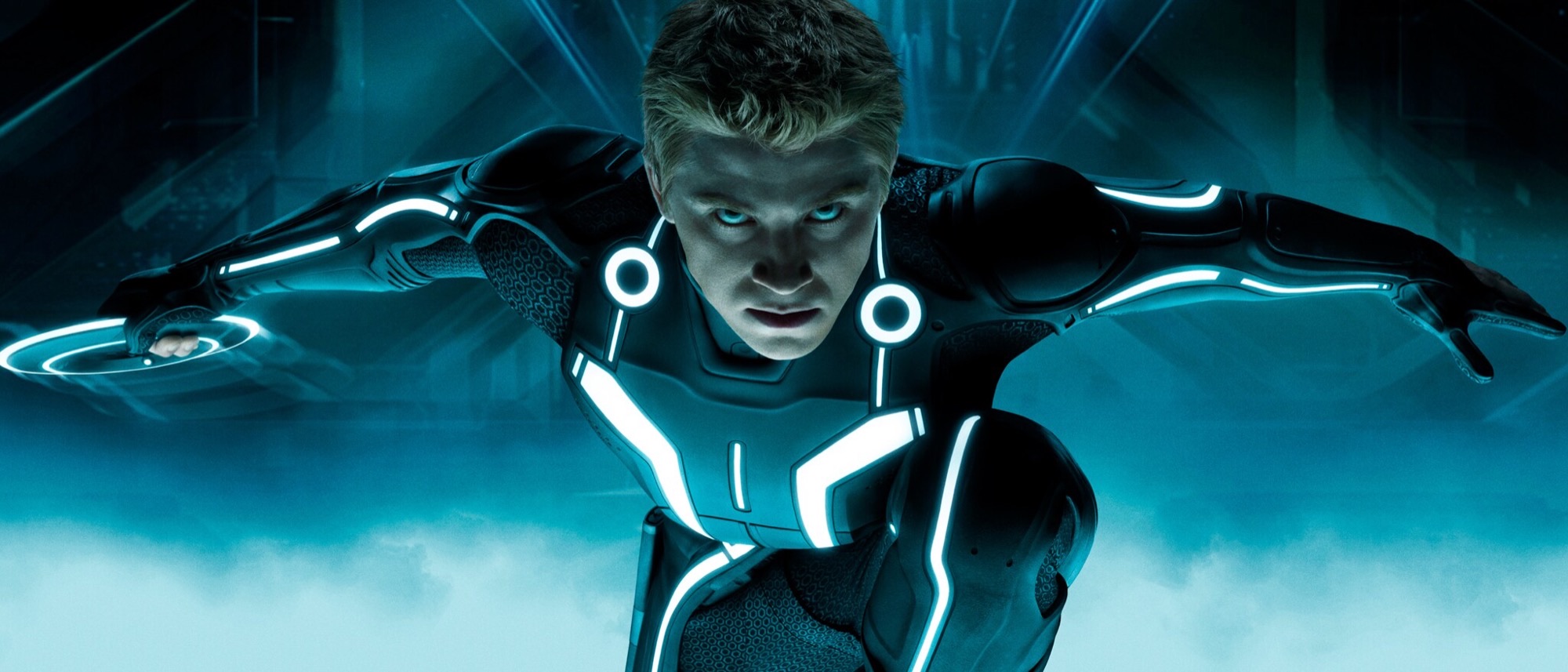
Joseph Kosinski’s film follows Sam Flynn into the digital world connected to his missing father, a premise that gives its designers considerable freedom to invent a coherent visual environment. That coherence is the attraction here. The circuitry-like markings of the clothing find relatives in the vehicles and architecture, so a luminous sleeve feels like a small piece of the same system that produced a light cycle. Follow those relationships and the familiar image of a glowing black suit becomes considerably richer: figure and environment appear to have been drawn with the same tools.
There’s also a pleasing physical stubbornness beneath all this digital elegance. The production’s costumes incorporated practical lighting into flexible foam-latex suits, giving the illuminated designs an actual body to accommodate. That tension is worth keeping in mind as you look at them. The luminous markings flatten a person into a readable graphic, while the curved surface beneath them keeps insisting on volume.
For anyone drawn to luminous clothing, this is an inviting first stop. The generous dark surfaces give those few bright lines their force. The suit’s fascination lies in that selective translation of a human silhouette into the visual language of its surroundings.
Alita: Battle Angel (2019): Two Designs for a Mechanical Body
Alita’s hands are a lovely place to begin. Their pale surfaces are divided into small, fitted sections, with warm metallic mechanisms visible between them. Decorative flourishes run along her forearms, while the fingers retain the slender proportions of a human hand. There’s an appealing excess of care here, as though a piece of fine ornament has been given the responsibility of picking things up.
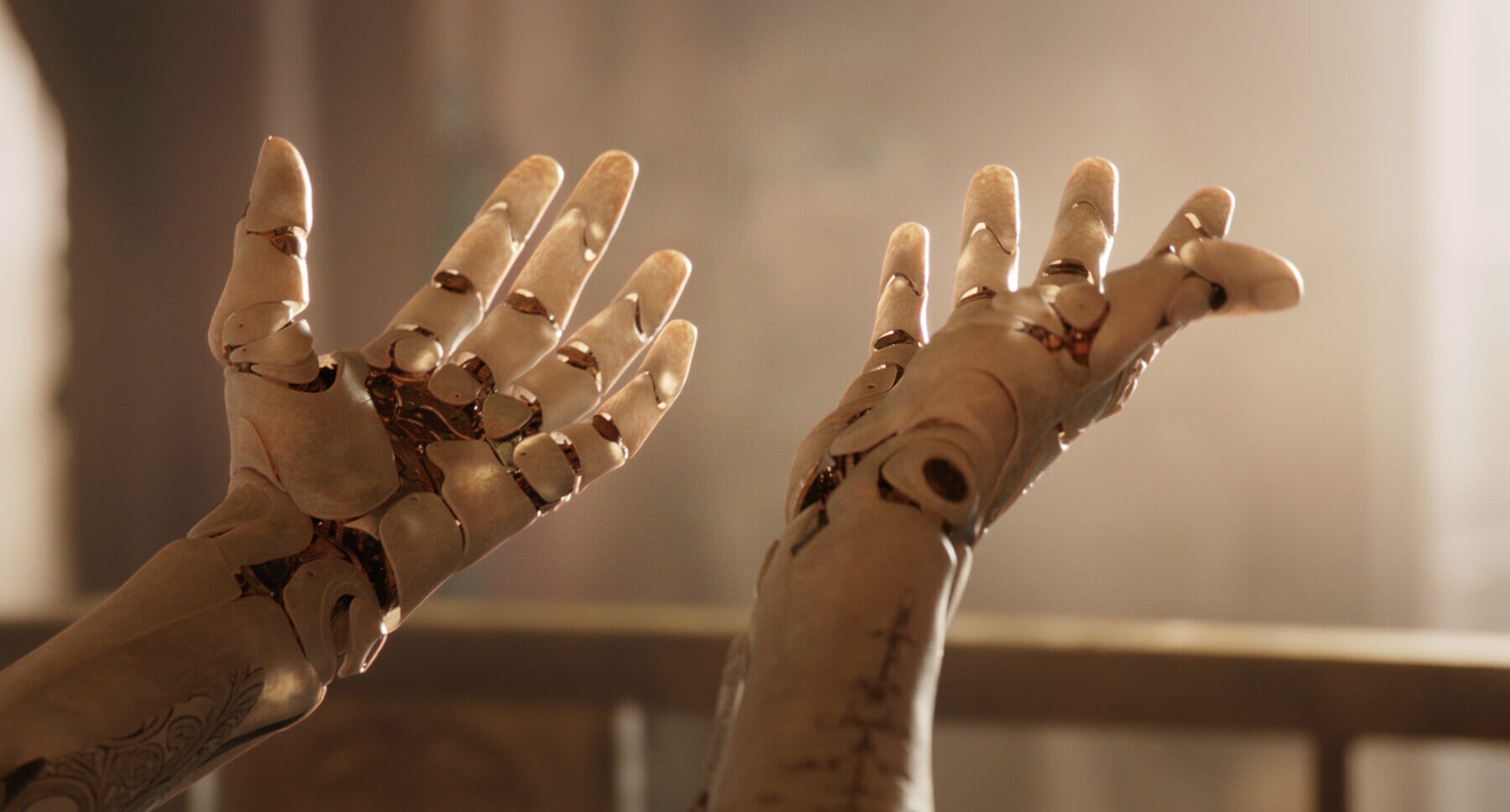
Robert Rodriguez’s film introduces Alita as a cyborg who awakens without her memories and is taken in by the doctor Ido. For our purposes, the most interesting introduction is the one she receives to her own body. Her human-looking face sits above an unmistakably constructed form, and the close view of those raised hands makes their unfamiliarity easy to share. The gaps are as expressive as the plates; they show where the body has to yield in order to move.
Compare that Doll Body with the Berserker design. The contrast is especially clear in contributing artist Vitaly Bulgarov’s concept work, where the latter’s dark surfaces and fine, muscle-like bundles follow the arm’s anatomy. Weta Digital’s animation team likewise describes a change from the Doll Body’s clockwork interior to a more muscle-based construction.
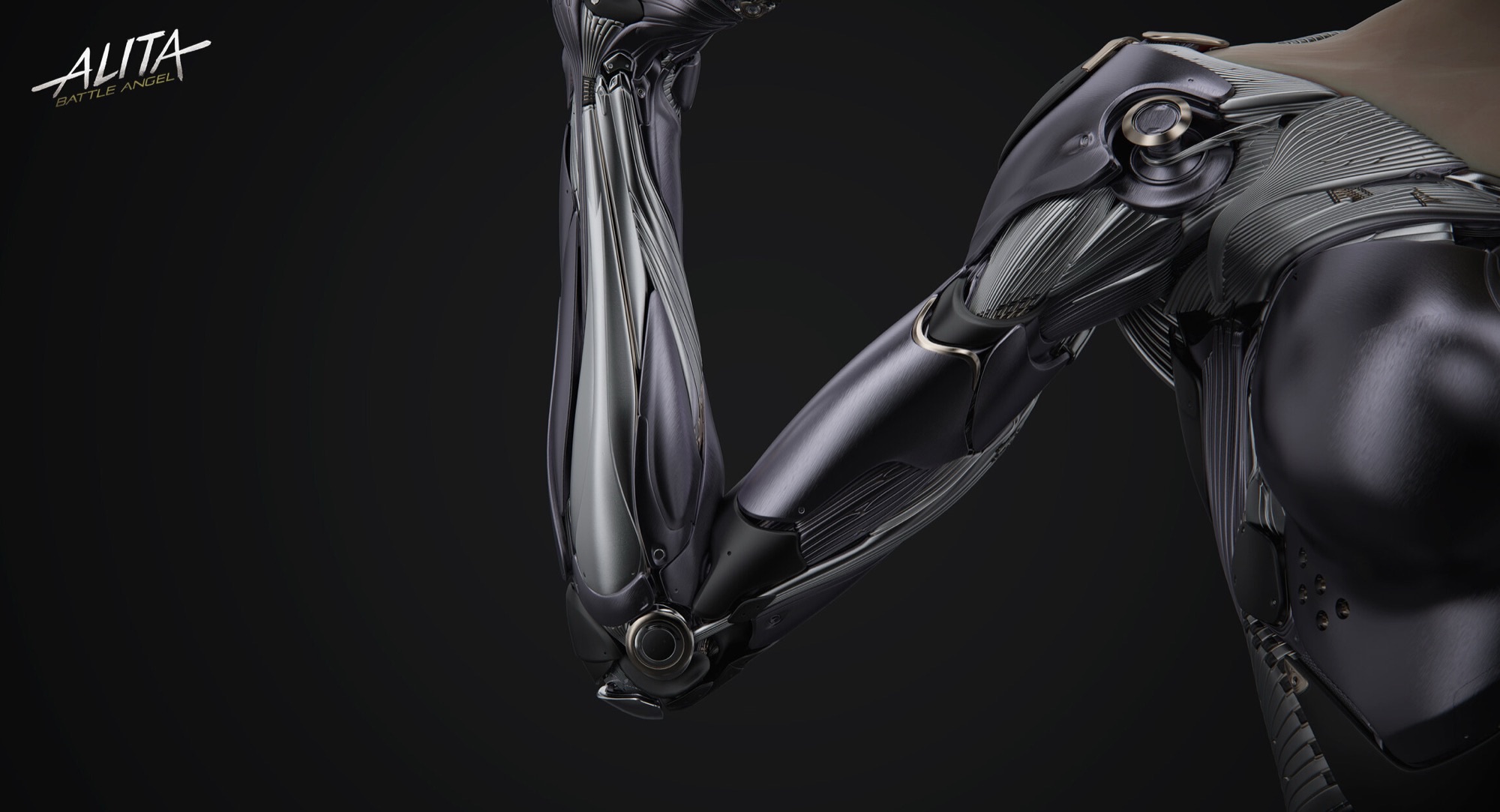
Alita is a rewarding choice for anyone interested in mechanical anatomy. The Doll Body’s ornamented plates and slender fingers have a delicacy quite distinct from the Berserker design’s dark, muscle-like bundles. The comparison runs through the elbow, the wrist, the transition from shoulder to arm. A changed body offers different capabilities and a different means of expressing herself.
Ghost in the Shell (2017, Live Action): Human Surfaces and Hidden Machinery
The opening body-manufacturing sequence offers the most direct way into this film’s visual interests. Internal structures acquire successive layers, and a constructed object approaches the familiar outline of a person. The process gives the finished surface a peculiar charge: once you have been invited beneath it, smoothness can begin to feel like concealment.
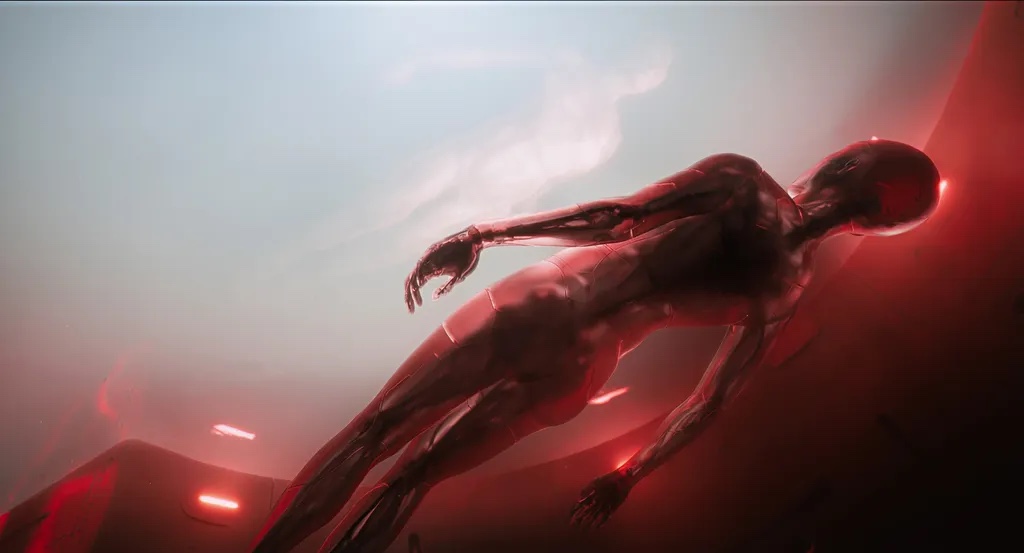
Rupert Sanders’ live-action film follows Major, a woman whose human brain inhabits a manufactured body. That premise places a great deal of visual weight on the boundary between exterior and interior. The body can look continuous from a distance while its construction suggests divisions, access points, and parts that might be exposed. It’s a particularly useful reference if your interest in futuristic design lies in the almost-human, in forms whose strangeness emerges through a seam or an interrupted surface.
The thermoptic suit extends that interest into clothing. Wētā Workshop made the costume from smooth silicone, with panel lines impressed into its surface. It adheres closely enough to read as another skin, though it remains a garment worn over the body. That small distinction creates an intriguing visual complication: a manufactured covering can resemble the manufactured person beneath it. The robotic geishas offer a more abrupt variation, their composed faces concealing elaborate mechanisms that can be opened to view.
These are compelling objects to place beside Alita’s openly articulated hands. Here, the pleasure often comes from following a human outline until it gives way to its construction. The film’s future city provides a setting for those artificial human forms, while Major’s uncertain relationship with her memories gives the polished exterior something it cannot readily explain. Begin with the making of the body, then notice how persistently its surfaces invite another look underneath.
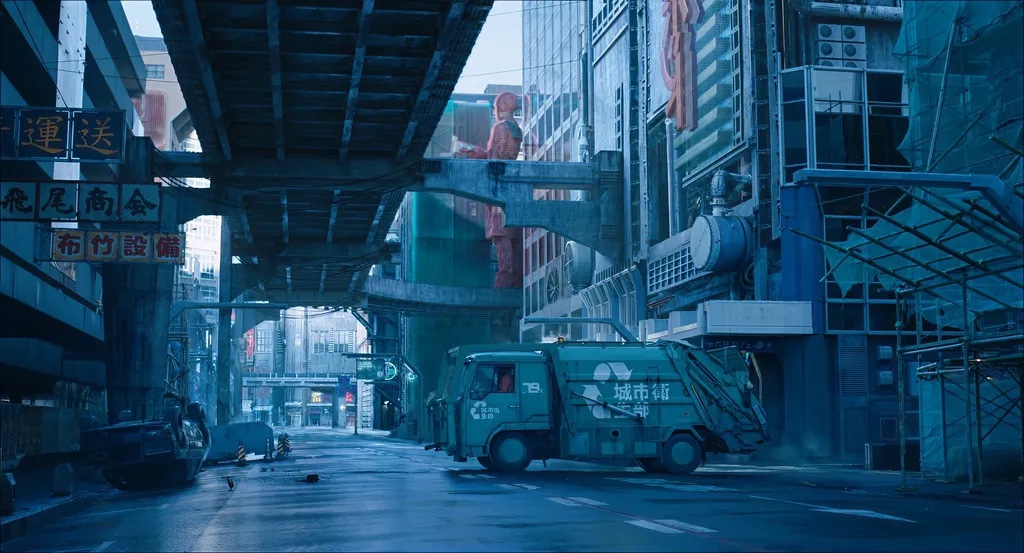
Blade Runner 2049 (2017): People and Monumental Architecture
Look for the person in the architecture. In the orange haze surrounding K’s arrival in Las Vegas, his small, dark figure stands among enormous concrete forms, with distant buildings fading into the same dense atmosphere. The structures occupy so much of the image that the person becomes a measure of their scale. Find him, and the whole composition suddenly feels larger.
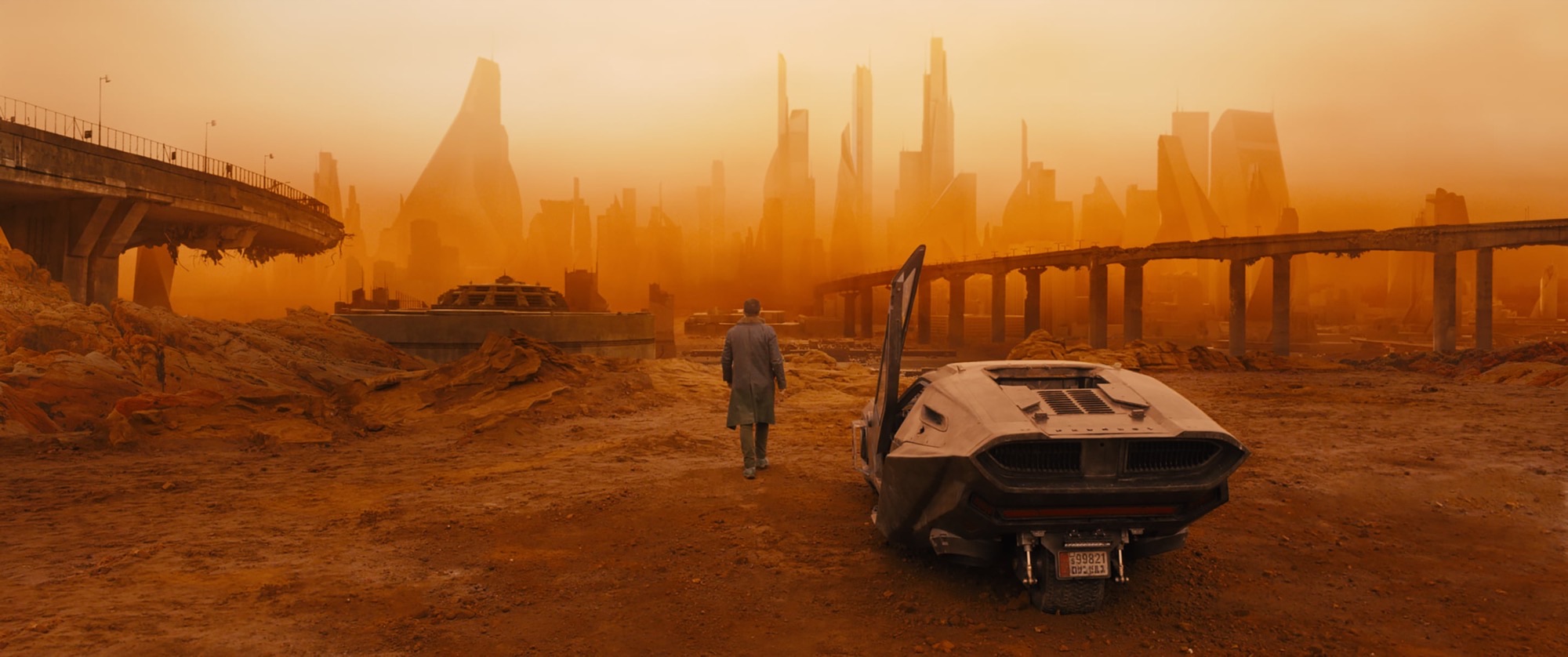
That is a compelling reason to move from futuristic bodies to futuristic environments. The orange light draws these separate structures into one continuous expanse, while their darker edges keep enough definition to make the space imposing. There’s considerable beauty in the arrangement, but very little reassurance that it was built with someone of K’s size in mind. Even the vehicle beside him seems modest against those surrounding masses.
Production designer Dennis Gassner described the film’s world in terms of brutality, developing an environment harsher than its predecessor’s. That choice gives the architecture a useful specificity. Its weight and severity suggest something endured, something a person must find a way through. K’s work for the LAPD, and his own status as a manufactured replicant, lend that imbalance a quiet social pressure without requiring us to unravel the film’s central mystery.
For anyone collecting visually stunning sci fi movies, Blade Runner 2049 is a particularly rewarding choice for its sense of scale. That small, upright figure gives the towering architecture something to dwarf; the dark silhouette remains essential to the grandeur of the luminous world around it.
Ex Machina (2015, US Release): Human Expression and Visible Machinery
Ava’s face is an immediately familiar point of attention within a much stranger body. Skin meets an exposed mechanical neck; mesh-covered portions of her torso sit beside areas through which her internal construction is visible. The design lets the eye travel from a recognizable expression into a region where the ordinary expectations of flesh no longer apply, without losing the continuity of the person-shaped figure.
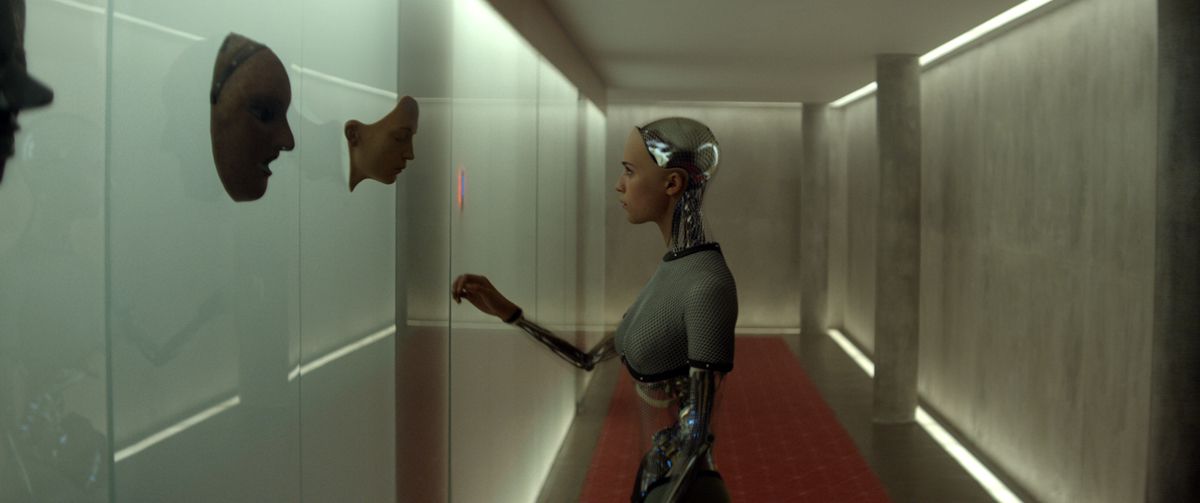
Alex Garland’s film centers on a programmer invited to evaluate Ava’s consciousness. She is an artificially made robot, and her design gives that encounter an unusual visual intimacy. You can inspect the mechanisms and still find yourself returning to the face, looking for the ordinary signs of attention or hesitation. The mechanical detail makes that return more interesting. It supplies another way of looking at the same figure, one that offers different information without settling what to make of her.
The effects work preserves the face and hands as points of expression and contact, while the transparent portions expose structures derived from human anatomy. I particularly like the restraint of that division, especially around the neck, where the transition between skin and machinery is so difficult to ignore.
Glass adds another layer to this arrangement. The enclosed spaces make visibility part of the architecture, placing a body that can be looked into within rooms that can be looked through. That relationship gives the film a distinctive place beside the enormous environments elsewhere on this list. Its visual interest gathers around a face, a torso, and the transparent boundaries nearby. Choose it if the fine distinctions between human expression and manufactured structure are what keep drawing you back to an image.
Which Film Should You Watch First?
Your next film can follow whichever detail remains most vivid. If it’s the illuminated sleeve, begin with TRON: Legacy and watch how the same graphic decisions extend into a whole environment. If it’s the articulated hand, Alita offers two bodies worth comparing; Ghost in the Shell then shifts attention toward the surface that covers such construction. Ex Machina brings that investigation close to a face, while Blade Runner 2049 opens it outward into immense spaces.
There’s no need to work through these as a ranking. Pick the image that makes you curious, then give its surroundings some attention too. A cropped hand can be beautiful on its own, but placing it beside a face changes what you notice. So does putting a small figure back into the architecture around it. Those relationships are where a collection of striking futuristic details begins to suggest a world worth exploring.