
Kit Wan Studios' Mutant // Mythology: How Sci-Fi Becomes Wearable Fashion
A close look at KIT WAN STUDIOS' Mutant // Mythology show at CENTRESTAGE and how sci-fi, mechanical design, and stage costume become wearable fashion.
TL;DR
- KIT WAN STUDIOS’ Mutant // Mythology treats science fiction as a problem of making clothes live on a body, not just a visual mood.
- The collection moves through industrial futurism, nature, and romanticism rather than staying inside one mechanical look.
- Its mix of fantasy pieces and wearable separates keeps the boundary between collectible fashion and everyday wear in view.
- CENTRESTAGE’s Hype² pavilion makes the distribution question visible: fashion objects need a route from image to desire.
What Did KIT WAN STUDIOS Show at CENTRESTAGE?
36 looks.
A runway in Hong Kong’s Grand Hall, with Victoria Harbour behind it.
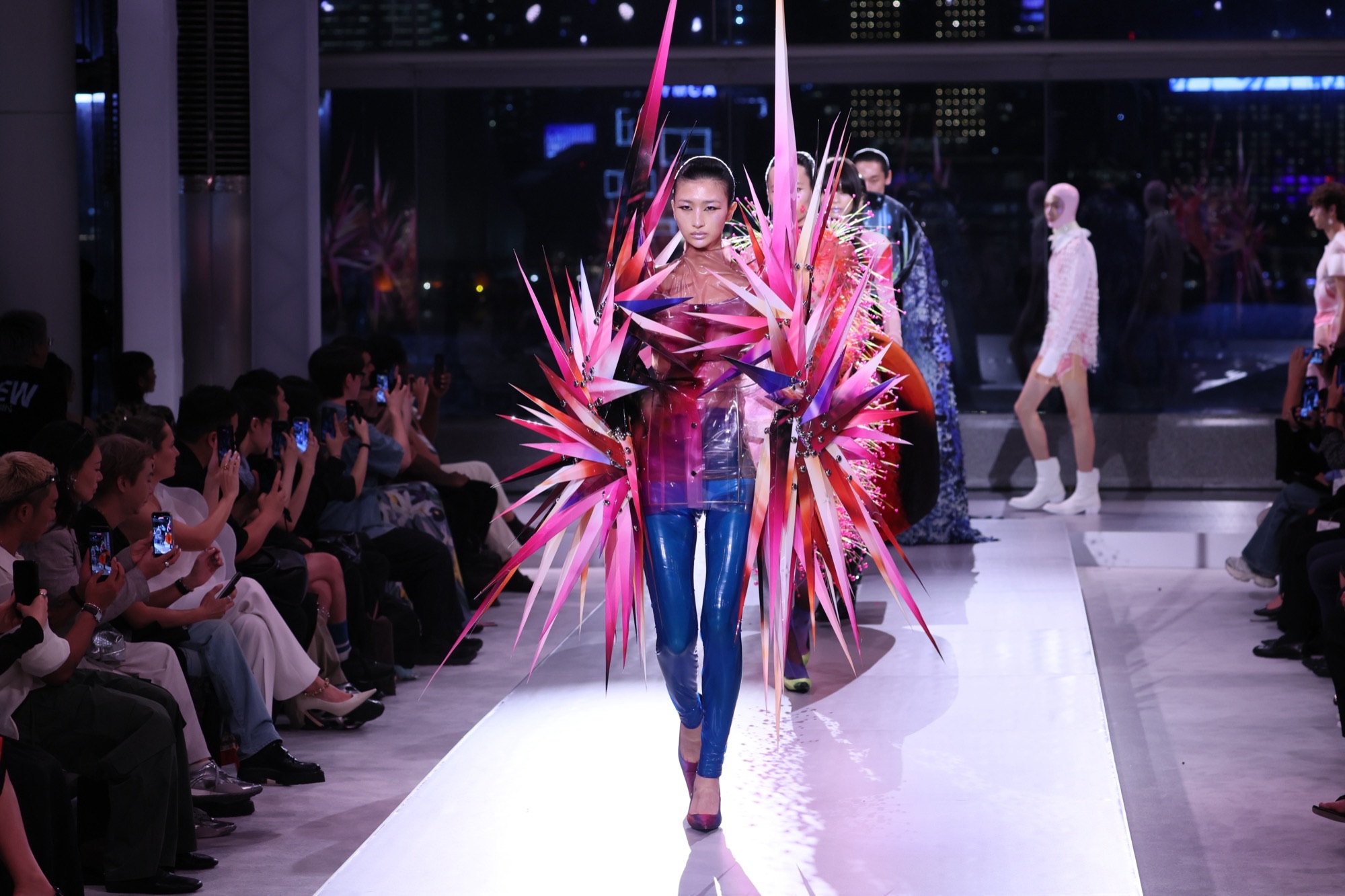
Industrial futurism, a breath of nature, essential romanticism, and enough mechanical detail to make “futuristic fashion” feel like a very lazy description.
KIT WAN STUDIOS called the show Mutant // Mythology, and it opened CENTRESTAGE ELITES on September 2.
The interesting part is not that science fiction showed up at a fashion event. It is that the studio had to make science fiction live on a body.
That is where a lot of “future fashion” gets stuck. Costume. Moodboard. A silver thing that looks good in a campaign and impossible everywhere else.
Kit Wan is trying something more complicated.
CENTRESTAGE is Asia’s annual fashion event, now in its eleventh edition. This year it brought around 270 brands from 24 countries and regions to Hong Kong, with more than 30 runway shows and a new Hype² streetwear pavilion.
The opening show was the one with the pressure on it.
HKTDC’s show report described more than 30 new looks. Kit Wan told Vogue Hong Kong the full collection had 36, including 12 fantasy pieces alongside wearable separates and avant-garde looks.
That distinction matters.
A fantasy piece can be an event. A separate has to negotiate with a body, a room, a door, a chair, a day that did not ask you to be in a fashion show.
The word wearable is doing actual work here.
Kit Wan’s practice has always sat somewhere between the art object, the costume, the installation, and fashion. He is known for sculptural silhouettes that look like mechanical extensions of the body — adjacent to EZ’s mecha armor as wearable fashion and the broader posthuman fashion question — but Mutant // Mythology is not simply asking how far a garment can go before it becomes sculpture.
It is asking what happens when the sculpture has to move.
How Does Mutant // Mythology Move Beyond Sci-Fi?
The collection is built in three acts.
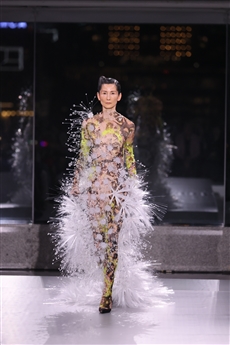
Industrial futurism.
A breath of nature.
Essential romanticism.
Those are not three different Pinterest boards. They are three forces that should not naturally fit together, which is exactly why they make a useful fashion problem.
The industrial part is the obvious entry point. Kit Wan’s work has a mechanical DNA, with metalwork, sculptural forms, and a relationship to technology that is more material than digital.
The nature section is the interruption. It keeps the future from becoming a room full of chrome and hard edges.
Then romance arrives and makes the whole thing less like a machine.
This is where the collection gets more interesting than the sci-fi label.
Anyone can make a futuristic reference. Add a metallic surface, a hard silhouette, a graphic from a film, and congratulations, you have made a mood.
The harder thing is to create a visual language where industrial forms, forgotten craft, softness, and colour can belong to the same studio.
Kit Wan told Vogue that he was bringing colour back, lots of colour, while staying inside the studio’s futuristic and mechanical DNA.
That is not a small choice.
Colour is often treated as the part of fashion that makes technology friendly. A little pink, a nice blue, perhaps a “feminine” edition after the hardware is finished.
That is not what is happening here.
The colour is part of the world-building. It keeps the mechanical from becoming emotionally flat. It gives the clothes somewhere to go after the first visual shock.
What Does a 1990s Vision of 2035 Add to the Collection?
The collection began with a film from the mid-1990s set in the year 2035.
Kit Wan was watching it in 2026.
This is the kind of time travel that actually makes a future-fashion collection useful. Not because the film predicted the future correctly. It probably did not. The point is that every future is someone else’s old idea of what comes next.
We are always looking at a prediction from the wrong side of the date.
The 1990s imagined 2035. Kit Wan takes that old future and brings it into a Hong Kong runway in 2026, then puts it beside nature, mythology, and the craft that technology keeps trying to make obsolete.
That is a much better use of science fiction than pretending the future has one look.
The future is not a colour palette. It is a conversation between what we thought was coming and what the body still needs.
What Can Stage Costume Teach Wearable Fashion?
Before this full fashion show, KIT WAN STUDIOS was already known through performance.
The studio has created stage looks for artists including Miriam Yeung, Hins Cheung, MC Cheung, and Panther Chan. Its work has also appeared around major international events including the Grammys and Eurovision.
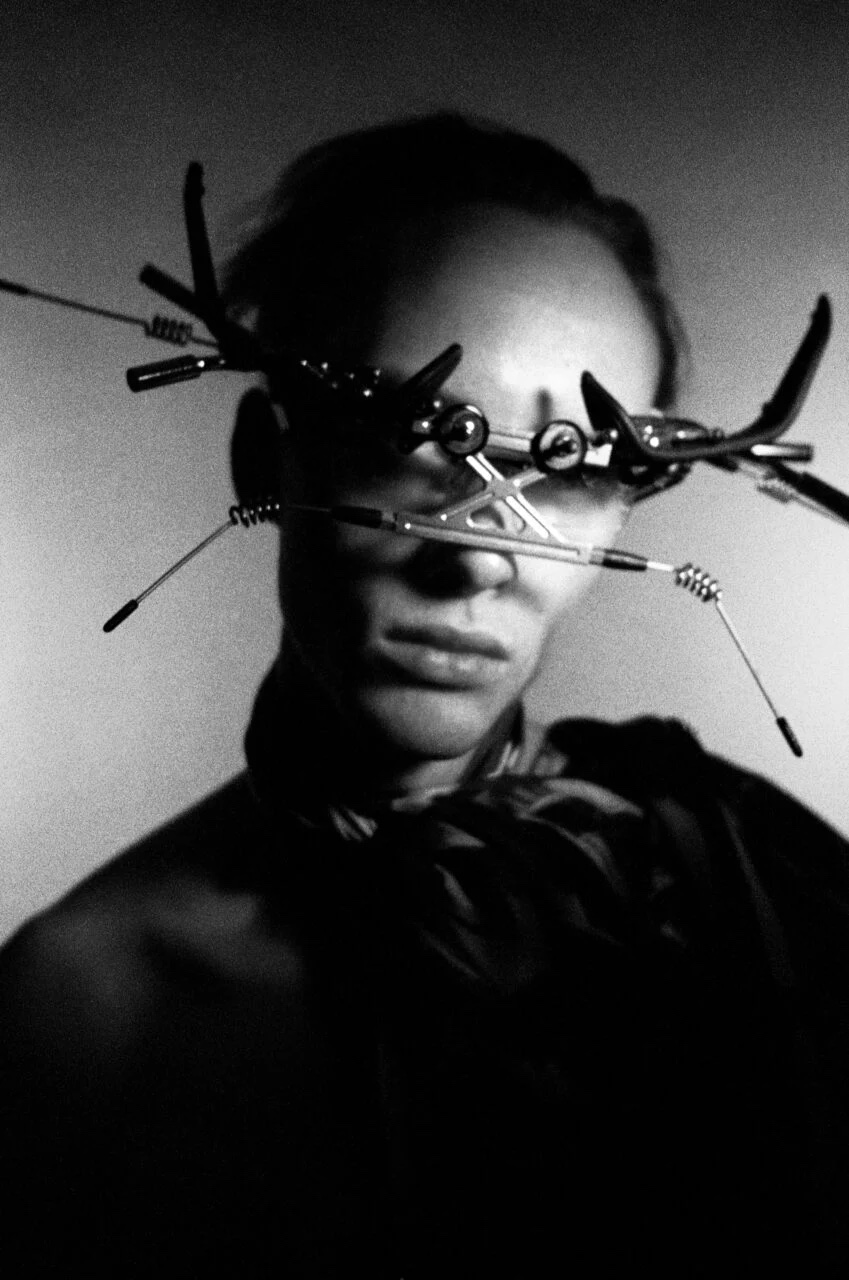
Stage clothing is allowed to be excessive.
It has to survive distance, lighting, music, cameras, and the moment when an artist walks into a room and needs to become larger than the room.
That is a different job from making a coat someone wears to dinner.
But the experience matters because stage design teaches you something that a lot of fashion-tech companies forget: the object has to understand the body before it can perform an idea.
A wearable is not just a thing placed on top of a person.
It has weight. It has movement. It has a front and a back. It changes when the person sits down, turns around, walks outside, or stops being photographed.
The body is not the display stand.
This is also why I pay attention to what Kit Wan calls the boundary between collectible and wearable fashion. The boundary is not a problem to solve by choosing one side.
The tension is the product.
Why Does Hype² Matter to the Fashion Story?
At first glance, KIT WAN STUDIOS and Hype² do not look like the same story.
One is an art-led, sci-fi-inflected fashion show with a Victoria Harbour backdrop and more than 30 new looks.
The other is a new pavilion built around local celebrity- and KOL-led streetwear brands, limited editions, and products people can actually buy during the fair.
But they are connected by the question of distribution.
A fashion object does not become culturally legible only because it is beautiful. It needs a place to appear, a person who can carry it, an audience that knows how to read it, and a route from image to desire.
Hype² makes that route visible.
CENTRESTAGE is not only showing clothes. It is putting different kinds of fashion into the same commercial and cultural room: international brands, emerging designers, stage-adjacent spectacle, celebrity labels, streetwear, and the public that wants to see what is next without needing an invitation.
That is the part of fashion technology that still gets under-discussed.
The object is one half of the work.
The other half is how it travels.
When Does Future Fashion Become Wearable?
I use a similar test when I look at wearable fashion tech.
Not: does it look futuristic?
Ask:
Does it have a reason to exist on a body?
The answer cannot only be “because the object has a camera,” or “because the material is innovative,” or “because the campaign image looks good.”
A future-facing design needs a visual point of view strong enough to be recognised, and a physical logic strong enough to be lived in.
That is what Kit Wan’s work keeps putting on the table.
The studio’s language can move from recycled metal components to a stage costume, from a glass accessory to a sculptural headpiece, from a concert production to a fashion runway. The medium changes. The signature stays.
That is harder than launching a new product category with a futuristic name.
A signature is not a logo. It is what survives when the format changes.
This is why the show matters beyond the runway.
Tech companies keep trying to make fashion-tech objects by adding intelligence to an object that already looks like a gadget. Fashion designers start somewhere else. They begin with the body, material, image, and the emotional reason someone might want to be seen in it.
Then the function has somewhere to go.
What Makes Future Fashion More Than Costume?
I would not call Mutant // Mythology proof that Hong Kong or Asia has suddenly settled on one mechanical, comic-book future.
That would be the lazy read.
The stronger read is smaller and more useful.
One Hong Kong studio took the exact things that usually push fashion toward costume — science fiction, anime language, mechanical forms, metalwork, mythology — and built a collection that could hold fantasy pieces and wearable separates in the same world.
That is not a trend forecast.
It is a design practice.
And design practice is where the future actually becomes visible. Not in the word “AI.” Not in the silver finish. Not in another moodboard that calls itself a category.
The best wearable technology is the one that already understands why someone wants to wear it.
KIT WAN STUDIOS is asking the fashion version of that question first.
What does the future look like when it has to live on a body?