
How Space Opera Shapes Jewelry, Photography and Installations
Explore how jewelry, ear-worn objects, fashion photography and installations translate the scale of imagined worlds into objects, images and spaces.
TL;DR
- Space opera accessories suggest an imagined world through their forms and references, not just a metallic finish.
- Moving a monumental reference onto the ear changes its relationship to the body; the reference does not establish an earphone’s technical quality.
- Styling, photography and digital effects can create an environment that the featured product cannot provide on its own.
- Spatial installations enlarge the relationship between body and accessory. Enjoying that imagined world does not require buying a piece of it.
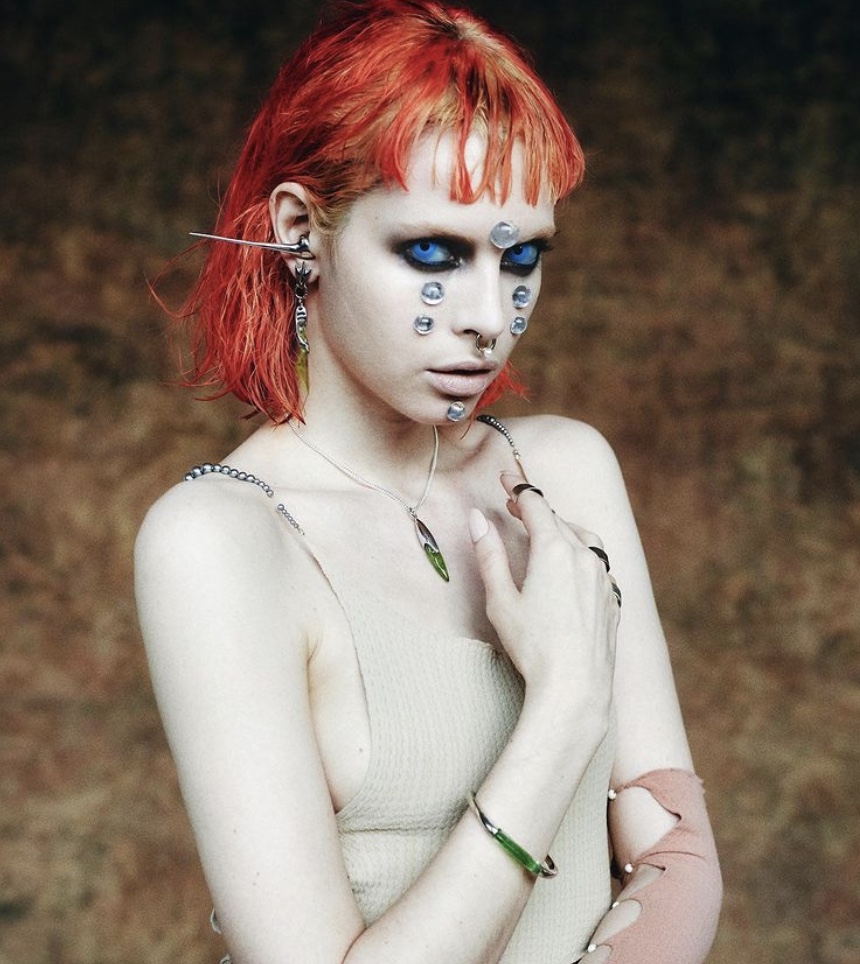
In the CHRISHABANA x DUNE lookbook, a model wears a small green pendant against pale clothing. There are round reflective ornaments on the face, red hair and startling blue eyes framed by dark makeup. The background is earthy and indistinct. No galaxy. No conveniently parked spaceship. And yet the image gives me more to think about than a silver accessory placed in front of some stars.
Part of the appeal is that the person seems to belong somewhere. The necklace is one detail of that somewhere, rather than the entire explanation for it. This is what interests me about the space opera aesthetic as it moves into jewelry, ear-worn objects, fashion photography and installations: how much of an imaginary world can a small thing carry, and how much are its surroundings carrying for it? A trailer like EXODUS tries to invent that world at cinematic scale; these objects have to do it at the size of an ear.
What Makes the Space Opera Aesthetic Different from Metallic Futurism?
It’s easy to confuse this with the broader category of futuristic jewelry. An unfamiliar shape or a reflective surface can suggest advanced technology without suggesting much about anyone who might use it. Space opera accessories make a more extravagant invitation. Imagine that the object has traveled out of a story large enough to contain other societies, conflicts and ways of living. Now someone is wearing it at the side of their face. The distance between those two scales is part of the pleasure.
I’m using that distinction to look at the objects, not to establish a dress code. There isn’t one correct future wardrobe, and an elaborate fictional universe shouldn’t become another reason to tell someone their earrings are wrong. But a named world gives us something more specific to consider than whether a piece looks vaguely spacey.
How Does DUNE Turn a Fictional World into Jewelry?
The DUNE collaboration makes the connection unusually direct. CAD designer Meave Cunningham-Perini dates their work on its promotional jewelry to June 2021, and the project archive identifies pieces including Spice and Fremen earrings. These names attach small objects to an existing fiction. In the Spice lookbook photograph, the pendant is slender enough that the face and styling remain prominent. The jewelry doesn’t have to reproduce a whole landscape to participate in the picture.
That leaves an interesting gap between recognizing a reference and wanting to wear it. A fan can enjoy the name; someone else might respond to the shape. Neither response cancels the other. Sci fi jewelry becomes more interesting to me when it permits both, instead of demanding that every stranger immediately identify the franchise. An accessory can suggest that its wearer has a story without requiring them to deliver the plot synopsis.
Still, look at how much assistance the photograph provides. Take away the unusual eyes, the face adornment and the clothing, and the same pendant would have a different introduction. That doesn’t make the styling a trick. Styling is part of how an object acquires meaning. But it does make me suspicious of the idea that a whole aesthetic can be purchased one item at a time, as if the image were merely a packing list.
How Does a Monumental Design Reference Become an Ear-Worn Object?
OF HUNGER approaches the relationship from a different direction. Its own brand language pairs Cosmic Aesthetics with Space Opera, connecting imagined worlds to names, forms, imagery and spaces. Within the NEBULA Collection, MONOLITH is an open-ear earphone whose name the brand connects to the monolith associated with 2001: A Space Odyssey. This is an account of a design reference, rather than the same kind of named film collaboration as CHRISHABANA x DUNE.
The reference sets up a peculiar change in proportions. A monument implies a body looking up at something. An ear object has to enter a much smaller relationship with that body: beside the cheek, against the outline of the head, within a space normally occupied by adornment. You can’t preserve the original encounter just by reducing its dimensions. The person who might once have looked tiny next to the imagined object now carries it.
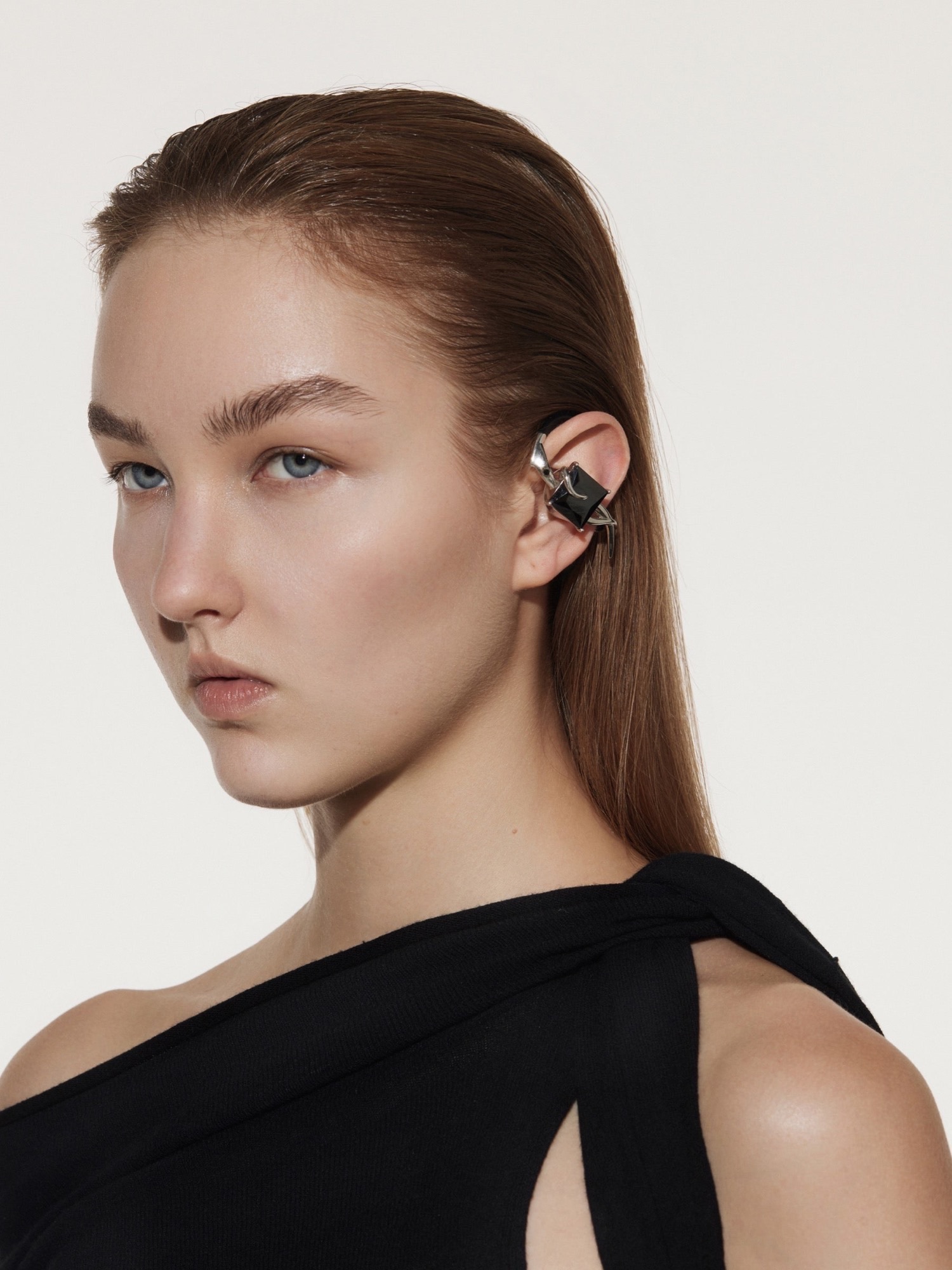
I like that reversal more than the promise of looking futuristic. It allows a monumental reference to become intimate without pretending that the monument itself has survived intact. The object is also audio hardware, which adds another complication. An earring can be considered largely through its visible relationship to a body; an earphone carries expectations of use as well. A cinematic name doesn’t settle those expectations. It makes the functional object available to a different kind of looking.
That difference matters for sci fi fashion. We can admire the way a device participates in a silhouette without treating its imagined world as evidence of its technical quality. Equally, the fact that something has a practical function doesn’t mean its appearance is an irrelevant shell. The ear is a small site, but it sits next to the face. An object there can change how we read a person before we know anything about what it does.
How Does Fashion Photography Create a Cosmic Setting?
Photography can push that transformation further than an object can manage on its own. In Mugler’s 2023 Angel Elixir campaign image, Hunter Schafer appears in a reflective outfit against a dark blue setting, leaning across a glossy surface. A star-shaped perfume bottle occupies the space beside her. The pose, reflection and lighting bring body and product into the same unreal environment. Mugler credits Harley Weir with the print campaign.
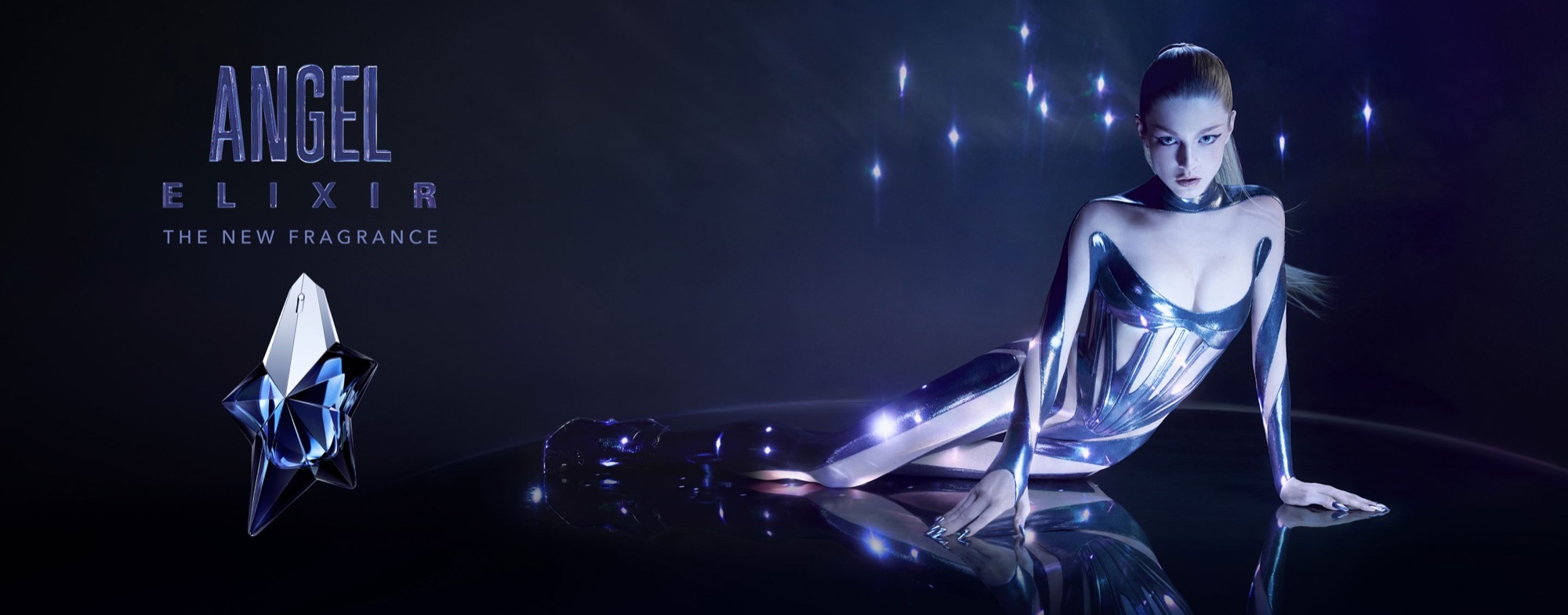
The accompanying film, directed by Quentin Deronzier, goes further: the brand describes fragments of stars becoming a digital crystal catsuit. That’s an event in the film, not something a still photograph can demonstrate. It’s also a useful neighboring example of cosmic fantasy rather than a claim that every star-filled campaign is space opera. The transformation is being produced through an image, not simply offered as a garment.
This is where futuristic fashion photography interests me most. Its body can inhabit conditions that an ordinary wardrobe cannot provide. We can enjoy that invention without confusing the product for the entire experience pictured around it.
How Do Installations Change the Scale of an Accessory?
A photograph also lets the viewer remain at a comfortable distance. You don’t have to decide how to move through its space, or what your own body would look like beside its figure. A physical installation has to deal with those questions, even if it later circulates mainly as another photograph.
OF HUNGER’s image of its SKP-S concept space in Beijing shows oversized dark heads wearing enlarged, gleaming ear objects. An illuminated band crosses the faces, while bright product displays sit underneath. The brand places the space within a Cosmic Titan narrative and dates it to July 2025.
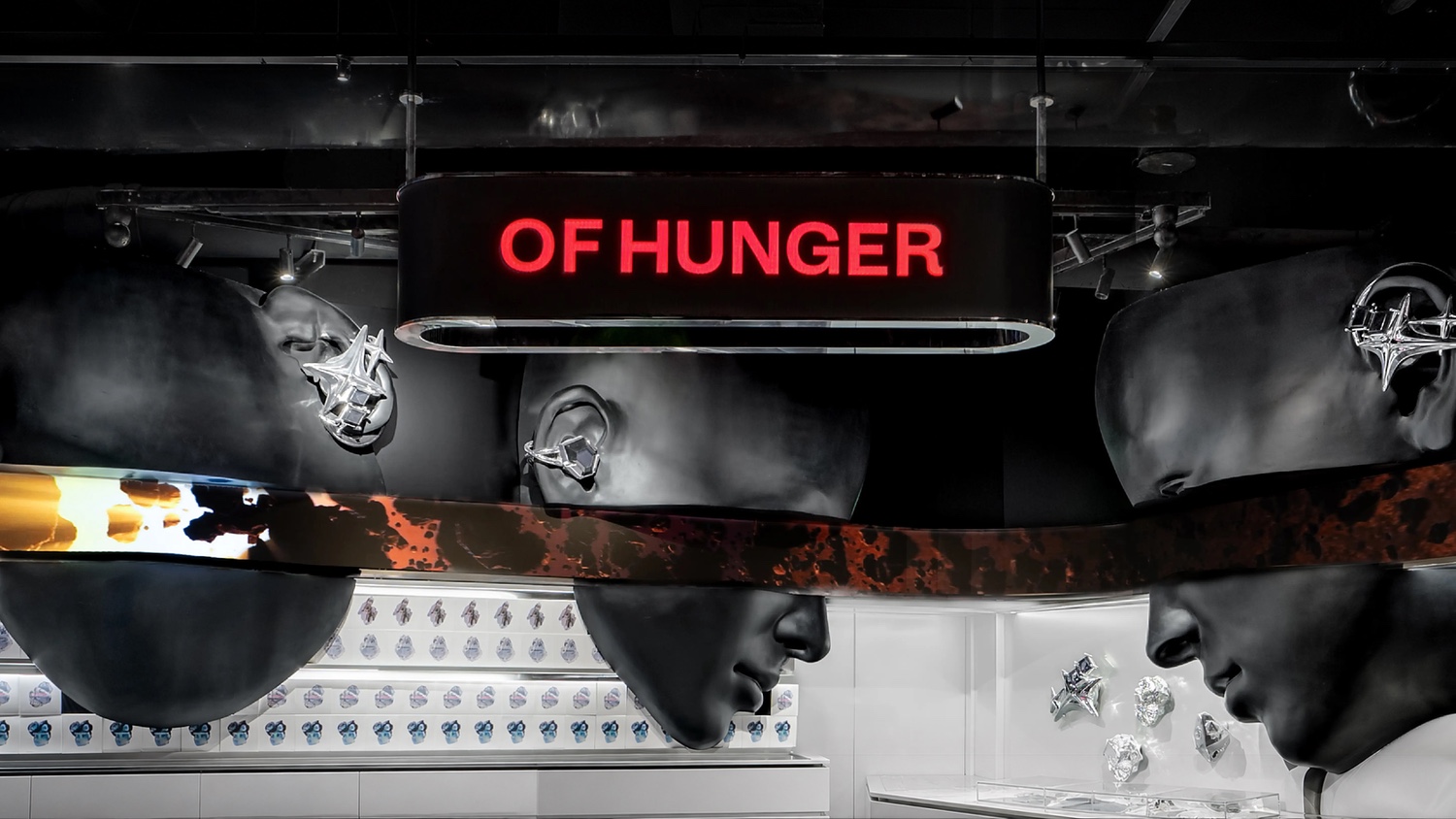
Here the ear has been enlarged along with the accessory. That is a different decision from putting a small product on a very large plinth. The heads turn the bodily relationship itself into the spectacle. A shape intended to sit next to someone’s face is presented at a scale that a visitor’s whole body must negotiate. Meanwhile, the smaller objects remain in their displays. The picture moves between an imagined inhabitant and merchandise in a shop.
And it is a shop. When considering sci fi art installations alongside spaces like this, I don’t think the commercial setting should quietly disappear because the sculpture is impressive. The installation gives products a world to belong to, and those products give the world something it can sell. Both functions are visible here.
That doesn’t automatically make the world less worth looking at. The opposite response, treating anything commercial as incapable of generating a meaningful image, would leave us unable to discuss much of fashion at all. What matters is whether we can see the relationship clearly. A room might make a small object feel like a fragment of a larger civilization. Buying that fragment does not give you the room, its scale or the experience of encountering it.
Do You Need to Buy an Object to Enjoy Its Imagined World?
There’s also something rather freeing about the fragment remaining incomplete. A pendant doesn’t need to explain the economy of its fictional planet. An earphone doesn’t need a screenplay. The surrounding image can offer enough context to make a shape suggestive, then leave the wearer some room to do something else with it. The fantasy becomes restrictive when it insists on supplying everything, including the person you’re supposed to become.
So I don’t want to separate these accessories from their pictures and spaces as if only the isolated product were real. The picture is a made thing too. So is the installation. What I want is to notice when my enthusiasm moves from one to another: when I’m drawn to a piece of jewelry, when I’m drawn to the character wearing it, and when I mostly want to stand inside the scene.
Those desires can overlap without being interchangeable. You might love a futuristic object and wear it with something its campaign would never put beside it. You might prefer the photograph to the product. And you might spend time with an imagined world without wanting to take any of it home. Looking is allowed to be the whole experience.