
4 Anime Digital Worlds to Explore, Plus Paprika’s Dreams
Explore how BELLE, Summer Wars, Den-noh Coil and Expelled from Paradise build digital spaces, with Paprika’s shifting dreams as a separate comparison.
TL;DR
- BELLE uses a moving concert and vast architecture to make a small performer stand out.
- Summer Wars contrasts OZ’s open white space with the crowded screens used to access it.
- Den-noh Coil layers digital content over familiar streets; Expelled from Paradise contrasts DEVA with a damaged Earth.
- Paprika offers a separate dream-space comparison, where scale and image boundaries can change.
A singer standing on a whale ought to be difficult to overlook. In BELLE, though, she can almost disappear. The animal’s enormous head fills the image, black speakers rise behind her, and the little red figure at their feet briefly becomes another accent in a city of illuminated towers. Then that change of scale registers: this whole improbable arrangement is carrying a person and her voice through the city. The buildings have become the surroundings of a concert.
It’s an inviting place to begin looking at anime virtual worlds, partly because the spectacle gives us something more particular to follow than the sheer quantity of things onscreen. Where does the eye land? How much room does a character have to move? Those questions lead to some very different recommendations: Mamoru Hosoda’s BELLE and Summer Wars, Mitsuo Iso’s Den-noh Coil, and Expelled from Paradise. Their digital spaces range from a destination entered through an avatar to a layer encountered on the street. After those four, Satoshi Kon’s Paprika offers a separate excursion into dreams, where even the continuity of the surroundings becomes negotiable.
BELLE (2021): A Concert Moving Through U
The whale is a wonderfully excessive piece of stage equipment. Its pale body gives Belle’s red dress a clear background, while the speakers make the amplification of that small body’s song physically enormous. The singer remains the point of attention without having to grow to the dimensions of the architecture. A close view can find her again; a wider one lets the distance between her and the speakers do the work.
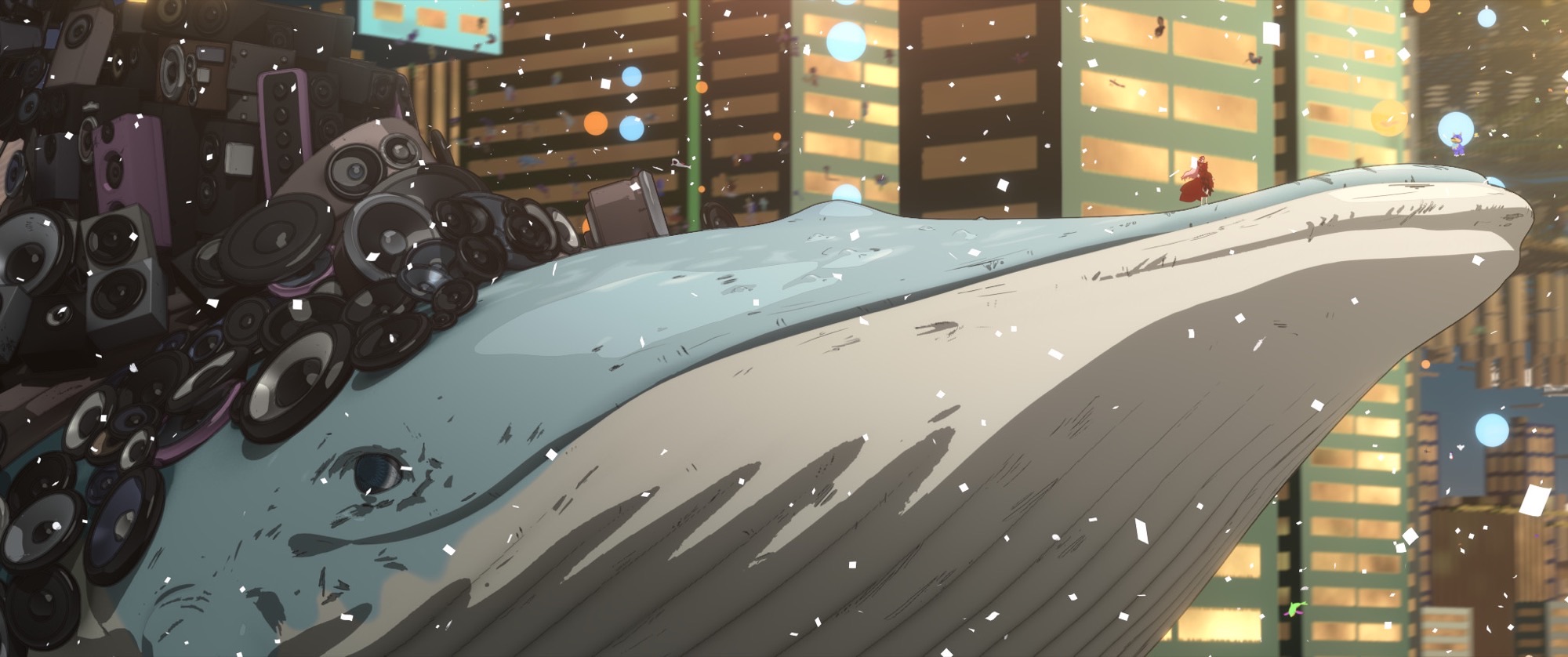
That relationship is especially effective within U, the virtual society where Suzu performs as Belle. Look past the whale and the surrounding city keeps extending along channels of light. Structures occupy the upper part of the image as well as the lower, turning what might have been an open sky into another inhabited surface. There is an abundance of detail, but the strong lines running into depth keep offering the eye a route through it. The city can feel immeasurable while a particular passage remains legible.
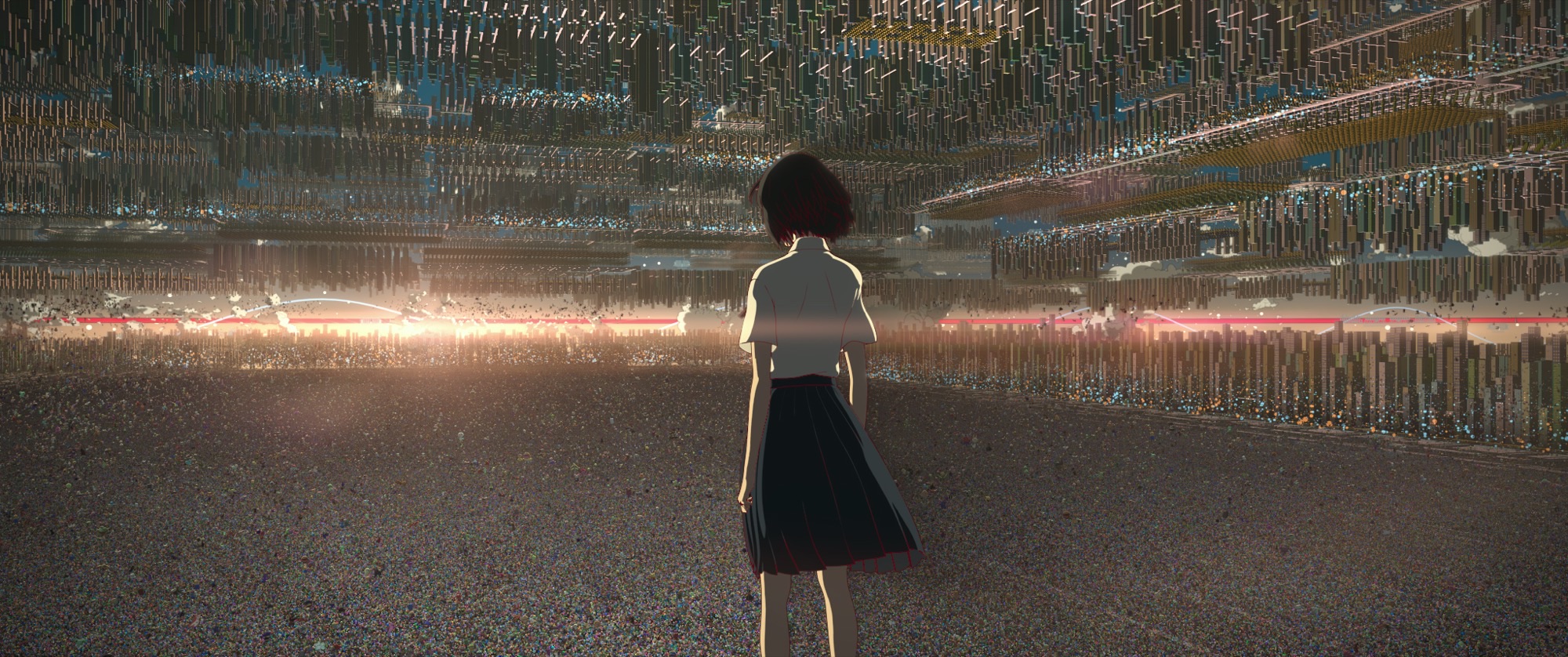
U’s architectural designer Eric Wong describes a space organized around a linear horizon, with buildings extending above and below. That helps explain the peculiar pull of these views. A conventional city gives us streets underfoot and a sky we can use to get our bearings. Here the familiar promise of a horizon survives inside a much less familiar distribution of buildings. We can recognize the invitation to travel without quite knowing where the ground ought to be.
And then a concert travels through it. There’s a lovely friction between the scale that makes Belle seem tiny and the staging that makes her impossible to ignore. Her costume contributes color and a silhouette; the whale, speakers and surrounding architecture establish where that silhouette matters. For all its appeal as an extravagant digital fashion image, the sequence’s strongest invention is this moving relationship between a performer and the space around her.
Summer Wars (2009): OZ’s Avatars and Physical Screens
For anyone exploring cyberspace anime, Hosoda’s earlier virtual environment makes a striking companion to U. OZ has room to spare. Against its white background, a crowd of brightly colored avatars can gather without becoming an indistinct patch of texture. A panda-like figure, a square blue head, a round green mouth: the differences are immediately available to the eye. Each new shape has a chance to register before the next one intrudes.
There’s a particularly useful arrangement around the red-clad rabbit fighter. His long ears and forward-reaching arms occupy the foreground, with smaller avatars spread behind him. The open white around his limbs preserves the gesture even as the crowd supplies a sense of public scale. Thin red contours help pale forms hold their edges. The scene can accommodate a ridiculous variety of bodies without requiring a building or a street corner to keep every participant in place.

Hosoda has spoken of wanting a welcoming white cyberspace rather than the ominous dark imagery often associated with computer worlds. What makes that choice interesting is how little reassurance the story ultimately allows it to offer. OZ supports everyday activity beyond entertainment, and an attack there has consequences outside it. The ease with which its bright inhabitants share the image belongs to a platform whose failures can spread into ordinary life.
The physical terminals provide another revealing view. People lean toward monitors crowded with graphs and map displays, while green countryside remains visible behind them. We are back among shoulders, screens and the limits of a room. The avatars’ spacious gathering and the users’ concentrated huddle describe different ends of the same connection.
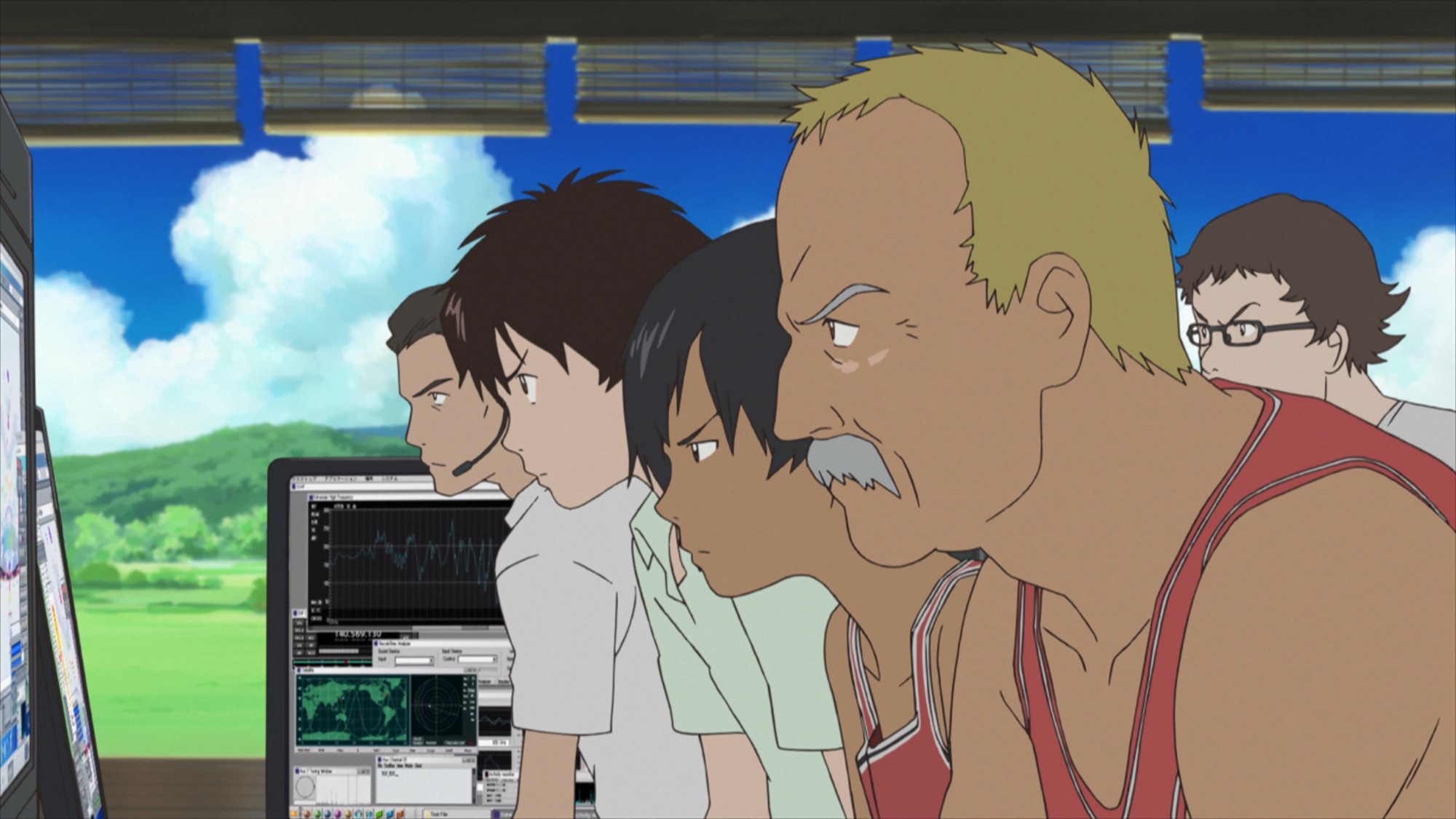
That distinction is useful when looking at anime digital interface design. The monitor’s panels are tools someone reads and operates; OZ gives the activity on the other side an inhabitable appearance. Its avatars include representations of users, while the platform also contains programs. Calling the whole colorful gathering a population of independent digital beings would miss how much of its drama depends on people reaching in from elsewhere.
Den-noh Coil (2007): AR in Familiar Streets
Den-noh Coil brings the distance between those two ends almost to nothing. Children wearing networked glasses encounter digital content in Daikoku, a town with old shrines and temples as well as advanced infrastructure. The neighborhood continues to exist beneath the information. A pair of glasses changes what can be found there.
The series’ anniversary artwork offers a neat expression of that arrangement. An enormous lens sits in front of an ordinary street, bringing the children and strange forms within its curve into sharper presence. Behind it, the road carries on between familiar buildings. The image doesn’t need to replace the neighborhood to make it extraordinary; the lens changes which occupants become available to our attention.

Even the combination of a digital pet and a concrete wall creates a different spatial problem from the vast corridors of U. The wall supplies a familiar measure of height and distance. Wires, fences and trees establish a place that was already full of objects before any digital companion appeared. An added creature has to share that visual field. Its position relative to a child matters because we already understand the child’s position relative to the street.

This is the particular appeal of augmented reality anime: the ordinary environment can retain its proportions and still acquire another set of possibilities. A small patch of road can hold information worth attending to. Looking down, turning a corner or following another person all remain recognizable actions, even when the reason for doing them belongs to the digital layer.
There’s an economy to that premise which I find more enticing than another enormous skyline. Familiar surroundings can contribute their own density without being covered in luminous decoration. The buildings needn’t announce that they belong to the future. That attention to familiar surroundings also matters when sci-fi design moves into everyday life. They give the eye something settled against which the digital additions can become surprising, a space whose existing boundaries make the prospect of another layer worth investigating.
Expelled from Paradise (2014): DEVA and Earth
Expelled from Paradise changes the scale of commitment. DEVA houses digitized human minds; it is a place where people live after leaving their original bodies behind. Security officer Angela Balzac travels to a devastated Earth in a material body to investigate an intrusion into that society. The journey makes the distance between digital and terrestrial existence more substantial than the gap between two displays.
One of DEVA’s most striking images arranges three gigantic figures above clouds. Gold mechanical forms, a gray classical figure and a red horned body occupy the space beyond a narrow blue approach. Circular markings overhead give the view a further sense of measured order. The architectural references differ, but their convergence feels deliberate: the approach leads toward figures that already dominate the encounter through sheer size.

There’s plenty of air in the composition, yet little of OZ’s cheerful invitation to mingle. A narrow route beneath immense bodies makes open space feel ceremonial. The gap is something to cross under the gaze of what stands ahead. This particular use of DEVA reads as an assertion of authority, even before we start asking what such a society expects from its residents.
Earth’s damaged towers and roads provide a harsher kind of scale. Their repeated openings and broken surfaces belong to construction exposed to destruction. A road through those structures feels like a surviving route within a damaged place, rather than a pristine path prepared for an audience. Angela’s material body must operate in this other environment, alongside the people who remain there.

The contrast opens a question about what a digital society makes available and what it asks its inhabitants to accept. Space looks freed from ordinary terrestrial damage, but access and permitted action still matter. For a recommendation built around visual environments, that is the film’s useful complication: a beautiful, expansive view can also arrange a person’s approach with considerable severity.
Paprika (2006): A Separate Dream-Space Comparison
Paprika belongs beside these works as a comparison, with one crucial change of terms. Its technology allows people to enter and record dreams. The spaces it opens are dream environments, rather than a network society or an augmented layer laid over a town. Their instability has a different source, and Kon makes that difference wonderfully troublesome to watch.

Consider the parade of dolls and household appliances. Objects whose sizes and uses normally help organize a room become members of a procession. Once they start moving together, their density acquires a direction: the image is crowded with things going somewhere. A viewer can follow that momentum even while the collection resists any sensible explanation.

The giant doll makes the disruption of scale especially forceful. A face that ought to belong to a small, manageable object looms against urban surroundings. The features remain recognizable, which makes the change more disconcerting. We don’t need an unfamiliar creature to make the city feel overmatched; a familiar object has simply acquired a size the buildings can no longer comfortably contain.
Other passages interfere with the surface of an image itself. When a detective crosses a movie screen, a boundary that separates an observer from a picture becomes a route into the action. That is a different visual pleasure from travelling through an elaborately built virtual city. The space changes what kind of movement it will admit, and the film invites us to follow before we have finished adjusting our understanding of it.
Paprika is particularly rewarding after the more ordered digital environments because its transformations unsettle the tools we have been using to read them. A clear outline can still identify a doll, yet fail to establish its proper scale. A frame can still contain a scene, yet fail to keep someone outside it. The dream supplies recognizable pieces and then changes how they fit.
It leaves an interesting choice of where to look next. An enormous digital world can draw attention through its expanses, but a single boundary may give us more to follow. The space around a small singer, the white between two avatars, the street seen through a lens: each depends on a relation the image lets us grasp. Paprika makes the grasp itself precarious. Faced with its movie screen, we recognize where the picture ends and the spectator stands. Then someone steps through, and the line we were using to separate those positions becomes the beginning of another journey.