
How Sci-Fi Design Moves from Movies into Everyday Life
How sci-fi films shape real products, clothing and buildings, and what changes when cinematic designs have to work in everyday life.
TL;DR
- Sci-fi films offer designers shapes, materials and imagined interactions; looking futuristic is not the same as delivering a technical advance.
- The influence runs both ways: real interiors and industrial research shape films, whose visual language can then return to products and buildings.
- Translating a cinematic object into everyday use means addressing fit, function and maintenance that a convincing screen image can leave out.
- A film reference can become part of personal style without recreating a character’s outfit; cosplay serves a different creative purpose.
The future apparently has a fingerprint problem. In Things to Come, the 1936 science-fiction film, some of the hats were made from Rhodoid plastic molded to look like glass. According to the BFI’s account of the costumes, they stayed wrapped until the actors were dressed on set, because handling them would spoil those immaculate surfaces. Which is a lovely little complication for sci fi design. Here is a civilization that looks technologically transformed, and someone still has to worry about smudges.
I find that detail more interesting than another announcement that the future has arrived. A movie can make an object feel inevitable before anyone has worked out how to live with it. We see the shape, the sheen, the person moving confidently through a room with it. We don’t necessarily see whoever is preparing it for the next take.
But it would also be unfair to dismiss all of this as packaging. A fictional object can give a designer something quite specific to pursue. Sometimes that’s a surface or a silhouette. Sometimes it’s a way of using a device that doesn’t exist yet. The trouble starts when we treat those as the same achievement. Looking futuristic, doing something new, and being pleasant to live with are separate things, even when a product photograph encourages us to experience them all at once.
How Do Sci-Fi Films Make Clothes and Materials Look Futuristic?
Before getting to the real objects, though, I think we need to make the future a little less uniform. What does it even mean for something to look like science fiction? Clean planes and controlled symmetry can suggest an orderly, engineered world. An organic curve can suggest something grown rather than assembled. These are useful readings, but they aren’t the natural properties of a particular shape. A curve doesn’t come with a date attached.
And the films themselves are much less committed to a single futuristic look than a rack of silver clothing might suggest. The BFI describes Blade Runner’s costumes as a mixture of older styles, including 1940s dressing, and contemporary punk. Its imagined future was already wearing the past, the same argument as Blade Runner 2049 and retrofuturist aesthetics. Meanwhile, Hardy Amies supplied 2001: A Space Odyssey with traditional tailoring as well as modern uniforms. Apparently moving into space doesn’t require everyone to abandon a good suit. That is closer to Andre Courreges and Space Age fashion than to inventing a new material for every scene.
This matters for sci fi inspired fashion because it gives us considerably more to work with than making everything shiny. A film can rearrange familiar clothes until they suggest a different social world. The same shape might read as a uniform, an expensive accessory, or a piece of protective equipment depending on what surrounds it. Remove it from the scene and some of that meaning disappears. That isn’t necessarily a failure. It might be where the design becomes useful to someone who isn’t a character.
How Did Real Design and Space Research Shape 2001?
Even the apparently otherworldly spaces have ordinary sources. The Design Museum notes that the hotel room near the end of 2001 was developed using photographs Kubrick took at London’s Dorchester hotel. I like the reversal here. We might look at a strange cinematic interior and wonder how to bring that atmosphere into reality, when part of its reality was there before the film.
The industrial connections are more direct still. In its account of the film’s production, the Museum of the Moving Image describes how Arthur C. Clarke introduced Kubrick to Harry Lange and Frederick Ordway, both formerly at NASA. Lange became a production designer; Ordway connected the production to industrial space research. So this wasn’t simply an artist making a prediction that engineers later scrambled to fulfill. Knowledge was already traveling into the film.
That makes the idea of futuristic industrial design less mystical, which I think is a good thing. A convincing screen object can borrow enough from existing engineering to make an unfamiliar world legible. A designer looking back at the film may then borrow from that transformation. The traffic can go both ways, with practical knowledge and dramatic invention getting mixed together. Calling the result a prediction gives the movie a very flattering amount of sole credit.
How Does OF HUNGER Turn Film References into Ear-Worn Objects?
OF HUNGER’s NEBULA Collection offers a more intimate version of this exchange. In its own account of the designs, the brand connects NEBULA to the organism in Life, MONOLITH to the monolith archetype associated with 2001, and STARSHIP to the spacecraft of Interstellar. Its descriptions distinguish flowing organic geometry from architectural planes and angular, directional forms. These are different cinematic references, brought into a collection of ear-worn objects rather than collapsed into one generic idea of space.
What interests me is what has to happen between those two scales. You aren’t putting a spacecraft on your ear. A direction, an edge, or a relationship between solid form and empty space has to do the work of suggesting it. A person who doesn’t recognize the reference still encounters a shape. The film connection can add another reading without becoming an entrance exam.

The construction also brings the fantasy back to something specific. OF HUNGER lists white-gold-plated copper, zirconia and ABS for the NEBULA product. That is a material description, not an extraterrestrial substance. The collection combines an open-ear audio device with an ornamental exterior; the result has to sit on a human ear, however far away its inspiration might be. The brand’s own fit guidance acknowledges that very small ears or flatter ear ridges may not hold it securely.
For me, that’s where futuristic accessories become interesting as design rather than as an image category. The outer contour might suggest a machine or a living form, but there is still a body underneath it with its own dimensions. Looking at it as jewelry and looking at it as an earphone place different demands on the same object. The cinematic reference can make that encounter more appealing. It doesn’t make the fit question disappear, and it doesn’t tell us how the audio sounds.
None of this means ornament needs to apologize for existing. A shape that someone enjoys wearing has a function in their life, even if that function isn’t measurable as a technical upgrade. I just don’t think a beautiful surface should be asked to prove a completely different claim. We can be attracted to the design without deciding that its appearance makes it more advanced.
How Did the Nike Mag Move from Film Prop to Working Product?
Then there are objects whose cinematic appeal really does depend on an action. The Nike Mag is a useful contrast because its film version appears to do something, not merely belong somewhere. In Back to the Future Part II, the shoe seems to lace itself. Nike’s archive explains that someone outside the shot was pulling strings to produce the effect.
There is our invisible helper again.
Nike released a public replica in 2011, with functioning power laces arriving in the 2016 edition. The distinction between those versions matters. Reproducing a recognizable shoe and reproducing its behavior are different design projects. In the film, the action only had to convince the audience. Outside it, an actual mechanism had to take over from the person pulling the strings.
This is the point where futuristic product design becomes more than a resemblance. The screen supplies a proposed interaction: put your foot in, and let the shoe handle the fastening. That gesture gives development a target. But a successful demonstration still leaves a designer with questions about weight, power, fit, maintenance and how the thing behaves when someone isn’t watching a demonstration. Those are questions I’d ask of a real product, not problems a film is obliged to answer.
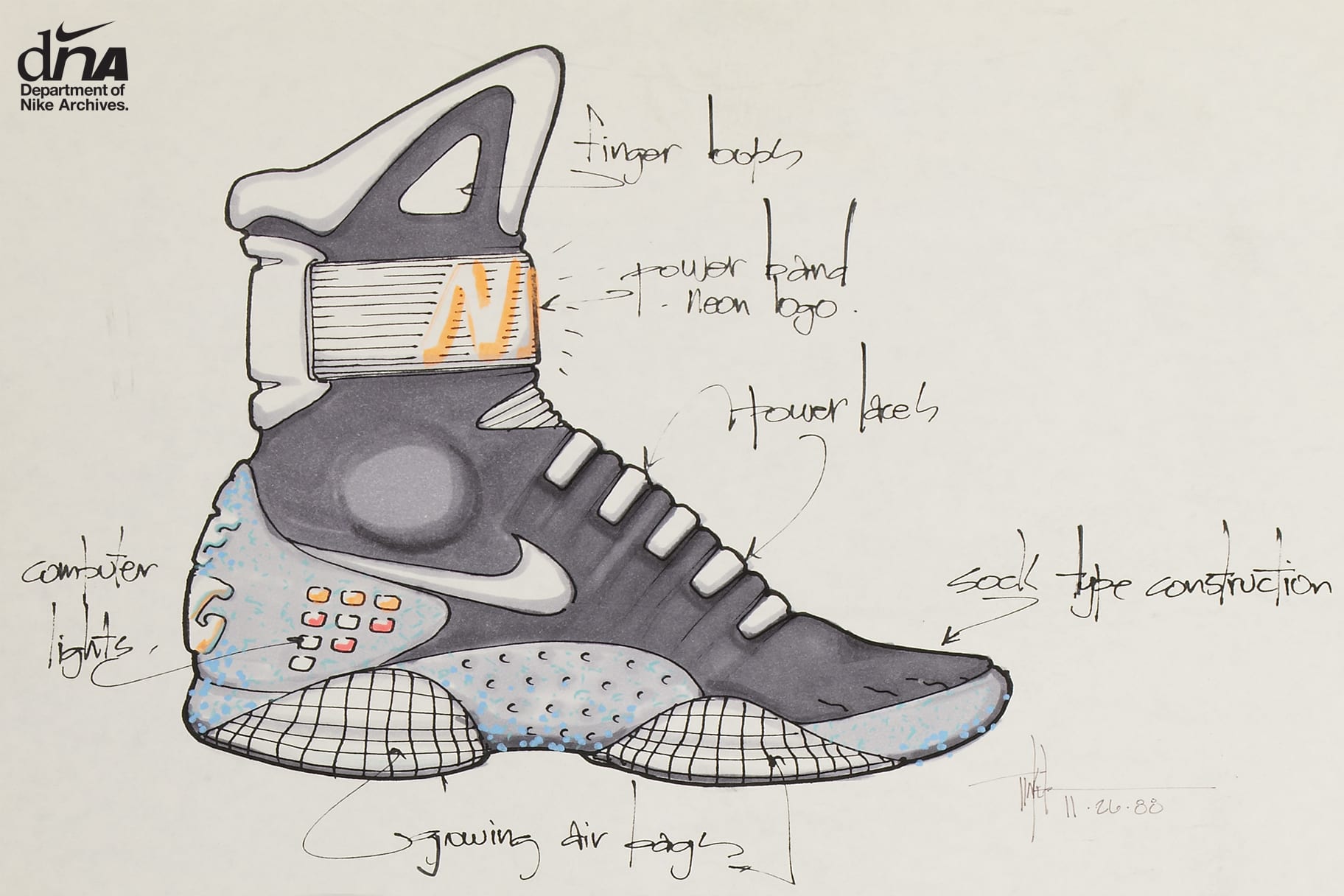
I don’t think that makes the cinematic version dishonest. Fiction is allowed to skip the inconvenient parts; that’s rather fundamental to the arrangement. The interesting part is what someone decides to build after seeing it. A movie can make a particular interaction desirable enough to pursue, without possessing the technical solution itself.
How Does Sci-Fi Influence Buildings as Well as Products?
The exchange doesn’t stop at objects you can buy and take home. The Museum of the Moving Image explicitly identifies 2001’s modernist appearance as an inspiration for architect Thomas Leeser’s design of its building, especially the spaceship-like Sumner Redstone Theater. Here the cinematic influence becomes a place where people watch other films. You aren’t carrying a prop into everyday life; you’re sitting inside an architectural interpretation.
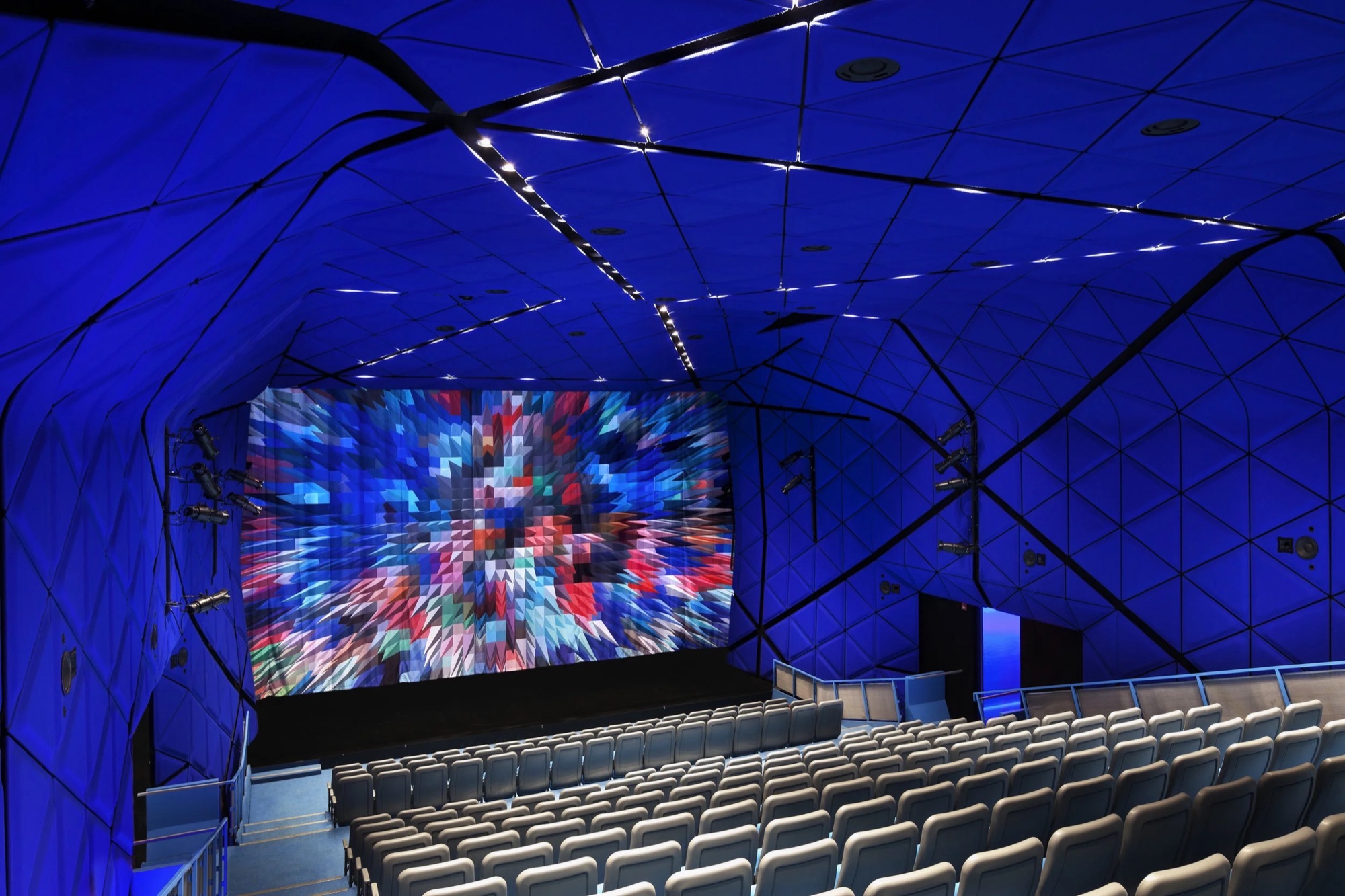
I find that a useful corrective to the tendency to imagine influence as a matching pair of pictures. Film object on the left, consumer product on the right, mystery solved. A room works through proportions, circulation and the relationship between your body and its surroundings. Even when a visual reference begins the process, a built space has to accommodate people who will occupy it rather than simply admire a still.
Where Is the Line Between Sci-Fi-Inspired Design and Cosplay?
All of which makes the boundary between science-fiction-inspired design and cosplay a little more complicated than whether something is sufficiently subtle. A highly sculptural ear accessory can work with otherwise ordinary clothes. A familiar-looking watch can carry an extremely specific film association. The amount of shine tells us very little about how literally someone is dressing as a character.
Hamilton’s Khaki Field Murph is a good example of the latter. Hamilton describes the watch as originally created for Interstellar, then recreated for a public audience after requests from fans. Its connection to science fiction is quite direct, but it remains recognizably a wristwatch. The story doesn’t have to be announced to everyone in the room for its wearer to enjoy it.
And I don’t want to make this into a hierarchy where discreet references are sophisticated and cosplay is embarrassing. Reconstructing a character’s appearance is a different creative project. It can involve serious attention to materials, proportion and construction. It simply asks for a different relationship between the person and the source. One outfit might be trying to make a particular character recognizable. Another might borrow a single design decision because the wearer likes what it does with their own clothes.
That second possibility is what a lot of science fiction inspired design can offer without demanding a whole new wardrobe. You can keep a contour and lose the fictional identity. You can take an interaction seriously while changing the object around it. Or you can keep the very recognizable object because you love the film. There isn’t one correct level of allegiance.
The question I’d rather ask is what survives when the surrounding movie is gone. With the Mag, the action becomes an engineering project. With OF HUNGER, the reference has to hold together as a form beside a face. With the Murph, much of the pleasure can remain private. None of those requires pretending the future has arrived in its entirety.
I still like the ambition of a hat that looks like glass. But the person keeping fingerprints off it belongs in the story too. Give that hat to someone who wants to wear it out, and suddenly they get to make decisions the film never needed: whether to keep it pristine, whether to accept the marks, whether they even like how it looks with their coat. That’s the part of the future I’d want some say in.