
How Qwen AI Wearables Use Glasses and Ear Clips as Different Interfaces
A closer look at Qwen Glasses and Qwen Clip, and why putting AI at the eyes or ears changes how wearable devices interact with the world.
TL;DR
- Qwen Glasses and Qwen Clip treat AI wearables as two different body interfaces: one for vision, one for hearing.
- Qwen Glasses N1 Pro centers first-person visual input, eye tracking, and visual interaction.
- Qwen Clip uses an open-ear clip form for face-to-face translation, AI note-taking, and voice-driven tasks.
- The important product decision is where the AI interface lives, not how many features appear in the launch list.
Qwen AI wearables are already starting to look less like one new product category and more like a choice about where you want the computer to live on your body. At the 2026 Apsara Conference, Alibaba introduced Qwen Glasses N1 and N1 Pro alongside Qwen Clip. One puts the computer in front of your eyes. The other clips it around your ear. That sounds like a small form-factor difference, but it is actually the whole story.
Because these are not just two versions of the same AI assistant. They are two different ways of interacting with an assistant. The glasses are built around first-person vision and visual interaction. The clip is built around hearing, speech, translation, and notes. So before getting distracted by the feature list, the better question is: do you want your AI to look at the world with you, or do you want it to stay in your ear and talk through the world with you?
That is the interesting thing about this announcement. It is not one of those launches where a company adds an AI label to a familiar device and calls it a day. Qwen is showing two body interfaces at once.
What do Qwen Glasses do as AI glasses?
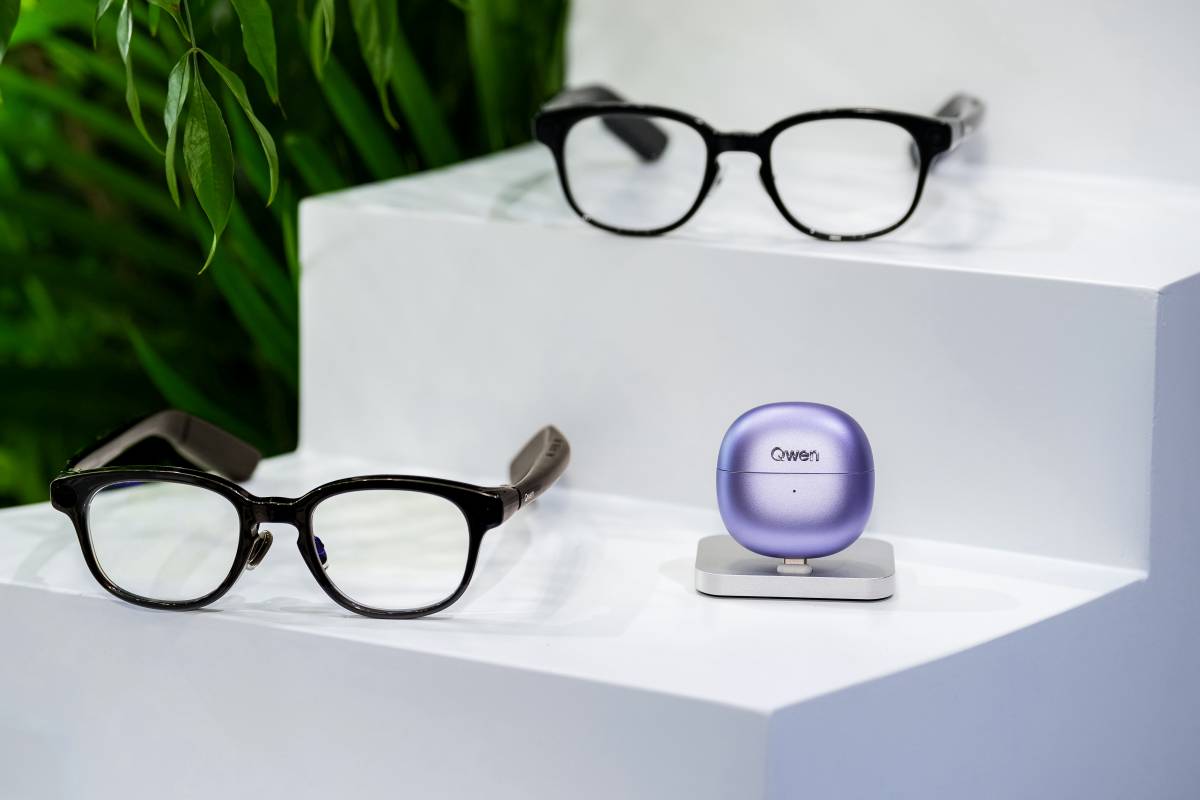
The glasses are the more obvious product. We already understand the basic pitch of AI glasses. There is a camera near your eyes, microphones somewhere around the frame, speakers near your ears, and an assistant that can respond while your hands stay free. But Qwen Glasses N1 Pro pushes the important part of that idea toward the front of the face. Alibaba describes a 50-megapixel first-person camera, eye tracking, and visual interaction. In other words, the glasses are not just trying to hear what you ask. They are trying to understand what you are looking at.
That changes the interaction model quite a bit. A voice assistant waits for a request. A camera-based assistant can begin with a scene. You look at something, the device has a visual input, and the question can become, “What am I looking at?” or “What is happening over there?” The eye is now part of the control loop, not just the place where a display might eventually appear.
This is why Qwen Glasses make sense as AI glasses rather than just glasses with a camera attached. The frame is acting as a small first-person computer. The object you are looking at is the starting point, the camera is the input, and the assistant is the layer that turns that input into an answer or an action. That is a much more direct relationship between your attention and the machine.
Why does eye tracking matter?
It also explains why eye tracking matters here. Eye tracking is not only about making an interface faster. It can give the device a better idea of what part of the scene is relevant to you. That sounds obvious when you say it out loud, but it is a major difference between a wearable that simply records the world and one that is meant to interact with the part of the world you have selected with your attention.
How is Qwen Clip different from AI earbuds?
The earbud-shaped side of this launch is more unusual. Qwen Clip is described as a clip-on open-ear device, with face-to-face translation, AI note-taking, and voice-driven tasks. Alibaba also says it was co-engineered with Bose. It is easy to file this under AI earbuds because it lives near the ear and plays audio. But the open-ear, clip-on form is doing something different from a conventional sealed earbud. That placement is already how clip-on open-ear earbuds and ear-worn audio get read as something you wear, not only something you listen with.
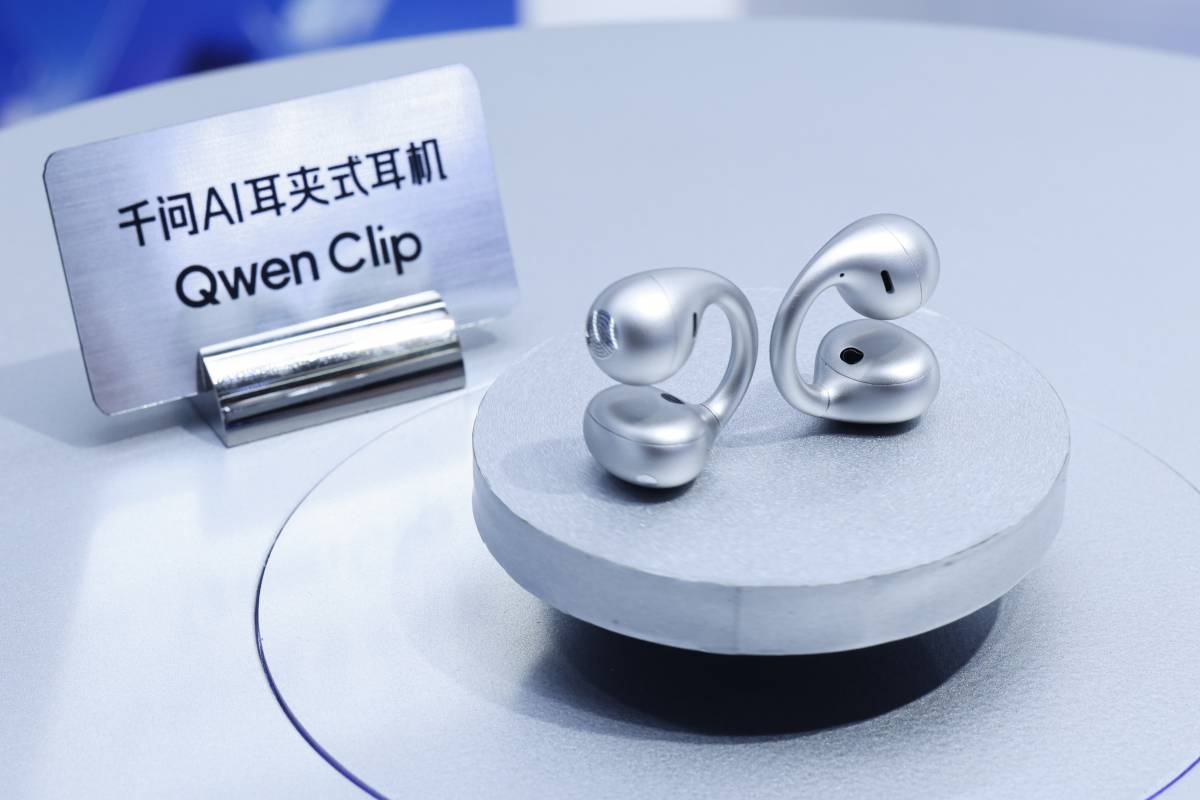
Traditional earbuds ask to be inserted. They create a private audio bubble, usually with some combination of an ear tip, a seal, and noise cancellation. An open ear earbuds design has a different social and physical ambition. It wants to deliver sound while leaving the ear more available to the room around you. Qwen Clip is not being positioned as a tiny pair of headphones that happens to have an assistant. It is closer to a voice interface that has been turned into an accessory.
What does the open-ear clip design change?
That is also why the clip-on design matters. A normal wireless earbud is visually familiar because the category has already decided what an earbud should look like. A clip can be more visible. It can sit on the ear as an object instead of disappearing inside it. It starts to look less like an audio component and more like something you are wearing on purpose.
The product language is doing a lot of work here. The phrase “clip on earbuds” is a useful description because it tells you where the object goes. But it does not fully describe what Qwen Clip is trying to become. The more accurate description might be an AI interface for the ear that happens to play audio. The product is not just asking whether you want music. It is asking whether translation, note-taking, and small voice tasks should be available every time you attach something to your ear.
How do these wearables change everyday AI interactions?
That creates two very different kinds of convenience. The glasses are useful when the answer depends on what you can see. The clip is useful when the answer depends on what you hear, what you say, or what someone is saying to you. Glasses turn the environment into a visual prompt. The clip turns conversation into an audio workflow.
Face-to-face translation is a good example. On paper, it sounds like a software feature. In practice, the body location changes the social shape of it. If the device is around your ear, the interaction can stay close to the conversation instead of forcing you to hold up a phone, look down, and turn the conversation into a screen-based activity. The Qwen Clip form is making a bet that translation should be available as part of the act of listening.
AI note-taking makes a similar bet. A phone can record a conversation, and a laptop can turn that recording into notes. But the clip form says the capture step should become almost invisible in the moment. It places the device at the point where speech is already entering your attention. That does not automatically make the experience better, but it does make the placement logical.
Why does the body location matter for wearable AI?
And this is where the comparison with Qwen Glasses becomes useful. The glasses are about adding a machine to the act of looking. The clip is about adding a machine to the act of listening. One feels more like a camera with an assistant attached. The other feels more like a voice assistant that has been given a body.
The difference is also visible to everyone around you. Smart glasses have to deal with the fact that other people can see the frame and may wonder what the camera is doing. An ear clip has a different kind of legibility. People can see that you are wearing something, but they may not immediately know whether it is jewelry, an audio device, or a piece of tech. That ambiguity is not a small design detail. It is part of how these products enter everyday life.
This is the same problem every wearable computer eventually runs into. A smartwatch is not only a tiny computer. It is a thing on your wrist. A headset is not only a display. It is a thing on your face. The physical form tells everyone how much attention the device is asking for, how visible it is, and whether it reads as technology, clothing, or something in between.
What does Qwen’s two-product approach reveal about wearable AI devices?
Qwen’s two-product approach makes that choice unusually clear. If you want the most direct connection to the world in front of you, the glasses are the stronger concept. If you want AI to stay in the background while handling speech, translation, and notes, Qwen Clip is the more interesting object. Neither form is simply better. They are optimized around different senses and different kinds of interruption.
That is also why the phrase wearable AI devices can be a little misleading. It makes the category sound like a pile of products that all do the same thing in different shapes. But shape is not decoration here. The shape determines the input, the output, the social context, and the kind of attention the product can request.
The bigger question is whether these things become more useful when the interface is split across the body. Maybe the future is not one perfect pair of AI glasses that sees, hears, speaks, records, translates, and displays everything. Maybe it is a set of smaller devices, each attached to the body part that makes the interaction feel most natural. Eyes for visual context. Ears for conversation. Hands for control. Something else for sensing the environment.
That sounds more complicated than one universal device, but it may also be more realistic. The best interface for looking at a street sign does not have to be the best interface for translating a conversation. The best device for capturing a first-person video does not have to be the best device for taking an audio note. Qwen is making the product category look less like a single race and more like a set of competing interface decisions.
So no, the main story here is not that Alibaba announced another pair of AI glasses and another pair of AI earbuds. The main story is that the same assistant is being designed around two different places on the body. Qwen Glasses make the eyes the beginning of the interaction. Qwen Clip makes the ear the beginning of the interaction.
That is a much better way to think about Qwen AI wearables. Not as gadgets that add more features to your day, but as products that decide which part of your body gets to become the next computer interface. And between the eyes and the ears, that decision may matter more than the number of features in the launch presentation.
Frequently Asked Questions
What are Qwen AI wearables?
Qwen AI wearables are devices that place an assistant at a specific body interface. In this launch, Qwen Glasses focus on visual context while Qwen Clip focuses on listening, speech, translation, and notes.
How are Qwen Glasses different from Qwen Clip?
Qwen Glasses use the eyes and a first-person camera as the starting point for interaction. Qwen Clip uses an ear-worn, open-ear form for voice-driven tasks and conversation.
Is Qwen Clip an open-ear earbud?
Qwen Clip is described as a clip-on open-ear device, but its intended role is broader than audio playback. It is presented as an ear-based interface for translation, note-taking, and voice interaction.
Why does the body location matter for AI wearables?
Body location shapes the device’s input, output, social visibility, and the kind of attention it requests. A product placed at the eyes can work from visual context, while one placed at the ear can stay closer to conversation and listening.