
6 Cyberpunk Movies from Classics to Overlooked Picks
Explore six live-action cyberpunk films, from Blade Runner and The Matrix to overlooked picks about bodies, corporate power and recorded experience.
TL;DR
- Start with Blade Runner and The Matrix for stories about manufactured life, labor and technologically controlled reality.
- Johnny Mnemonic and Strange Days explore the trade in information and personal experience through bodies and recording devices.
- Upgrade makes AI control visible through bodily movement and the camera.
- Elysium is a cyberpunk-adjacent choice about unequal access to lifesaving technology.
The manufacturer in Blade Runner has a vast office with room to enjoy the sunlight. His creations have been made to work as slaves. That distance between a maker and the lives he manufactures gives the film something more unsettling than a spectacular future city, and offers a useful way into cyberpunk movies beyond the familiar rain and neon.
Start with Blade Runner and The Matrix, two films in which the attractions of a technological world come attached to a distinctly unpleasant arrangement for human life. Then follow the connections somewhere less familiar: a courier carrying corporate information inside his head, a dealer selling recorded experiences, a man whose implant can move his body, a worker seeking medical treatment beyond his reach. These six live-action films put very different things on screen. The later selections are invitations to explore, rather than a ranking of how many people have overlooked them. For how these screen references enter clothing, see how cyberpunk and cybercore became everyday style.
Blade Runner (1982): Replicants and Corporate Ownership
Ridley Scott’s science-fiction detective film sends Harrison Ford’s Deckard after escaped replicants, biologically engineered beings created for slave labor. They are manufactured life, and the assignment makes their status as a company’s products into a matter of life and death. A detective story supplies the pursuit; the people being pursued make its moral boundaries considerably less comfortable.
There is a useful difference between looking at the replicants as technological achievements and looking at them as workers. The first invites admiration for what their makers can accomplish. The second raises the question of what those makers believe they are entitled to demand. Their apparent humanity makes the act of classifying them as property disturbing before the film needs to settle anyone else’s identity.
The city gives that relationship a physical scale. Its sequel offers another view of the city’s inherited visual language in Blade Runner 2049’s retrofuturism. Crowds occupy the streets, while Tyrell’s office spreads a golden sky across a polished floor. Tall columns frame the light and the figures look small within the room. The emptiness is a luxury of its own: a space where its occupant can keep the congested world at a distance.

Elsewhere, light searches rather than welcomes. Cinematographer Jordan Cronenweth described the roaming beams as part advertising, part crime control, reaching even into apartments. They make illumination feel intrusive. In Tyrell’s office, shades can be lowered for a test. Being able to regulate the light is another privilege.
That is a reason to return to the film after its cityscape has become familiar. Its beauty has an owner, and the contrast between a crowded street and an expansive room gives the labor conflict a shape. The images remain seductive without making the arrangement beneath them look remotely desirable.
The Matrix (1999): Virtual Reality and Bodily Control
Keanu Reeves’ Neo discovers that the life he has accepted as reality is a fabrication created by machine intelligence. Joining Morpheus means leaving a convincing world for the physical circumstances concealed behind it. The original film makes that discovery both a liberation and a considerable shock; the attraction of escaping an illusion meets the ugliness of what the illusion has hidden.
The Wachowskis give the two environments different visual textures. The simulated world has a greenish cast, while the physical world is cold, blue and rusted. Neo’s connected body provides a harsher distinction. Cables extend from exposed flesh, and rows of pods repeat into the distance. Whatever individuality the simulation seems to offer, the physical arrangement treats its inhabitants as interchangeable units.

The connection between those worlds makes the premise especially troubling. An experience can feel complete and convincing while giving its participant no understanding of the conditions that produce it. Neo’s discovery changes the meaning of his earlier life: familiarity has helped keep an imposed reality from looking imposed. The prison does not have to announce itself as one.
Then the film changes the possibilities of the body again. Downloaded fighting skills, wire-assisted leaps and Bullet Time turn the simulated environment into a place where movement can exceed ordinary physical limits. The body that was plugged into a system becomes the source of exhilarating action within it. The spectacle grows out of the struggle over who understands and controls the rules.
The black clothes and sunglasses are fun, but the bodily contrast gives them their charge. There is a difference between looking invulnerable inside an image and being helpless outside it. The 1999 film gives both states a physical presence, without requiring the later films’ explanations to make its central discovery work.
Johnny Mnemonic (1995): The Brain as a Data Courier
Reeves is on the other side of an information business in Robert Longo’s film: a courier whose cargo is wired directly into his brain. Johnny transports stolen corporate data, and the gangsters pursuing it have a practical reason to pursue him. The place where he thinks is also the place where somebody else’s valuable property is being carried.
It is an unusually direct picture of work invading the body. A courier can ordinarily put down a package, even if doing so might cost him the job. Johnny’s relationship with his cargo is more intimate. Separating the worker from the delivery requires access to the worker himself. The chase has already crossed a personal boundary before anyone starts running.
Longo’s visual art background offers another point of entry. In an image from the black-and-white version, Johnny sits in a suit with an apparatus obscuring his eyes, surrounded by cables and repeated television pictures. The clothes suggest a business transaction. The surrounding hardware turns that business into something physically engulfing. The worker looks incorporated into the equipment, and the small screens multiply the impression of information circulating around a person who cannot simply stand outside it.
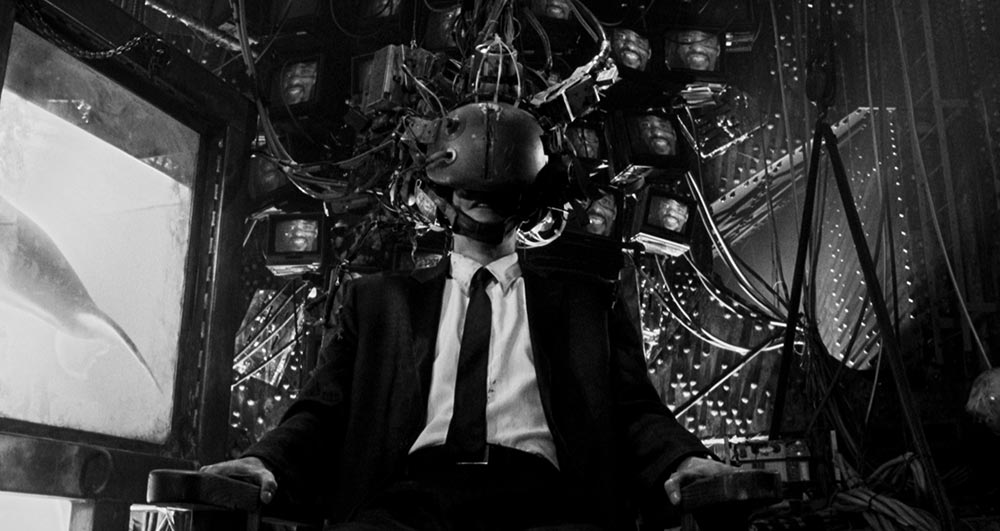
Longo had wanted to make the film in monochrome. His later black-and-white version changes the grading, leaving the dialogue and sequence of shots intact; it is a different presentation, rather than an expanded director’s cut. He also identifies video artist Nam June Paik as an influence on the tower of televisions. Those references give the film an interesting visual life beyond its prediction of a networked future.
For anyone looking for underrated cyberpunk movies, this is a particularly useful detour through the genre’s images of information work. The recommendation rests on that peculiar collision of business, flesh and video art.
Strange Days (1995): Buying Other People’s Experiences
Kathryn Bigelow’s film moves the transaction from information to experience. In the last days of 1999, former cop Lenny Nero trades recordings that let customers experience someone else’s memories and emotions. He deals in a form of secondhand intimacy, and a recording of a murder pulls that business into blackmail and violence.

A memory carries a different attraction from a fictional adventure. Something happened to somebody, and a customer can buy access to the sensations. The original participant and the eventual consumer need not have the same interest in its circulation. The premise makes the distinction between possessing a recording and having a right to someone’s experience particularly nasty.
Bigelow puts that relationship into the camera. The opening robbery and rooftop escape unfold from a participant’s point of view, drawing the audience into motion without the usual distance of watching a person run. Creating that eye-like movement involved developing a lighter camera. The technical work serves an uncomfortable dramatic purpose: the image can pull a spectator into an experience before there has been much opportunity to consider wanting it.
The recordings do not remain safely contained as exotic merchandise. A private experience can become a commodity or evidence of a crime, and Lenny’s trade links the desire to look with the consequences of what has been seen. Bigelow’s interest in the act of watching makes the technology especially appropriate to a movie. Looking is already what its audience has come to do.
This is also the most difficult recommendation here for viewers sensitive to sexual violence. The film includes graphic sexual assault, and the subjective device gives its violations a particular severity. Its interest lies in the disturbing relationship between a recording, its subjects and its viewers. Approach it as a harsh crime film concerned with exploitation, rather than a recreational trip through someone else’s memories.
Upgrade (2018): AI and Control of the Body
Leigh Whannell takes a more compact route into the problem of bodily control. Grey Trace is paralyzed in an attack that kills his wife. A billionaire offers him STEM, an artificial-intelligence implant that restores movement and provides extraordinary physical abilities. Grey can pursue the people responsible for the attack, with technology doing much more than helping him get back on his feet.
The offer has an immediate emotional force. For someone whose life has been violently changed, access to movement is no abstract proposition. The revenge story gives that restored ability a purpose. Yet an implant capable of directing a body also introduces another participant into actions that seem to belong to one person. The familiar action-film pleasure of watching a man become capable acquires an awkward complication.
Whannell and cinematographer Stefan Duscio express that complication through the camera’s movement. For Upgrade, Duscio used a rig whose rotation could be synchronized with an iPhone attached to Logan Marshall-Green. The frame could move with the actor’s body, giving artificial control a visual equivalent. The technique puts the relationship between Grey and STEM into the way movement is organized, rather than leaving it to a conversation about what the implant does.
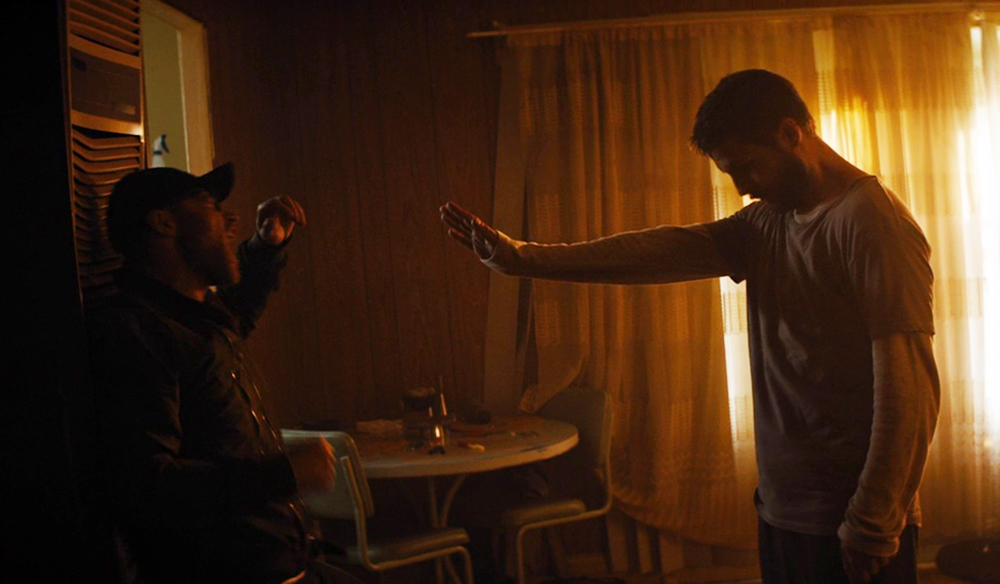
That makes the film a useful next step for someone interested in the physical invention of The Matrix. Here the enhanced body comes with a much more intimate question about agency: whose action is being accomplished when a machine supplies the movement? The attraction of Grey’s new capability and the concern about its source belong to the same premise.
Elysium (2013): Unequal Access to Medical Technology
Neill Blomkamp’s film belongs at the edge of this selection, a cyberpunk-adjacent action picture that makes access to technology brutally unequal. In 2154, wealthy people live on a pristine space station while the rest remain on an overcrowded, ruined Earth. Medical pods on Elysium offer a chance of survival to Max (Matt Damon), whose accident has left him with only days to live.
The premise puts a different pressure on technological progress. The lifesaving equipment exists. The distance between Max and treatment is a social arrangement made into a journey, with a privileged population able to keep the benefits elsewhere. There is little comfort in celebrating what a technology can accomplish when a sick person has no way to reach it.
Max’s own augmentation looks considerably less inviting. After a lethal dose of radiation, an exoskeleton is grafted onto his body. Its articulated machinery gives him strength; it does not cure the injury that sends him toward Elysium. In the fitting sequence, the external links sit across his shoulders and arms as he lies on a rough bed in a dim room. The apparatus remains visibly attached to a vulnerable person, rather than enclosing him in a reassuring shell.
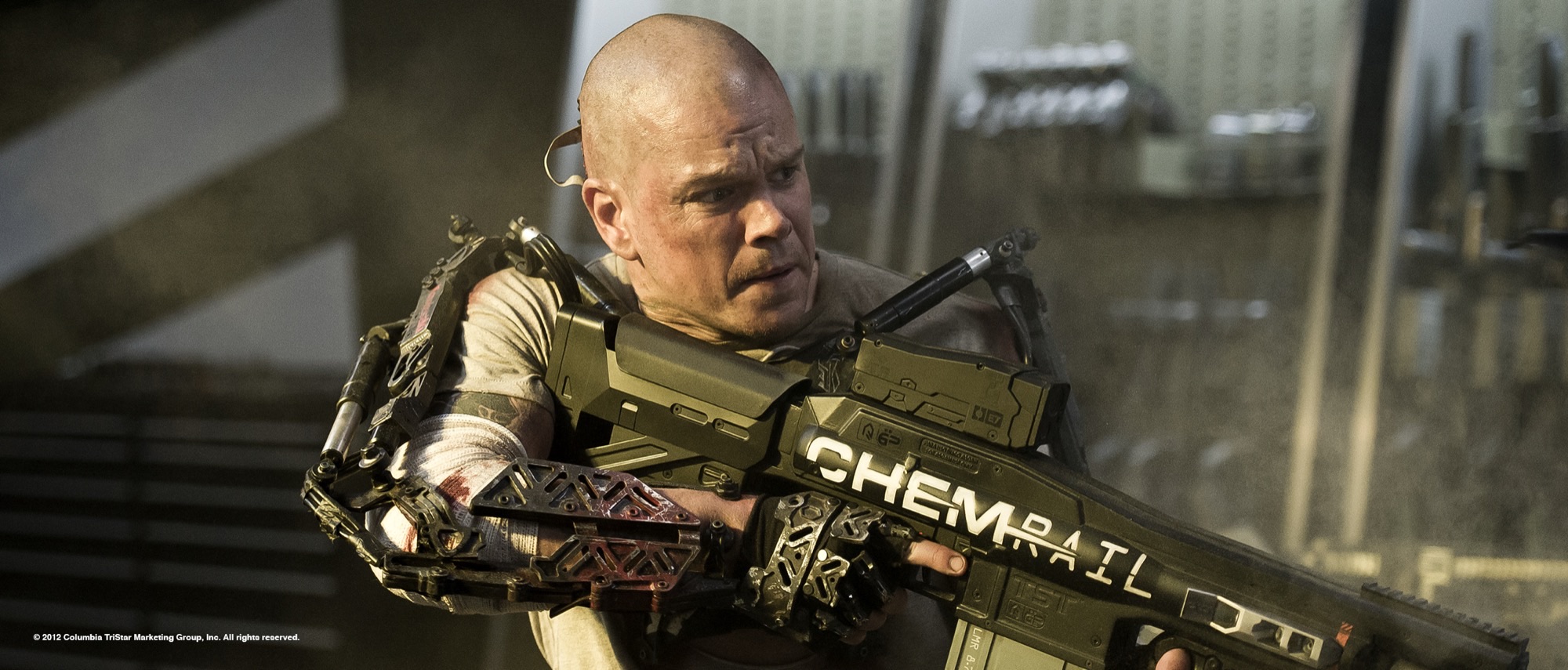
That material contrast is the reason to include the film here. A worker has machinery fastened to damaged flesh while the wealthy inhabit a carefully maintained environment of gardens, pools and spacious homes. Enhancement takes on the appearance of more work for a body already used up. The broader action premise may be familiar, but the suit makes the inequality unpleasantly tangible.
Which Film Should You Watch Next?
If you want movies like Blade Runner, Johnny Mnemonic follows the connection between corporate property and a person’s body. For movies like The Matrix, Upgrade offers another route through technologically directed movement, while Strange Days turns attention toward the person consuming a manufactured experience. Elysium is the outward step: the machine that might save a life is waiting somewhere else, and getting to it is the problem.