
Why avant garde fashion keeps coming back in different disguises
A wiki-style fashion essay on avant garde fashion, the fashion trend cycle, modernism, decadence, kitsch and postmodern style as recurring visual languages.
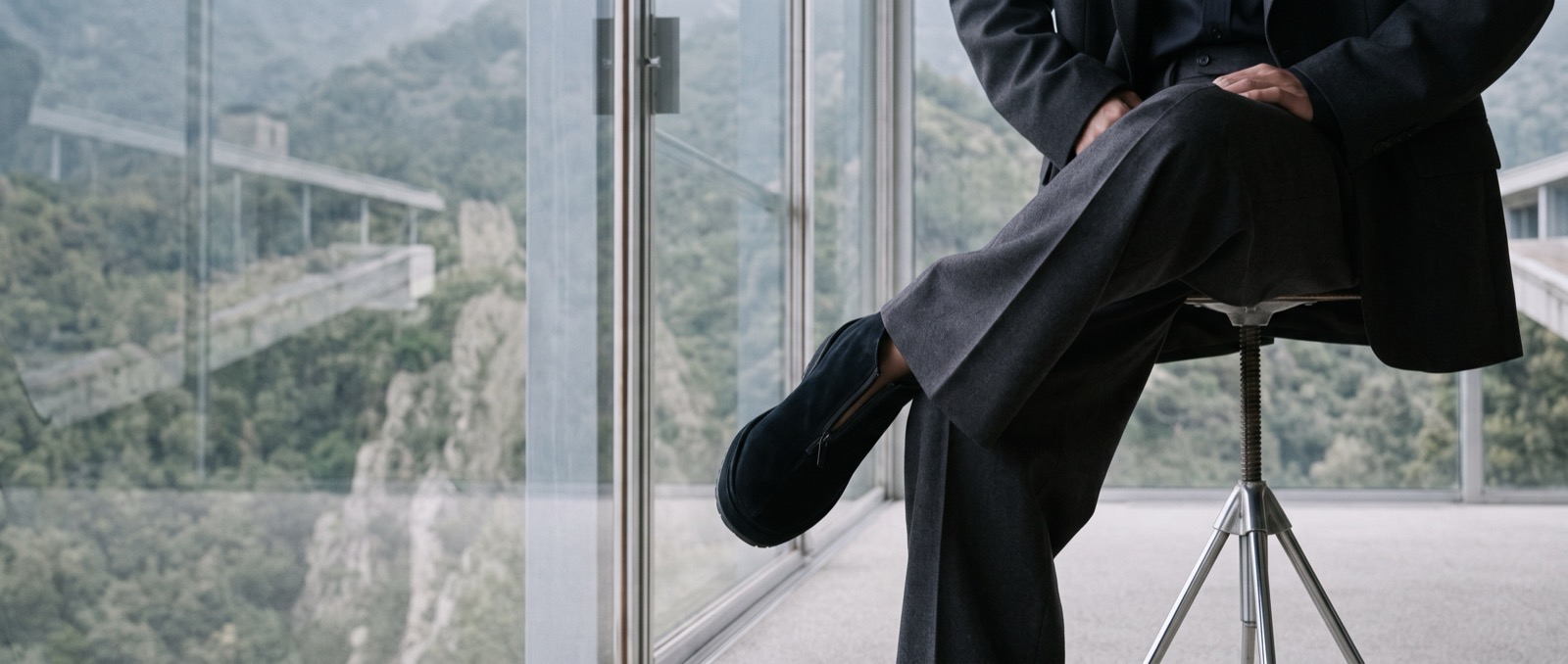
Fashion does not repeat because designers run out of ideas. I think that explanation is too easy, and frankly, too boring. Fashion repeats because the industry keeps returning to the same emotional problems with different visual tools.
We want discipline, so modernism fashion comes back. We want rupture, so avant garde fashion comes back. We want pleasure after restraint, so decadence comes back. We want irony when everything feels overproduced, so kitsch fashion and postmodern fashion come back. The clothes change. The anxiety does not.
That is the useful way to understand the fashion trend cycle. It is not a neat wheel where one skirt length replaces another skirt length every few years. It is a recurring argument about what the body is allowed to be: efficient, offensive, indulgent, silly, unserious, controlled, chaotic, expensive, impossible, approachable, untouchable.
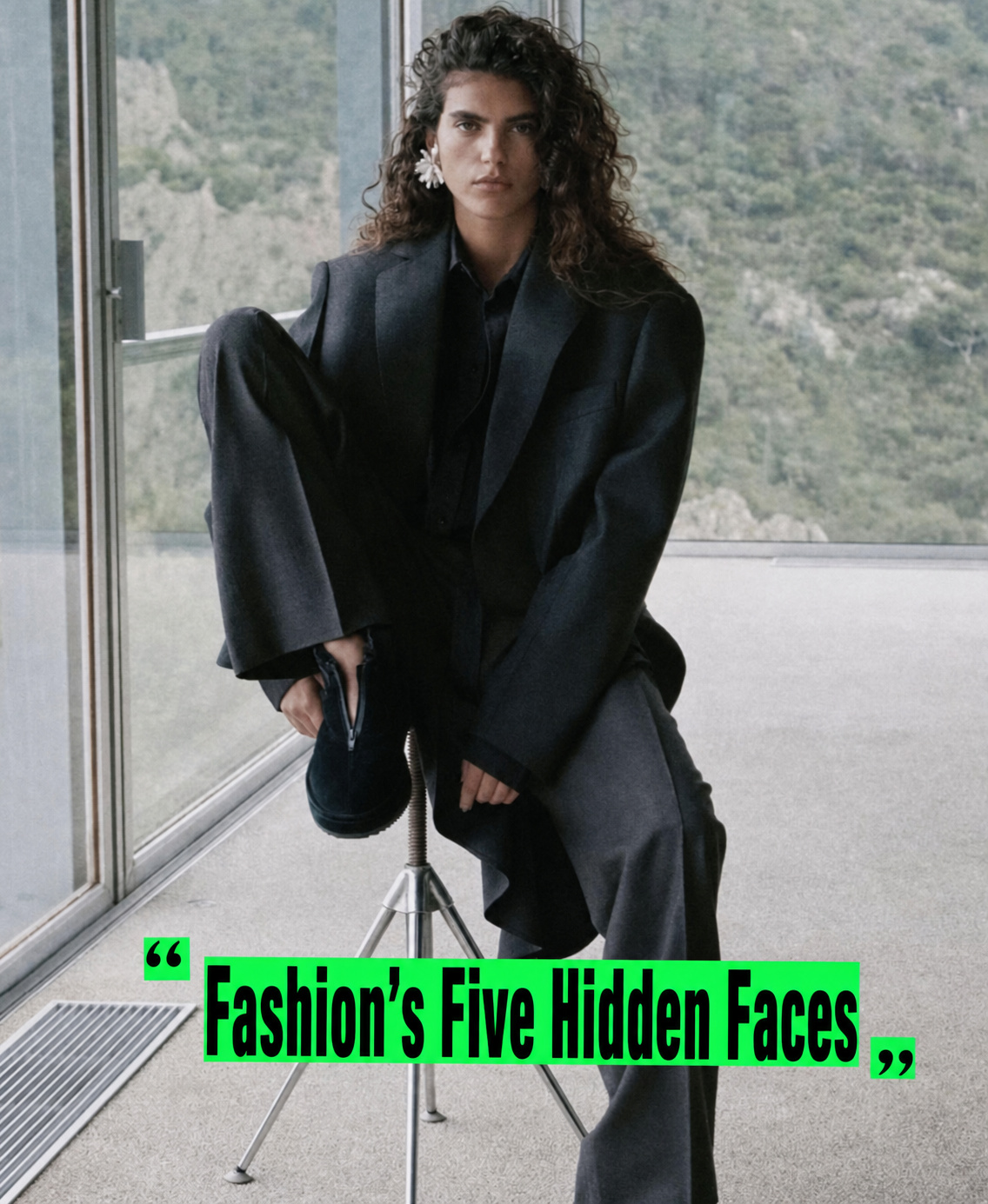
The fashion cycle is emotional, not just visual
When people ask why fashion trends come back, the answer usually gets flattened into nostalgia. We loved the 1990s, so the 1990s came back. We miss Y2K, so Y2K came back. We are bored of minimalism, so maximalism returns. There is truth in that, but it does not go far enough.
Nostalgia explains the reference. It does not explain the need.
The real question is: what does a society want from clothes at a particular moment? Do we want rationality? Escape? status? mess? beauty? irony? protection? distance? When the emotional weather shifts, old aesthetics become useful again because they already contain a vocabulary for that feeling.
This is why fashion is cyclical but never identical. The return is not a photocopy. It is a translation.
Modernism: the fantasy of control
Modernism fashion is the cleanest face in the room. Less is more, the body is rational, beauty should feel precise, and the outfit should behave like it has read a very serious design manifesto.
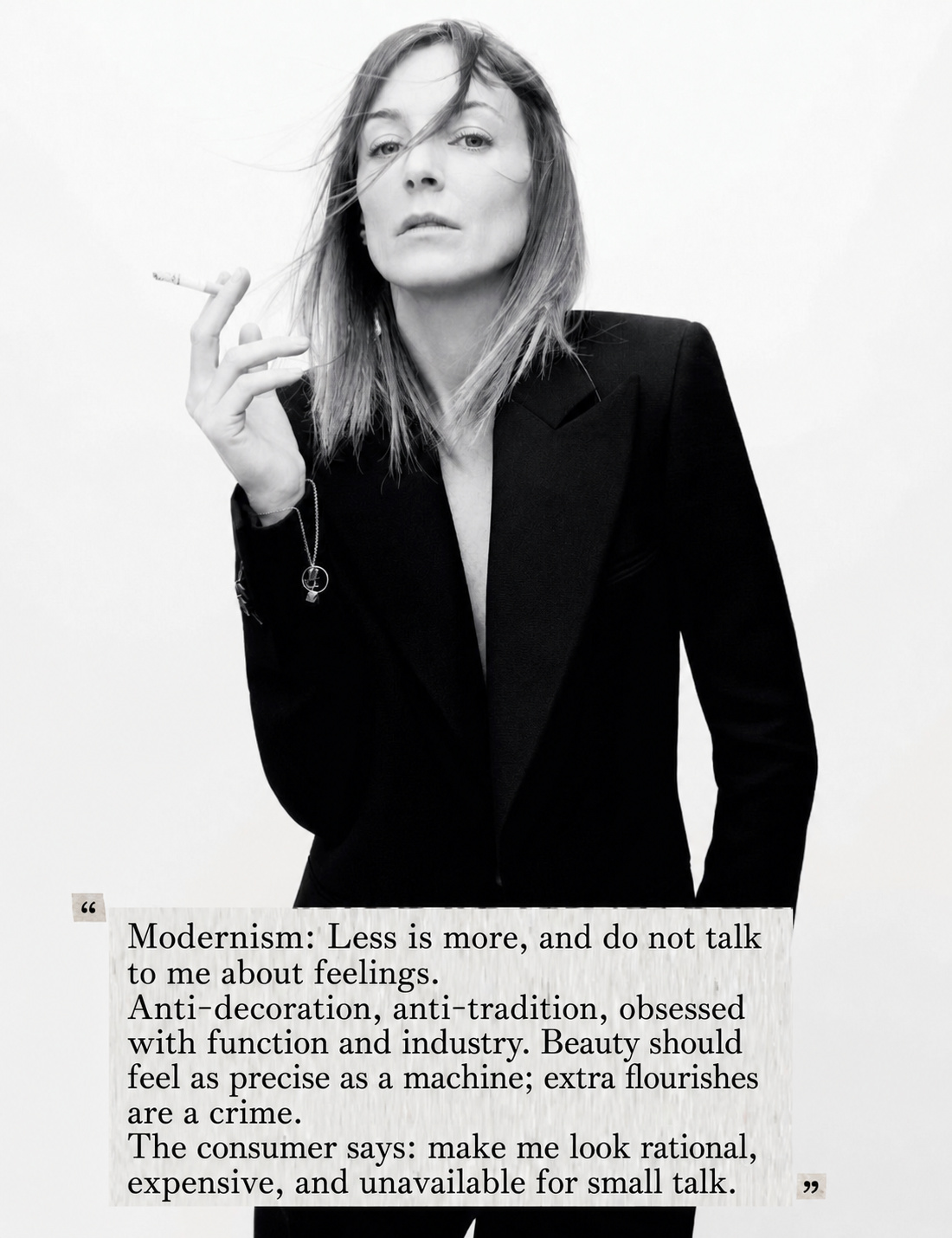
I understand the appeal. When the world feels noisy, a black blazer can feel like a moral decision. Sharp tailoring, monochrome palettes, clean lines and anti-decoration create the fantasy that taste can protect you from chaos. The modernist outfit says: I am not participating in the mess. I have standards. I am unavailable for nonsense.
But modernism also has a smug little shadow. It can pretend that restraint is always more intelligent than decoration. It can turn simplicity into a class code. It can make people believe that the quietest outfit in the room is automatically the most tasteful one.
That is when the cycle starts pushing against it.
Avant garde fashion arrives when politeness starts to rot
Avant garde fashion is the refusal. It does not enter the room to soothe anyone. It comes in oversized, distorted, aggressive, conceptual, uncomfortable or deliberately unflattering. It asks whether beauty is even the right goal.
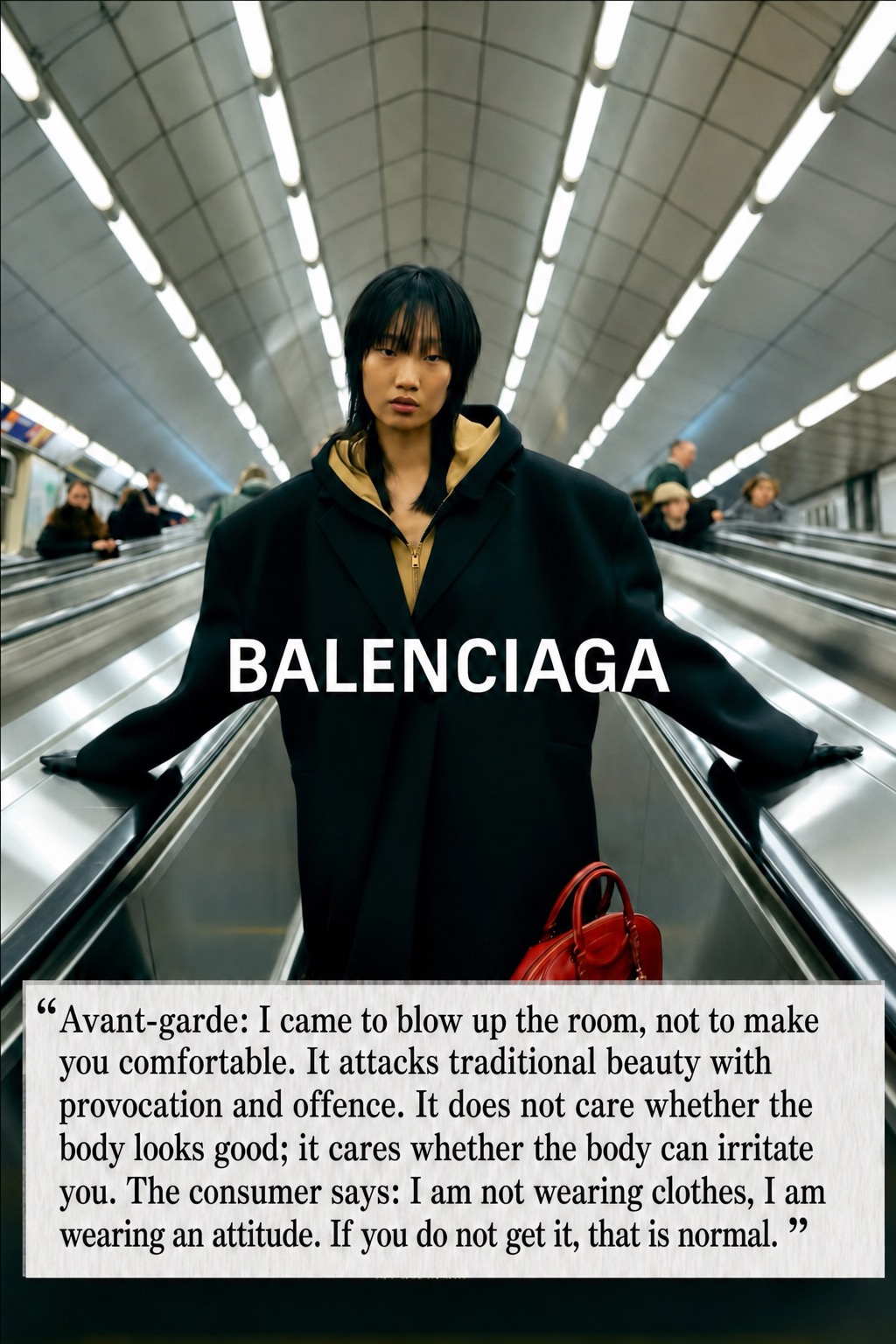
This is why avant garde fashion keeps returning. It gives clothes permission to irritate the eye. That sounds dramatic, but I mean it quite literally. When too much fashion becomes about looking nice, expensive and frictionless, the avant garde becomes necessary again because it reintroduces discomfort.
The oversized black silhouette here is not trying to make the body conventionally flattering. The body becomes graphic, almost architectural. The word across the midsection turns the image into a declaration. It is not saying, “Look how pretty I am.” It is saying, “You are going to deal with me.”
I like that. Not because every outfit needs to be difficult, but because fashion needs difficulty somewhere. Otherwise everything collapses into shopping content.
Decadence comes when restraint becomes exhausting
After control comes appetite. Decadent fashion is not interested in good behaviour. It wants slowness, texture, rot, shine, fur, heaviness, pleasure, exhaustion and the beauty of too much.
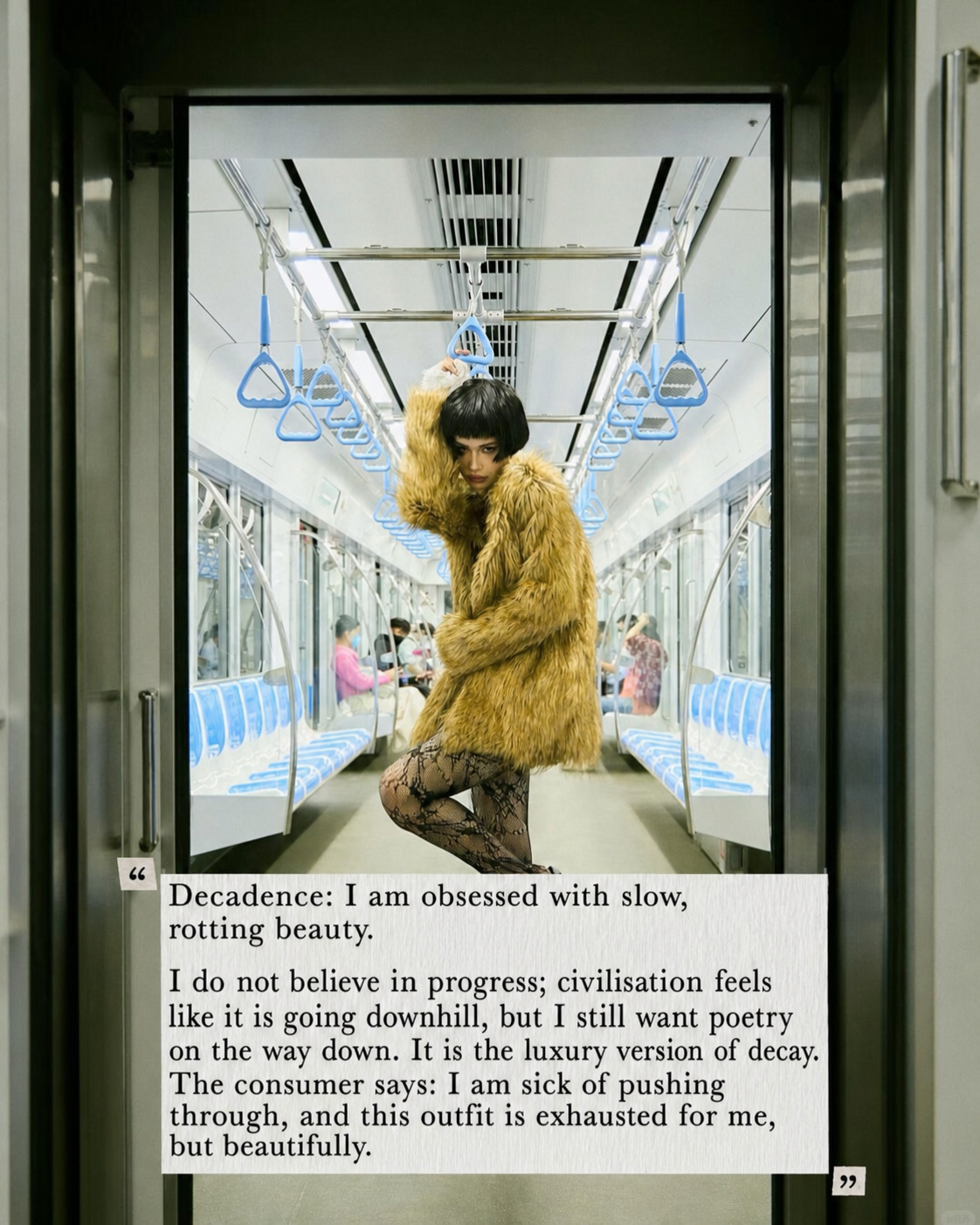
The decadent look says civilisation is tiring, so let the outfit become a little overripe. It is not clean glamour. It is glamour with residue. The fur, the train carriage, the slumped posture, the sense of being dressed for somewhere more dramatic than the commute: that contrast is what makes it work.
This is one reason the fashion cycle keeps swinging between minimalism and excess. Minimalism promises discipline. Excess promises release. Neither can satisfy forever because both eventually become their own trap. Too much discipline becomes sterile. Too much decadence becomes costume. So the cycle turns.
Kitsch is what happens when good taste gets boring
Kitsch fashion is often dismissed as unserious, but I think that is exactly where its power sits. Kitsch knows the rules of good taste and then decides to make them sweat.
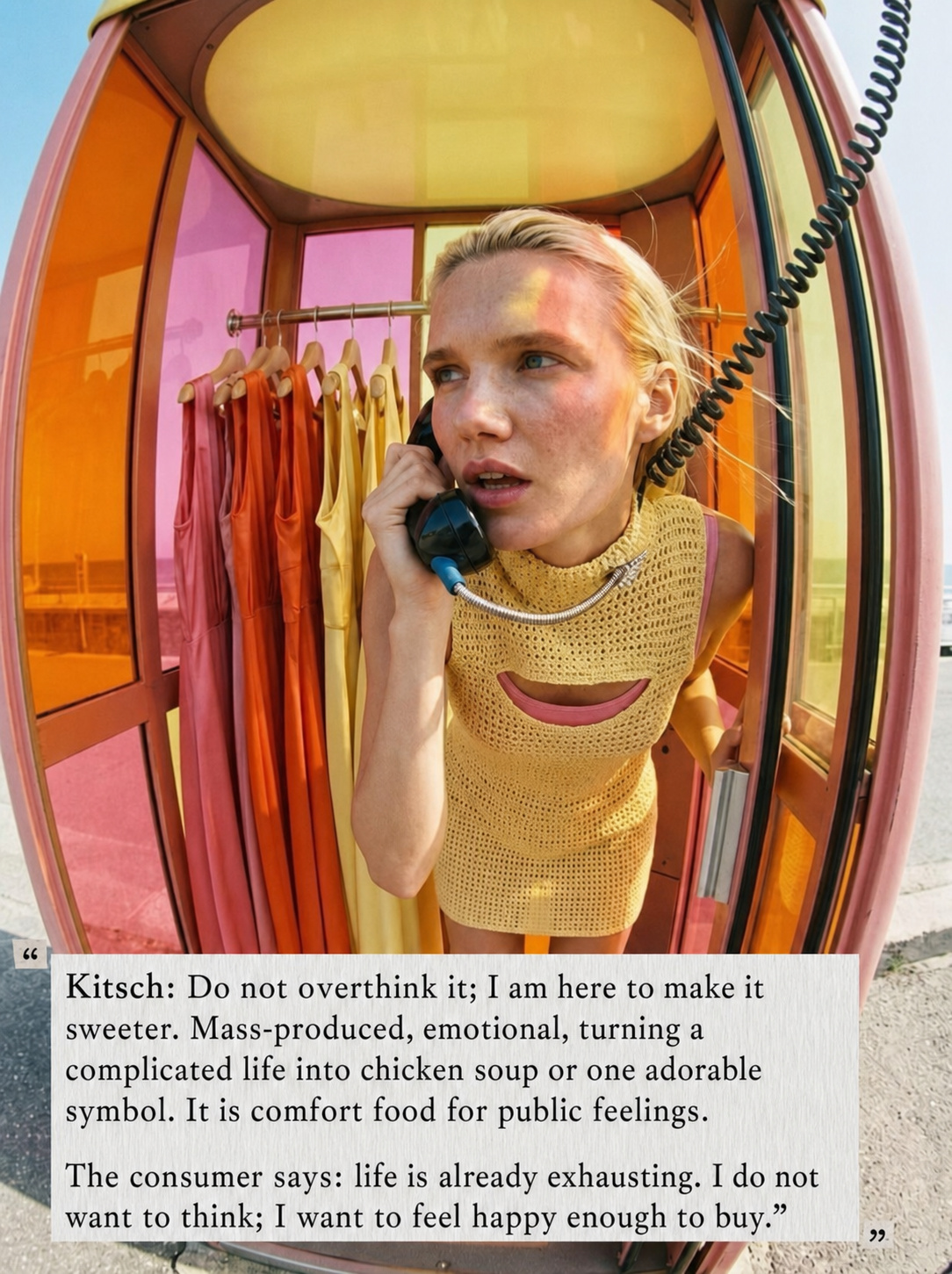
The bright orange and yellow palette, the glossy phone-booth set, the plastic-feeling colour world: none of it is subtle. That is the point. Kitsch does not want to be quietly admired. It wants to be consumed, laughed at, photographed, argued with and remembered.
In an age where taste gets endlessly optimised, kitsch becomes a kind of rebellion. Not a noble one, necessarily. Sometimes it is just tacky. But tackiness can be a useful pressure point because it exposes how anxious people are about appearing tasteful.
If modernism says, “Do not talk too much,” kitsch says, “I am going to talk in a colour you cannot ignore.”
Postmodernism is the end of purity
Postmodern fashion is where everything starts quoting everything else. The reference becomes the outfit. The joke becomes the structure. High and low culture collapse into one messy image, and the idea of pure originality starts looking a bit delusional.
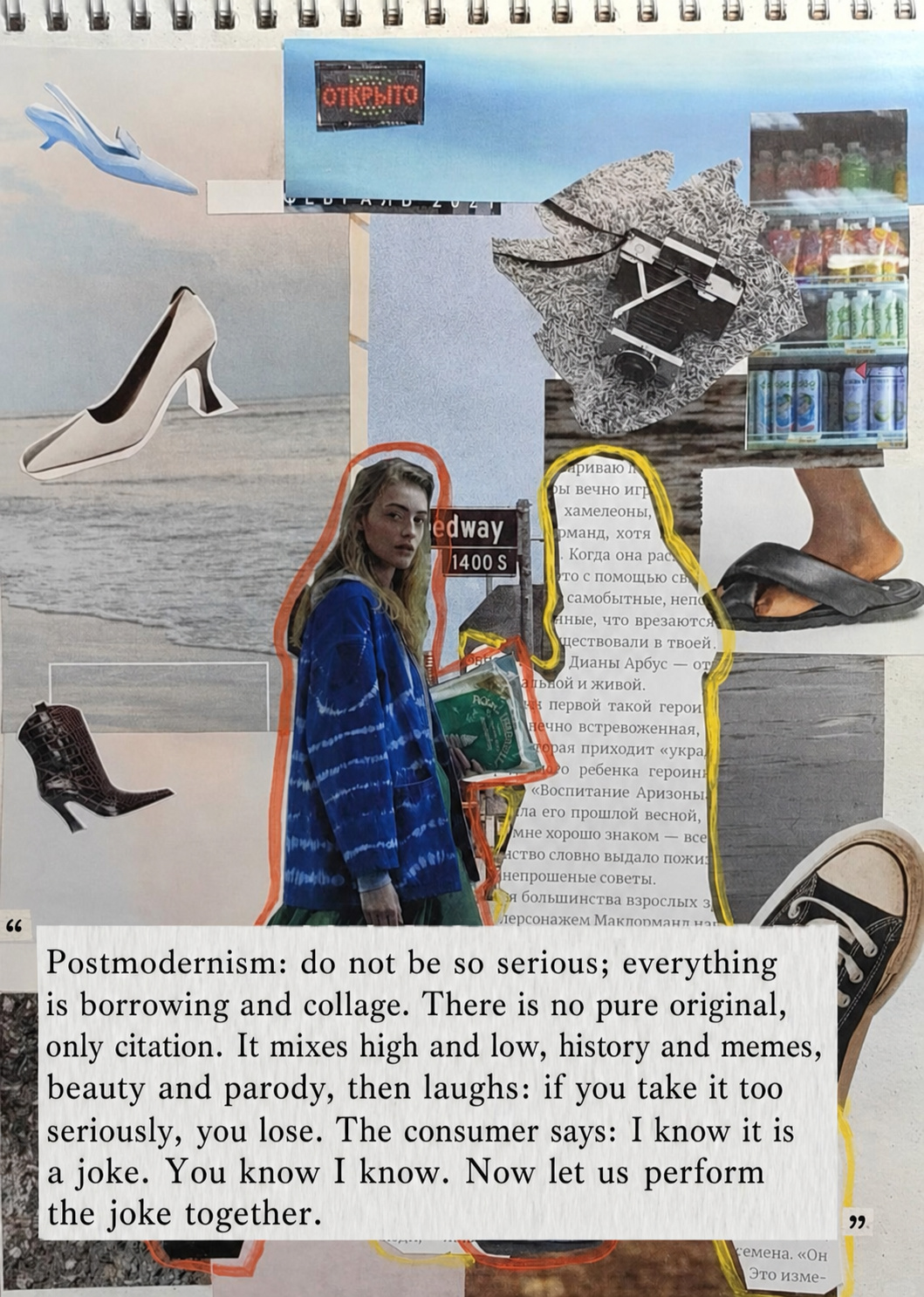
This is the point in the cycle that feels most like the internet. A heel next to a sneaker, a runway image next to a grocery shelf, a glamorous fragment next to something ordinary and disposable. The outfit is no longer just a look. It is a mood board with a sense of humour.
Postmodernism fashion makes sense now because our wardrobes already work like tabs left open in a browser. We are not living inside one reference system. We are living inside too many. The question is not whether fashion can be pure. It cannot. The better question is whether the mix has intelligence.
Why this matters for personal style
The practical lesson is not that you need to dress like a fashion theory textbook. Please do not. The lesson is that aesthetics return when they solve a feeling.
If you are drawn to modernism, you might be craving control.
If you are drawn to avant garde fashion, you might be tired of being visually agreeable.
If you are drawn to decadence, you might want clothing to feel more bodily, more indulgent, more atmospheric.
If you are drawn to kitsch, you might be bored of tastefulness and ready to let the outfit misbehave.
If you are drawn to postmodernism, you might not want one identity at all. You might want a collage.
That is why the fashion cycle is useful. It gives us old languages for new discomforts.
How trends come back without being copies
Fashion trends come back through selective memory. We rarely resurrect the whole era. We take the part that answers the current mood and leave the rest behind.
The new modernist look might use old minimal codes but style them with platform boots, digital-age severity or genderless tailoring. The new avant garde look might borrow conceptual silhouettes but run them through streetwear, celebrity styling or online visual culture. The new kitsch look might reference cheapness while being sold as luxury. The new postmodern look might look chaotic but be extremely calculated for the feed.
That is the contradiction. Fashion keeps repeating itself, but the repetition always reveals the present.
FAQ
What is avant garde fashion?
Avant garde fashion is fashion that challenges conventional beauty, proportion, wearability or taste. It often uses experimental silhouettes, distortion, conceptual styling, unusual materials or deliberately uncomfortable visual ideas.
Why does fashion repeat itself?
Fashion repeats because old aesthetics keep becoming useful for new cultural moods. Trends return when they help express control, rebellion, nostalgia, excess, irony, status or discomfort in a way the current moment recognises.
What is the fashion trend cycle?
The fashion trend cycle is the recurring movement of styles, silhouettes and aesthetics through periods of visibility, decline and return. It is not only about clothes changing; it is also about cultural needs shifting.
What is the difference between modernism and postmodernism in fashion?
Modernism in fashion usually values restraint, function, clarity and anti-decoration. Postmodernism mixes references, embraces irony, collapses high and low culture and treats fashion as quotation, collage and play.