
Cybersigilism: The Coded Body and Cyber-Occult Tattoo Style
A deep guide to cybersigilism: what it means, how it differs from neo-tribal and Y3K, styling without permanence, and the cultural boundary of body marking.
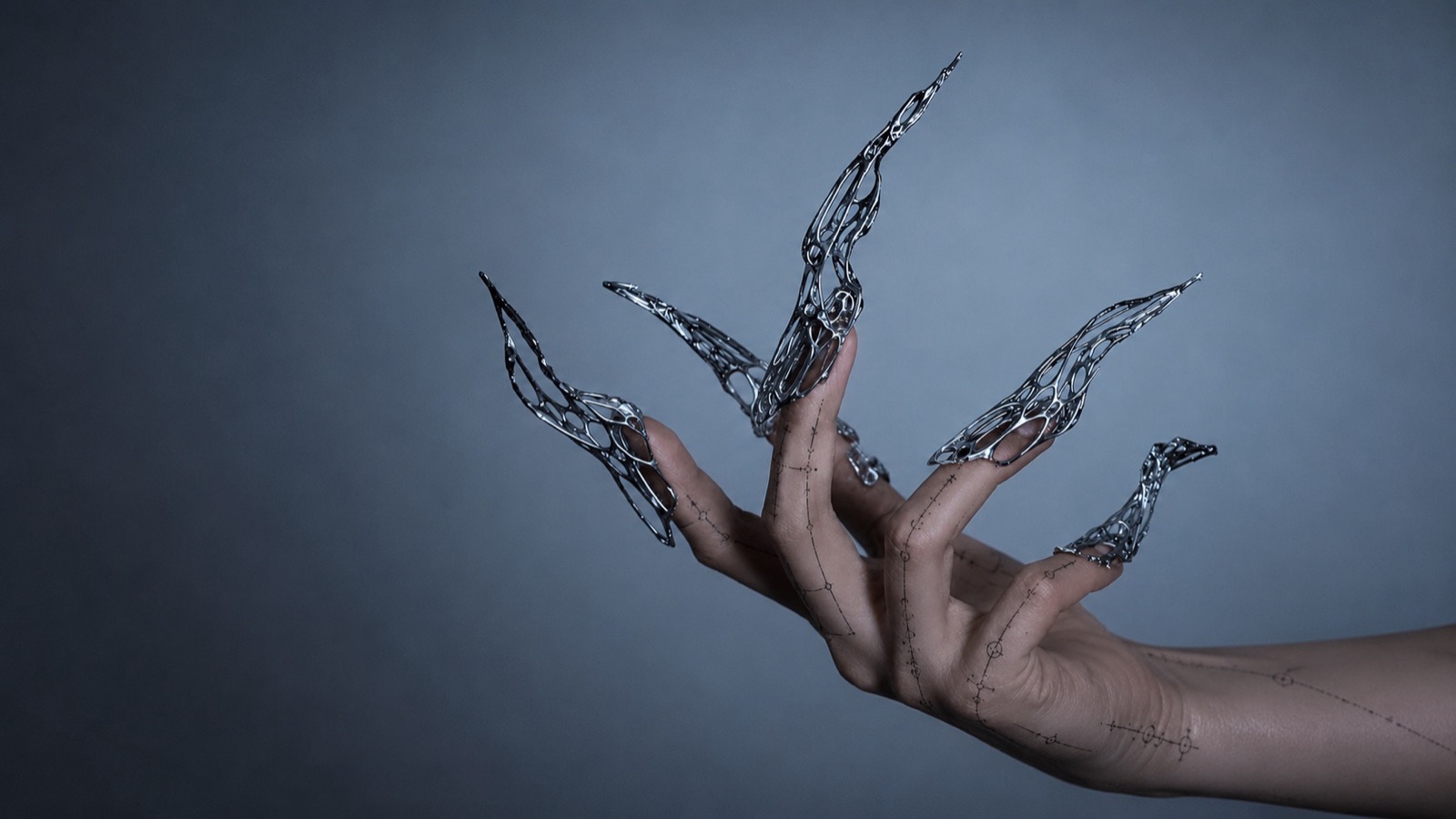
Cybersigilism is an internet-era visual aesthetic built from sharp black linework, cybernetic shapes, occult-looking sigils, neo-tribal body mapping, and future-goth intensity. If you are asking what is cybersigilism, the shortest answer is: it is what happens when a tattoo looks part circuit board, part spell, part thorn, and part character customization screen.
It began most visibly as a tattoo style, but it has not stayed only on skin. Cyber sigilism now shows up in fashion graphics, rhinestone layouts, nail art, jewelry, album visuals, digital avatars, and clothing that treats the body like a surface for coded symbols.
The important thing is that cybersigilism is not simply “a tattoo trend.” It is also not the same thing as historical tribal tattooing. Its strongest form looks like a symbol system from a broken future: a black mark running along the spine that does not look like decoration, a thorn shape near the collarbone, a silver ear cuff that makes the ear feel like hardware, or a rhinestone T-shirt graphic that looks a little too sharp for ordinary merch. The object is not always permanent. The feeling is.
what cybersigilism means
The word does a lot of the work. “Cyber” points to technology, digital culture, game worlds, glitches, interfaces, and the synthetic future. “Sigil” points to a symbol with charge: something private, spell-like, protective, or meaningful even when it cannot be read like ordinary language.
Put together, cybersigilism names a visual language where the body looks encoded.
By the time GQ published What’s a Cybersigilism Tattoo and Why Are You Seeing Them Everywhere? in December 2025, the look had already moved past a niche tattoo reference and into fashion, pop bodies, club images, and online self-styling. The useful part is not the celebrity name-checking. It is the way the tattoo became a broader answer to the body being constantly photographed, judged, optimized, and turned into content.
That last part matters. A cybersigilism tattoo does not always need a clean symbolic translation. It does not have to mean “rebirth” or “protection” in the way a very literal tattoo might. Sometimes the cybersigilism meaning is visual and bodily: this mark makes the skin feel less plain, less socially available, less like it belongs to the default version of the wearer.
I think this is why the style feels so current. Cybersigilism answers all that smooth body-editing culture with a mark that looks neither natural nor polite. It says the body is not just a body. It is a site, a screen, a character file, a private mythology, maybe even a little curse.
the parts that make it cybersigilism
the symbol system
Cybersigilism is built from symbols that look like they should mean something, even when you cannot translate them.
The common shapes are thin black lines, branching spikes, thorn forms, abstract wings, rune-like marks, metal-logo curves, pointed hearts, claw shapes, and symmetrical emblems that look half sacred and half corrupted file. A good cyber sigil tattoo can feel like a diagram for a ritual that has not been invented yet.
This is where the aesthetic differs from a random spiky graphic. Cybersigilism needs the feeling of charge. It should look as if the mark is doing something to the body, not just decorating it.
I do not mean this in a mystical way only. A symbol can be charged because it has personal meaning, but it can also be charged because of placement, scale, and social effect. A thorned design down the spine behaves differently from the same design printed flat on a notebook. A small sigil near the hip, sternum, hand, neck, or collarbone changes the body because it changes where the eye goes.
the body map
Body mapping is probably the most important part of cybersigilism.
A sticker sits on top of the body. A strong cybersigilism tattoo appears to grow with the body. It follows the spine, ribs, sternum, shoulder blades, neck, arms, hands, collarbones, hips, or the curve behind the ear. This is why the style often looks better when it is not trapped inside a neat little box.
InkedMag’s July 2026 roundup Meet the Artists at the Forefront of Cybersigilism Tattoos moves through artists working with sharp lines, abstract symbols, and cyber-inspired designs. The artist part matters because this style can turn into visual noise very quickly. The line has to know where it is going. The body has to be part of the composition.
This is also why cybersigilism tattoo ideas are not always useful as a shopping-list phrase. Looking for ideas is normal, but the best versions are not simply copied from a feed. They need to sit on a real shoulder, a real hand, a real back, a real sternum. They need to survive movement and time, not only the fresh-ink photo.
the digital-occult collision
Cybersigilism works because it refuses to choose between old and new.
It borrows the emotional texture of ritual marks, medieval-looking symbols, gothic fantasy, blackwork, and occult diagrams. Then it pushes those forms through glitch culture, techno clubs, video games, Procreate sketches, avatar bodies, and the Y2K revival. Esquire India’s January 2026 piece Why Is Cybersigilism Everywhere? Here’s All You Need To Know puts the tension simply: archaic and futuristic at once.
That is the hinge. The look is old-magic, but not antique. It is cyber, but not clean.
It is gothic, but not necessarily romantic. It is Y2K, but not cute in the baby-tee way. It is future-facing, but not optimistic.
This is the part I find most interesting. A lot of futuristic fashion tries to become smooth: chrome, glass skin, invisible construction, clean headphones, perfect AI imagery. Cybersigilism goes the other direction. It makes the future jagged again.
the neo-tribal problem
Cybersigilism overlaps with neo-tribal tattooing, but the terms should not be collapsed into one another.
Neo tribal tattoo is the broader family: blackwork lines, body-flow designs, tribal-like forms, barbed shapes, and graphic marks that often recall late-1990s and early-2000s tattoo trends. Cyber tribal tattoo is one adjacent way people search for the same futuristic body-marking impulse.
But cybersigilism is more specific. It pushes the neo-tribal line toward cybernetics, glitch, goth, gaming, digital bodies, and occult-looking sigils. It also sits inside a very current internet culture of self-styling, transition, rave scenes, celebrity body art, and algorithmic overexposure.
There is also a real cultural boundary here. Historical tribal tattoo traditions are not just aesthetic moodboards. They belong to specific peoples, lineages, places, rituals, and social meanings. Cybersigilism may visually inherit some late-Y2K tribal tattoo memory, but it should not pretend that sacred cultural marking is just raw material for internet fashion.
That does not make every cyber sigilism tattoo automatically wrong. It does mean the style needs some self-awareness. If a design looks like it is borrowing from a living Indigenous tradition, the issue is not solved by calling it cyber.
the fashion translation
The most useful thing about cybersigilism is that it can move off the tattoo chair.
It can become a print, a rhinestone graphic, a mesh overlay, a cutout, an ear cuff, a claw ring, a chrome nail charm, a spiked belt, a black enamel pendant, a phone case graphic, or a piece of hardware that frames the ear or hand. It can also become a way of reading an outfit: does the body look marked, coded, protected, altered, or slightly hostile to smooth interpretation?
That is why I like the small glitch inside GQ’s June 2026 story on the Knicks’ bedazzled Nike championship T-shirt. It is only one gothy, rhinestone-covered sports tee, so I would not turn it into a whole thesis. But it shows how quickly this line language leaks. A look that began as skin-level body art can become typography, sparkle, sports merch, and teenage graphic taste.
That is usually how aesthetics travel now. They do not stay in their original medium. A tattoo becomes a shirt. A shirt becomes a nail design. A nail design becomes a phone case. A phone case becomes a filter. Then someone sees the filter and asks for the tattoo.
how cybersigilism shows up
in images
Cybersigilism images often use thin black spikes, mirrored symbols, thorned hearts, abstract wings, blackletter edges, biomechanical curves, scratched digital marks, glitchy runes, tattoo close-ups, low flash, harsh contrast, and skin as the main surface.
The best images usually have some tension between intimacy and unreadability. A sternum mark, a back piece, or a hand tattoo is physically close, but the symbol itself refuses easy explanation. It is not trying to be friendly. It is trying to be legible as power without becoming readable as text.
This is why cybersigilism can feel so different from a tiny fine-line tattoo of a flower or a date. Those tattoos often ask to be understood as memory, tenderness, family, place, or sentiment. Cybersigilism asks to be understood as transformation, but not always explained.
in objects
Objects are the safest way to try the cybersigilism style without making a permanent body decision.
Look for silver ear cuffs, open-ear audio jewelry, claw rings, black enamel jewelry, sharp hair clips, temporary tattoos, chrome nail charms, sigil-printed phone cases, belts with spiked hardware, bags with blackletter or thorn motifs, and small tech objects worn near the ear, face, or hand.
I keep coming back to cyberpunk ear cuffs and open-ear audio jewelry here because face-level and ear-level hardware can do some of the visual work of a tattoo. Not every ear cuff is cybersigilism. But the right piece changes the outline of the body without requiring ink.
The same logic applies to fashion tech accessories. A device does not become cybersigilism because it is new. It becomes relevant when it behaves like a body interface: something attached, visible, slightly coded, and aesthetically intentional.
For jewelry, the strongest options are not always the most gothic ones. A guide to niche jewelry brands helps here because symbolic jewelry, odd silver, sculptural ear pieces, and strange small objects can carry the altered-body feeling without turning the outfit into costume.
in outfits
A wearable cybersigilism outfit does not need a permanent tattoo. It also does not need to look like a full rave uniform.
I would start with one body-mapped graphic, one hard accessory, one controlled base.
That could mean a black mesh top layered over a cyber-sigil print, silver ear cuffs, and a plain dark skirt. It could mean a fitted jacket with thorned embroidery, black trousers, and one claw ring. It could mean jeans and a tank top, but with a temporary sigil near the collarbone and chrome hardware near the ear. It could mean a rhinestone sigil tee worn with a very normal jacket, so the graphic looks like a private flash rather than a costume declaration.
The mistake is trying to use every signal at once: spiked hair, cyber print, claw nails, black contacts, huge boots, harness, tattoo sleeves, metal logo bag, aggressive makeup, done. Technically, yes, the references are there. But the outfit starts to flatten into “cyber-goth costume” rather than a real person using one mark to change the body.
This is where self-consistent style matters more than purity. If the rest of your wardrobe is soft, romantic, colorful, or minimal, you do not have to abandon it to use cybersigilism. You only need to decide where the mark belongs. One sharp detail can change the atmosphere more than a whole checklist can.
how to tell cybersigilism apart
I find it easiest to separate these aesthetics by asking what object or surface is doing the work.
Y3K aesthetic is broader future-pop futurism. It likes chrome, AI-adjacent styling, smart accessories, avatar bodies, slick synthetic surfaces, and year-3000 polish. Cybersigilism is narrower and darker. It is not just future styling; it is a line language of sigils, thorns, marks, and body-coded symbols. If Y3K makes the body look upgraded, cybersigilism makes the body look marked.
Cybercore is more about devices and screens: wired earphones, flip phones, old cameras, blue light, interface nostalgia, retro anime, desktop windows, and early internet atmosphere. Cybersigilism can overlap with cybercore, especially through digital nostalgia and tattooed avatar bodies, but it is more symbolic. Cybercore looks like a device memory. Cybersigilism looks like a spell written in code.
With dark romantic fashion, black, drama, lace, volume, hats, and historical mood can do a lot of the work. But black clothing alone does not make something cybersigilism. Dark romantic fashion often wants shadow, emotion, and theatrical beauty. Cybersigilism wants sharp symbolic interruption. It is less candlelit and more corrupted interface.
Biopunk and future-body aesthetics focus more on mutation, organic technology, prosthetics, medical imagery, engineered flesh, or biology gone strange. Cybersigilism does not need the body to mutate. It needs the body to read as marked, coded, or ritually altered.
And neo-tribal is the closest tattoo neighbor. A neo tribal tattoo can share the black linework, body flow, and Y2K memory. But the cybersigilism meaning changes when those lines become cyber-occult: more glitch, more future-goth, more coded selfhood, more internet-born mythology.
the tattoo question
Because cybersigilism is so tied to tattoo culture, there is one awkward truth: tattoo-based aesthetics behave differently from clothing trends.
When Byrdie’s July 2026 essay Does This Tattoo Make Me Look Millennial? puts cybersigilism next to generational tattoo anxiety, it lands on the problem that clothing can usually escape and tattoos cannot. Clothes can be donated, resold, stored, or forgotten. A tattoo has to live through your future self, your future job, your future body, your future taste, your future relationship to whatever the internet was doing when you got it.
This does not mean a cybersigilism tattoo is a bad idea. I do not like the logic that says a style becoming recognizable automatically makes it embarrassing. Trends are always part of the time and place we live in. They are markers of the culture passing through us.
But the permanence changes the stakes. If you want the aesthetic without the commitment, use the style through clothes, accessories, temporary tattoos, nails, or jewelry first. See where your eye keeps going. See whether you like the mark because it is trending, or because it gives your body a shape you have been wanting.
There is no shame in admiring a tattoo without getting it. Sometimes the most useful version of an aesthetic is not ownership. It is recognition.
FAQ
what does cybersigilism mean?
Cybersigilism means a cyber-occult visual style built from sigil-like marks, sharp black linework, neo-tribal body mapping, digital futurism, and future-goth symbolism. In plain terms, it makes the body look encoded, protected, altered, or marked by a private symbol system.
what is a cybersigilism tattoo?
A cybersigilism tattoo is a tattoo style that uses thin black lines, branching spikes, thorn shapes, rune-like marks, cybernetic curves, and body-flow placement. It often follows the spine, ribs, sternum, arms, hands, neck, or collarbone so the design feels mapped onto the body rather than pasted on top.
is cybersigilism the same as neo tribal tattoo?
No. It overlaps with neo-tribal tattooing, but cybersigilism is more cyber, occult, glitchy, and internet-native. Neo-tribal is the broader blackwork and body-flow family; cybersigilism is the version that looks like a digital sigil or future-goth body code.
how do you style cybersigilism without tattoos?
Use one visible mark: a sigil print, temporary tattoo, thorned rhinestone graphic, silver ear cuff, claw ring, black enamel pendant, or sharp nail design. Keep the rest of the outfit quiet enough that the mark can change the body.
how to use cybersigilism without turning it into costume
The easiest way to make cybersigilism wearable is to stop treating it like a full identity kit.
You do not need to become a techno vampire. You do not need to buy a harness if you do not wear harnesses. You do not need to cover your whole body in cyber tribal tattoo graphics because one image on your feed looked good under flash.
Start smaller.
Put the symbol near the body part you want to change. Ear if you want hardware. Hand if you want gesture. Collarbone if you want intimacy. Shirt graphic if you want distance. Nail if you want the mark to appear only when you move.
Then let the rest of the outfit be normal enough to make the mark strange. A plain black top with a sharp silver ear piece. A gray sweater with claw rings. A simple skirt with a thorned belt. A white tank with a temporary sigil at the shoulder. A normal sports tee with a graphic that looks like it crawled out of a corrupted medieval logo file.
The best cybersigilism styling does not scream, “I am wearing an aesthetic.” It creates one small problem in the outfit. One place where the body looks less default. One mark that makes the rest of the look feel like it has a secret operating system.