
Ear Cuff Earbuds: How They Fit, How to Wear Them, and How They Compare
What ear cuff earbuds are, how they stay on, how to wear them step by step, and how they compare to in-ear earbuds — a practical guide before you buy.
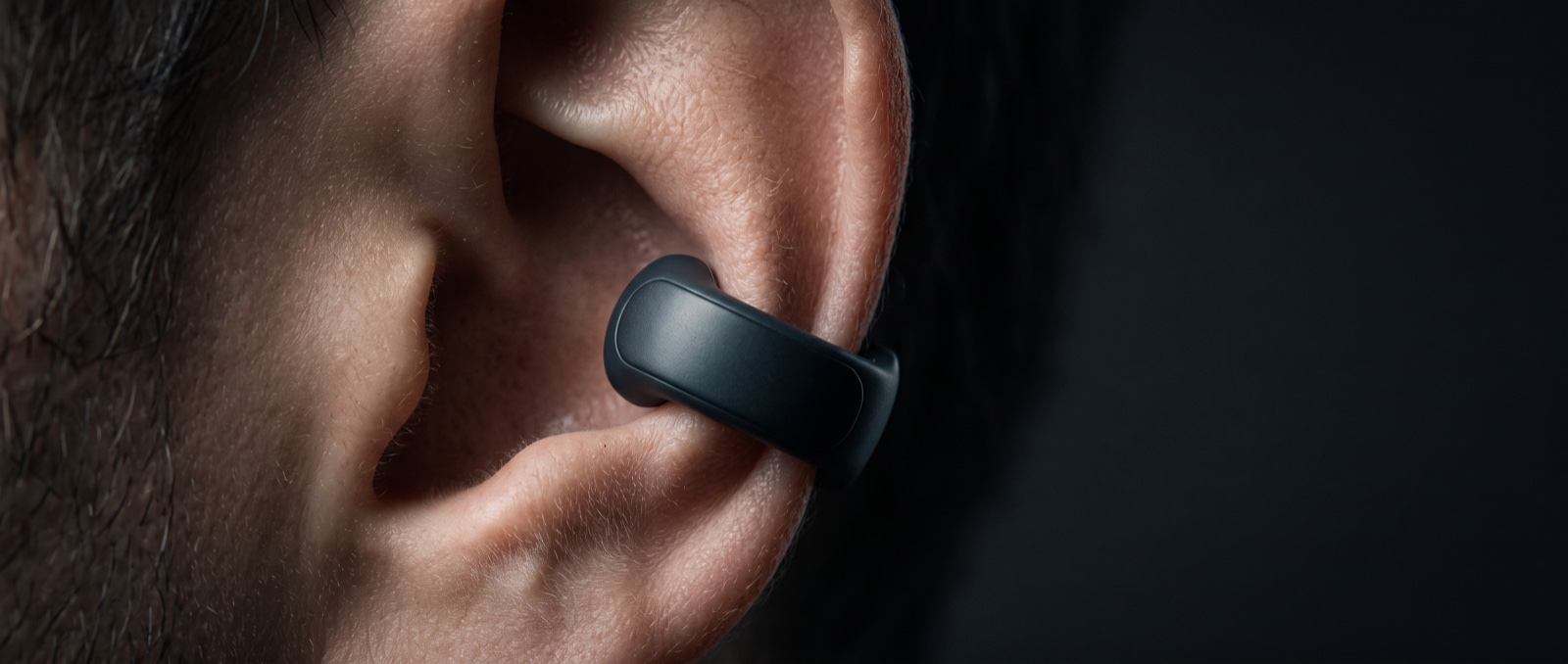
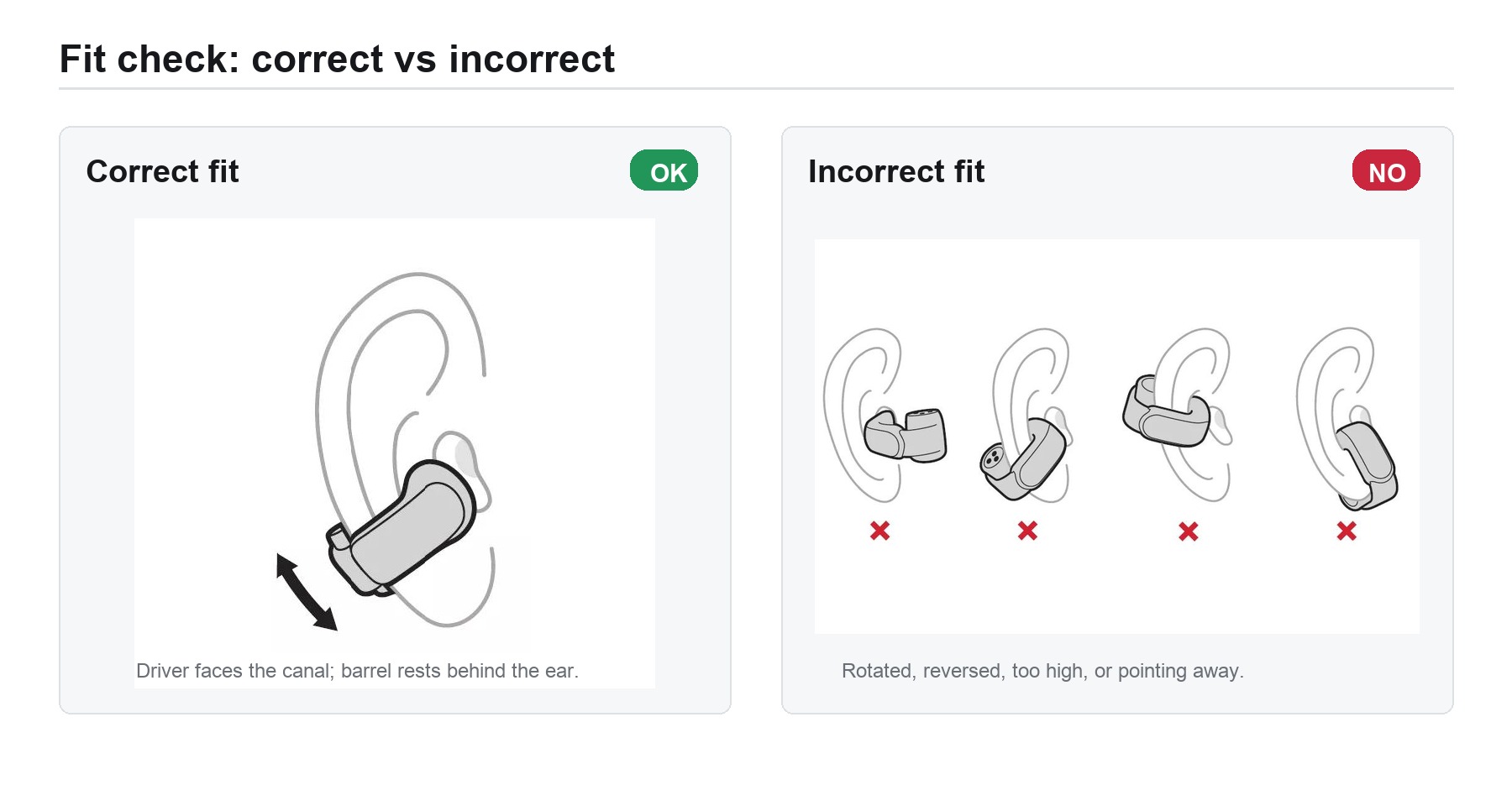
Ear cuff earbuds are open-ear audio devices that clip onto the outer edge of the ear rather than entering the ear canal. They typically use two contact points — one in front of the ear’s rim and one behind it — to form a light grip, with the speaker driver directing sound toward the canal opening from outside. The correct wearing position should feel stable without sustained pressure, and the driver should face your ear canal, not away from it. Exact placement, left-right orientation, and clip tension vary by product, so the steps below describe the general principle; always check the specific instructions that come with your pair. If you already wear jewelry there, read piercing-friendly earbuds and ear stacks before you buy. Exact placement, left-right orientation, and clip tension vary by product, so the steps below describe the general principle; always check the specific instructions that come with your pair.
What are ear cuff earbuds?
The category sits at the intersection of three overlapping labels. Ear cuff earbuds describes the wearing mechanism — a clip-on grip around the ear’s cartilage edge. Open-ear earbuds describes the audio format — sound delivered without sealing the canal. Clip-on earbuds is the broadest commercial term, covering anything that clips to some part of the ear. Not all open-ear earbuds are ear cuffs (some use ear hooks or bone conduction), and not all clip-on earbuds use the same grip location. The term ear cuff headphones appears in searches as a synonym, though “headphones” technically implies a larger form factor.
Market naming is not standardized. When evaluating a product, look at the wearing mechanism rather than the label. For context on where ear cuff earbuds sit within the broader landscape of emerging wearable tech — alongside smart rings, AI glasses, and audio jewelry — see our 2026 futuristic tech accessories overview.
What ear cuff earbuds are not
Because the category is new and naming is inconsistent, four common confusions are worth clearing up.
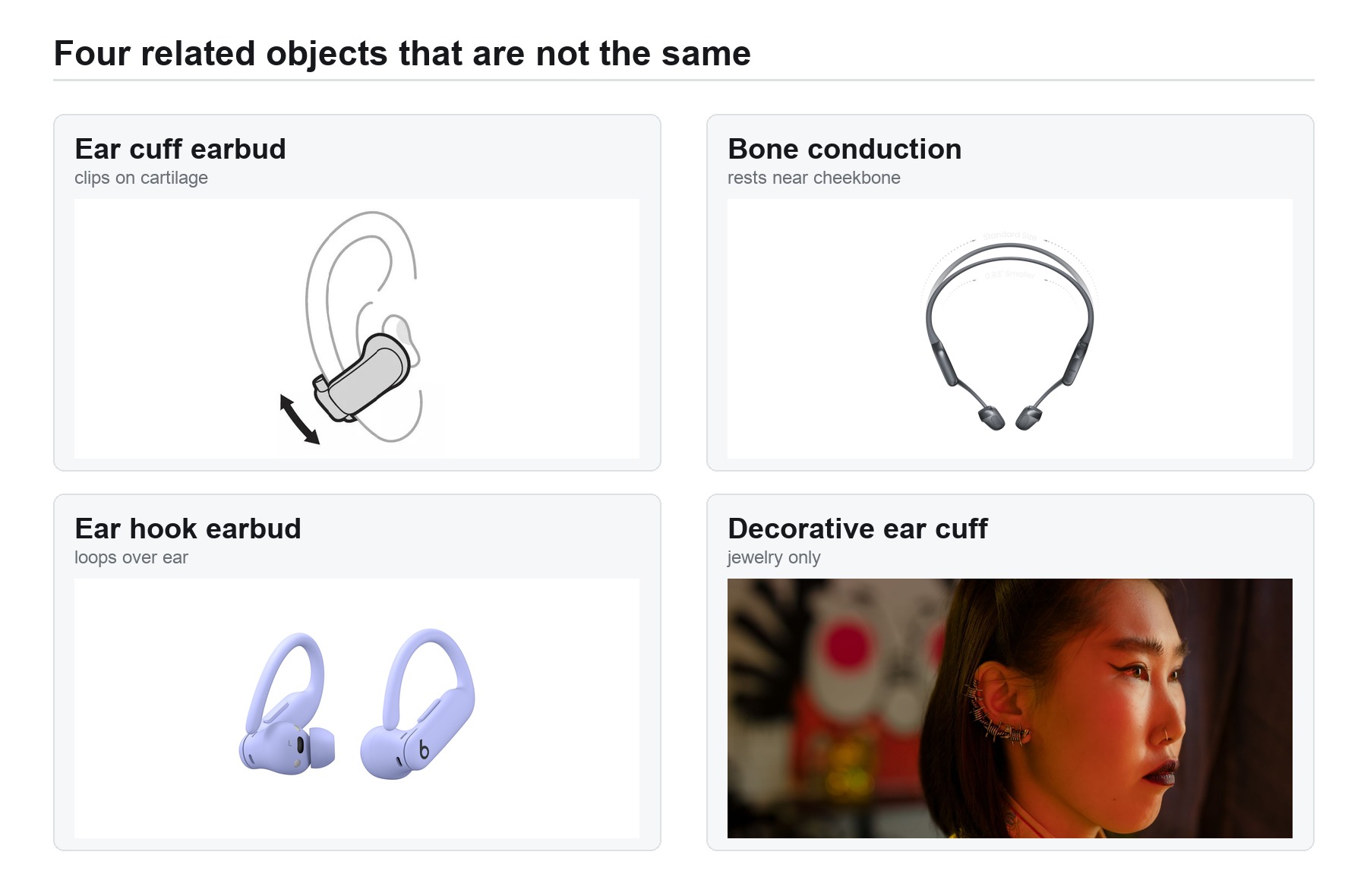
Not all open-ear earbuds. Many open-ear products use ear hooks that loop over the top of the ear, or temple-mounted drivers that sit near the cheekbone. These are open-ear but not ear cuffs — the grip mechanism is completely different.
Not bone conduction earbuds. Bone conduction devices transmit sound through the skull bone, usually via pads pressed against the temple. Ear cuff earbuds transmit sound through the air, directing it from a small speaker toward the ear canal opening. The physics, the wearing position, and the sound character are different.
Not decorative clip-on earrings. A clip-on earring is a piece of jewelry with no electronic component. An ear cuff earbud has a driver, a battery, and a wireless connection. They may share a similar grip location on the ear, but they serve completely different purposes.
Not traditional ear cuff jewelry. An ear cuff is a piece of jewelry that wraps around the cartilage — usually decorative, sometimes structural. An ear cuff earbud borrows the grip concept but adds audio hardware. The two can coexist on the same ear in some configurations, but they are not the same object.
How do ear cuff earbuds stay on?
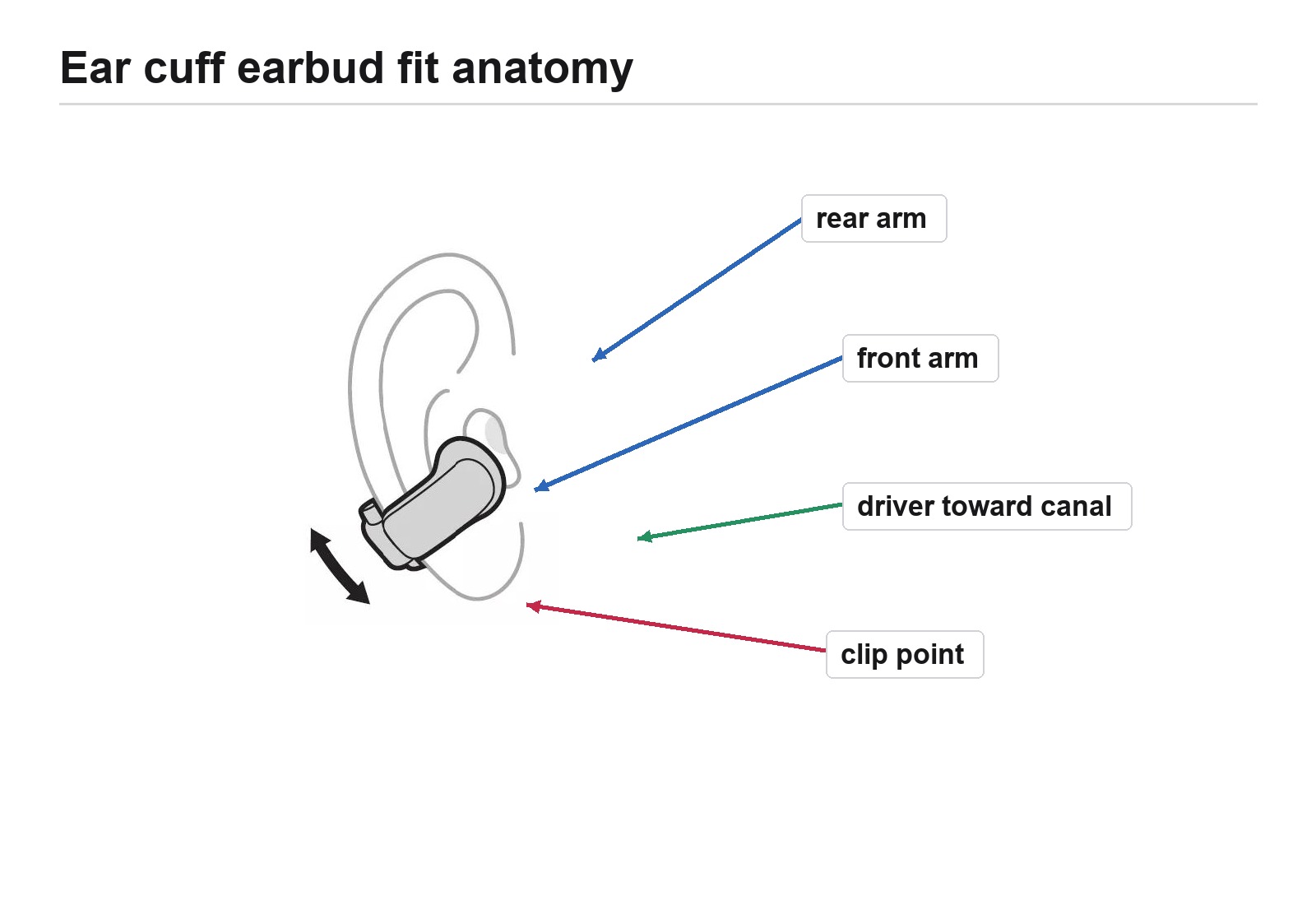
Most ear cuff earbuds use a C-shaped or bridge structure that spans the ear’s outer rim. The front arm sits inside the ear’s concha or against the inner rim, while the rear arm rests behind the ear. The natural springiness of the bridge holds the two arms in place, creating a friction grip without requiring an ear tip or a hook.
The speaker driver is typically on the front arm, positioned to direct sound toward the ear canal. The rear arm may carry the battery, the Bluetooth antenna, or a counterweight that balances the piece on the ear. Some products add a small silicone pad on the contact points to increase grip and reduce slippage.
Grip tension varies across brands and models. A lighter grip is more comfortable for all-day wear but more likely to shift during movement. A firmer grip holds position better but may cause pressure after a few hours. There is no universal ideal — it depends on your ear’s cartilage thickness, the product’s spring tension, and how much you move.
How to wear ear cuff earbuds step by step
-
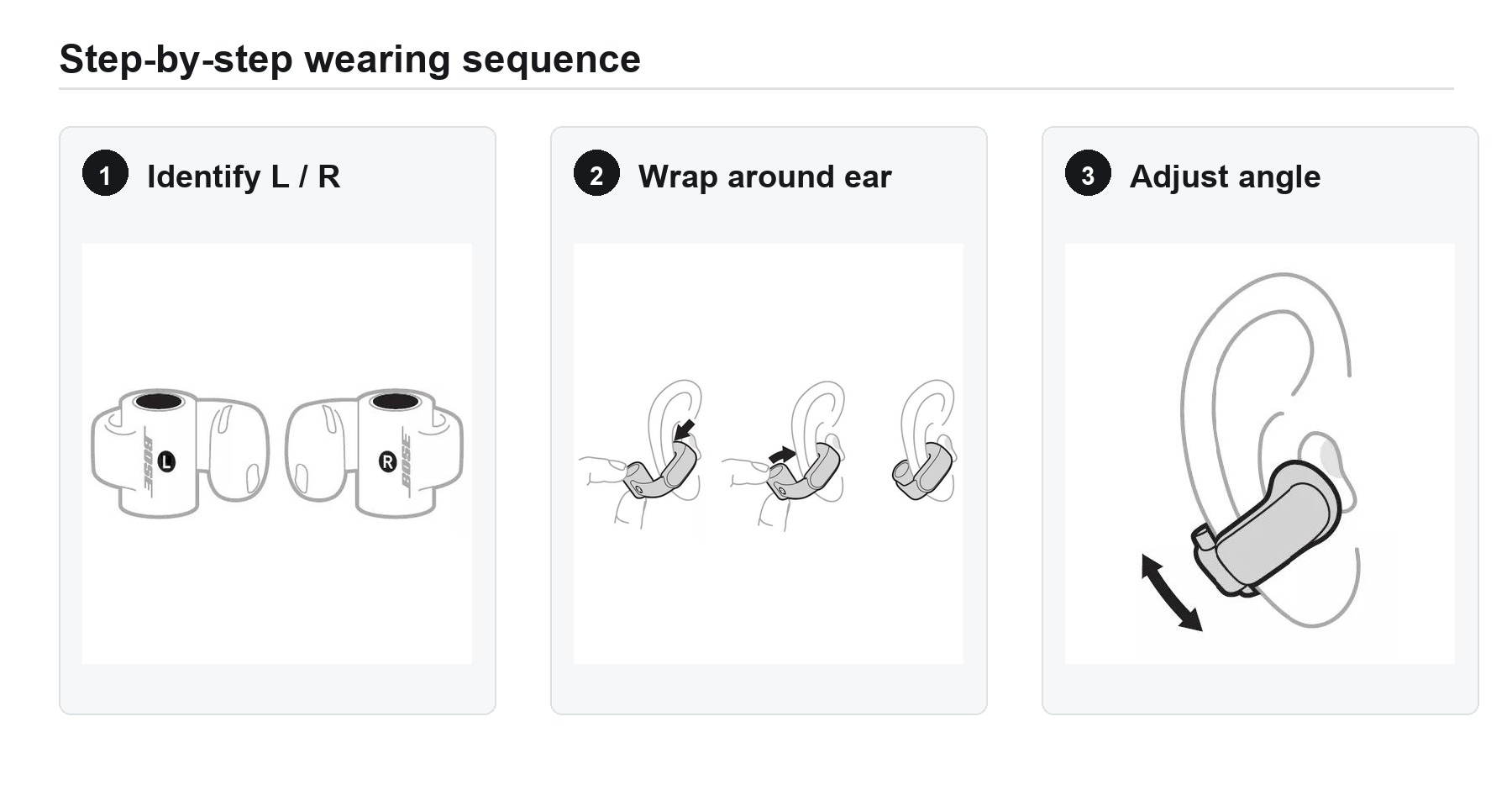
Identify left and right. Most pairs are labeled L and R on the inner surface or the charging case slot. If unlabeled, the driver (the side with the speaker grille) should face inward toward the ear canal.
-
Open the clip slightly. Hold the earbud between your thumb and index finger and gently widen the gap between the front and rear arms. Do not force the arms apart beyond their natural spring range.
-
Slide onto the ear from the thinnest part. Place the front arm against the inner rim of your ear and let the rear arm rest behind the ear. Start at a thinner section of the ear’s edge (usually the lower half of the antihelix) and then slide the piece into the recommended wearing position — typically where the cartilage is thick enough to hold the grip but not so thick that it causes pressure.
-
Adjust the driver direction. The speaker grille should point toward your ear canal opening, not upward, downward, or away from the ear. A misaligned driver will produce noticeably quieter or thinner sound.
-
Test the fit. Do a gentle shake by tilting your head side to side. Speak a few sentences to check that the microphone picks up your voice clearly. Walk ten steps to verify the piece does not shift. If it slides, reposition to a slightly thicker section of the cartilage. If it pinches, move to a slightly thinner section.
Different products may have different recommended positions, clip tensions, and orientation guides. Always cross-check these steps against the instructions included with your specific pair.
How to tell if the fit is right
| Correct fit signals | Incorrect fit signals |
|---|---|
| Stable during normal head movement and walking | Slides or rotates with light movement |
| Sound is clear and directed — you can hear audio without turning up volume to maximum | Sound is noticeably quiet, thin, or off-axis |
| No sustained pressure or pinching after 10 minutes | Persistent pain or pressure on the cartilage |
| Left and right are symmetrical or match the product’s intended asymmetry | One side feels secure while the other does not |
| Fits alongside existing piercings without contact | Physically pushes against a piercing, stud, or ear cuff |
| Stays in place when you speak or chew | Shifts position when your jaw moves |
If the fit fails on stability or comfort after repositioning, the product’s clip tension may not match your ear’s cartilage thickness. This is not a user error — it is a compatibility limitation. Some ears are too thin for a firm-grip model; some are too thick for a light-grip model. Trial before committing is the safest approach.
Ear cuff earbuds vs in-ear earbuds
| Ear cuff earbuds | In-ear earbuds | |
|---|---|---|
| Ear canal | Not entered — driver sits outside | Sealed or semi-sealed with an ear tip inside the canal |
| Noise isolation | None — open to ambient sound | Moderate to high, especially with ANC |
| Ambient awareness | Full — you hear everything around you | Reduced — requires transparency mode to hear surroundings |
| Visual presence | Fully visible on the ear — reads as an accessory or device | Mostly hidden inside the ear — minimal visual presence |
| Grip mechanism | Clip on cartilage edge | Friction fit inside ear canal (ear tip) |
| Earring compatibility | Lobe earrings unaffected; upper-ear jewelry may conflict | Lobe earrings unaffected; canal area is occupied |
| Comfort for long wear | No canal pressure; possible cartilage fatigue | No cartilage pressure; possible canal fatigue |
| Best for | Calls, podcasts, ambient listening, walking, commuting | Music, focus work, travel, noisy environments |
For a deeper comparison of whether a visible audio device counts as an accessory or just a prettier gadget, see our guide to evaluating decorative earbuds. For what makes any headphone look intentional in an outfit, see four criteria for stylish headphones.
Who should consider ear cuff earbuds — and who should not
| If you… | Good fit | Proceed with caution |
|---|---|---|
| Dislike the sealed, in-canal feel of traditional earbuds | ✅ | — |
| Need to hear ambient sound at all times (walking, cycling, office) | ✅ | — |
| Want your earphones to be visually part of your outfit | ✅ | — |
| Prefer a device that does not touch the inside of your ear | ✅ | — |
| Need strong noise isolation or active noise cancellation | — | ⚠️ Open-ear format cannot provide this |
| Have very thin or very thick ear cartilage | — | ⚠️ Clip tension may not match — try before buying |
| Plan to use them for running, gym, or high-impact exercise | — | ⚠️ Stability under intense movement is not guaranteed |
| Already wear a complex ear stack (3+ piercings on the same ear) | — | ⚠️ Physical conflict is possible depending on placement |
How to style ear cuff earbuds
Because ear cuff earbuds are fully visible on the ear, they follow styling logic closer to jewelry than to traditional earphones. Metal tone matching (silver with silver, gold with gold), outfit color coordination, and eyewear compatibility all become relevant the moment you put them on.
For a practical walkthrough of how to integrate ear cuffs and open-ear audio jewelry into city outfits, techwear looks, and glasses-wearing routines, see our full styling guide: How to Style Cyberpunk Ear Cuffs and Open-Ear Audio Jewelry. That guide covers the styling depth this page intentionally does not repeat.
A jewelry-led example
Most ear cuff earbuds on the market are designed as audio devices first and styled second. A smaller subset is designed as ear accessories first and engineered for audio second. The difference in approach affects the silhouette, the material, and the way the piece reads on the ear.
OFHUNGER makes open earphones built as ear jewelry — wearable tech designed as everyday accessories. The Electronic Gems White Zircon is a clip-on open earphone with a faceted gemstone surface and 18K white gold plated metalwork. It uses the same general clip mechanism described above — a front arm with the driver and a rear arm for balance — but the exterior is shaped as a drop earring rather than as a tech product. At USD 290, it sits at the entry point of the line. For how to judge whether a product like this genuinely reads as jewelry rather than as a decorated device, see the five-part jewelry earbud test.

The NEBULA in Silver represents a different end of the volume spectrum — larger, more sculptural, with design-fiction references that sit in Y3K aesthetic territory. It is an open-ear audio object, but its form factor is closer to wearable sculpture than to a conventional ear cuff earbud. It illustrates that the “clip-on open earphone” category is wider than a single silhouette.
Both are visible in community wear on the OFHUNGER Style page. Specific wearing instructions for each product follow their respective product guides — the general steps above apply as a starting framework, not as a replacement for the included directions.
FAQ
Are ear cuff earbuds the same as open-ear earbuds? Not exactly. Ear cuff earbuds are a subset of open-ear earbuds — they deliver sound without entering the canal, like all open-ear products, but they use a specific clip-on grip around the ear’s cartilage edge. Other open-ear formats use ear hooks, temple arms, or bone conduction pads, which are structurally different.
Do ear cuff earbuds go inside the ear canal? No. The driver sits outside the canal, directing sound toward the canal opening through the air. Nothing enters the ear. This is the primary comfort advantage over in-ear earbuds, and the primary acoustic limitation — without a seal, there is no passive isolation and very limited bass extension.
Can you wear ear cuff earbuds with piercings? It depends on the piercing location. Lobe piercings are typically unaffected because ear cuff earbuds grip the upper cartilage area. Helix, tragus, or conch piercings may conflict with the clip’s contact points. Check whether the earbud’s front or rear arm overlaps with your piercing position before buying. For jewelry brands that design specifically for layered ear stacks, see sculptural ear stack options.
Can you wear ear cuff earbuds with glasses? Usually yes. Most ear cuff earbuds grip the ear’s cartilage edge, which is above and forward of where glasses temple arms rest. Thick or wide temple arms may create slight pressure where they cross near the ear cuff’s rear arm. For a detailed look at how open-ear audio and eyewear interact, including sunglasses and oversized frames, see our ear cuff and glasses compatibility notes.